
Introduction
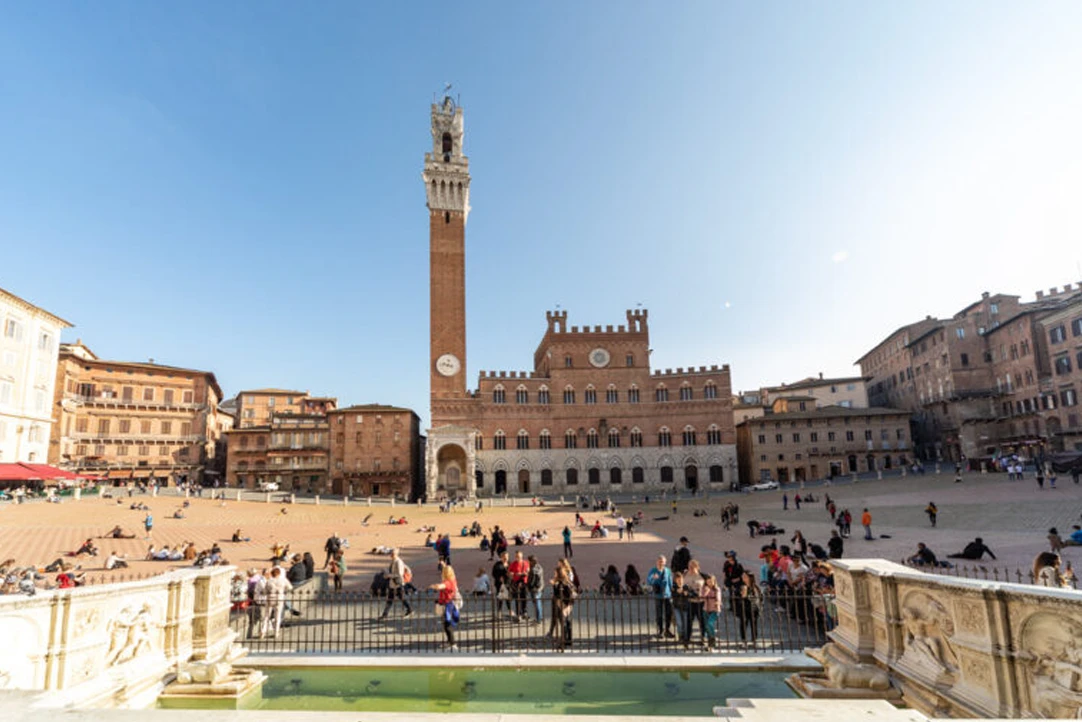
Siena – the mere name of this ancient Tuscan city conjures images of medieval squares, golden sunsets and cobblestone alleys lined with brick palaces. Its historic centre is a magical place that has remained surprisingly intact through the centuries and is listed as a UNESCO World Heritage Site for the extraordinary beauty it has preserved . At the heart of this “open‑air museum” lies Piazza del Campo, the beating heart of Siena and, in the eyes of many, the most beautiful square in Italy. Unique for its reversed shell shape, Piazza del Campo is renowned worldwide for its harmonious architecture and the timeless atmosphere that pervades it .
This comprehensive guide – designed for families, couples and curious travellers – explores the history of Piazza del Campo, the curiosities and traditions that make it special, with many questions and answers to help you learn every detail. You will find summary tables for quick reference on practical information about events, opening times and nearby attractions. We will also present Hotel Minerva, a delightful hotel ideal as a base for exploring the city and its surroundings . Prepare for a journey into the heart of Siena: welcome to Piazza del Campo!
What is Piazza del Campo and why is it so famous?
Piazza del Campo – simply called il Campo by the Sienese – is the main square of Siena and one of the most iconic squares in Europe. It immediately stands out for its slightly sloping hemispherical shape, similar to a shell made up of nine slices of red bricks that converge harmoniously towards the centre . It is surrounded by a ring of elegant medieval brick palaces that seem to embrace the open space . The square is famous for its intact architectural beauty, to the point that it is considered a masterpiece of medieval urban design . There are no other squares like it: the combination of the original shape, the stylistic unity of the surrounding buildings and its scenic position (in a valley nestled between Siena’s hills) makes it truly special .
Piazza del Campo is also famous because it hosts the legendary Palio di Siena, the horse race between the contrade (districts), held twice a year on 2 July and 16 August. Millions of tourists from around the world visit Siena to admire the piazza, photograph it and perhaps dream of watching the Palio in this unique setting . Every season offers a different atmosphere: summer is animated by the Palio and open‑air evenings; in winter the square is lit up with Christmas lights and hosts events like the New Year’s concert; in spring and autumn it offers golden sunsets and picturesque views in a calmer climate . In short, Piazza del Campo is not just a square: it is the symbol of Siena, a meeting place for locals and visitors, stage for centuries‑old traditions and everyday setting for a city that has preserved its ancient charm .
When and how did Piazza del Campo originate?
The origins of Piazza del Campo are rooted in the Middle Ages and are closely linked to the urban development of Siena. Before the 12th century this space was an open valley at the confluence of three hills, used for rainwater run‑off . The name “Campo” derives from the fact that it was originally a slightly concave field that had been drained and used as an open market . The first documented mention dates to 1169 when the area was called Campus Sancti Pauli . At that time, the space comprised both today’s Piazza del Campo and the adjacent Piazza del Mercato. By the end of the 12th century Siena acquired the land and gradually divided it into two distinct squares: the Campo, intended for fairs and general markets (grain, livestock, etc.), and the smaller Piazza del Mercato .
During the 13th century the square became increasingly important as a civic centre. Until 1270 it was simply a space for markets and public celebrations, strategically located at the crossroads of main routes to Rome, Florence and the sea . The turning point came with the famous Government of the Nine (1287–1355), the republican regime that brought Siena to its peak of splendour. The Nine conceived Piazza del Campo as the city’s “calling card” and, above all, as a neutral and monumental seat of civic power . They decided to build the new Palazzo Pubblico (the town hall) on the lower side of the square – a building majestic enough to symbolise the glory of the Republic of Siena. Construction began around 1298 and continued into the early 1300s .
The transformation of the Campo
At the same time, the Government of the Nine undertook a series of interventions to transform the Campo definitively into the piazza we know today. In 1333 work on the paving began: the inner part with bricks laid in a herringbone pattern was completed in 1334, while the outer band paved in stone was finished by 1348 . The square was divided into nine segments (the elegant brick sectors separated by strips of light travertine) specifically in homage to the number nine, a reference to the nine rulers . In those same decades the first monumental public fountain of the city was created at the centre of the Campo: Fonte Gaia, whose digging began in 1334 and which was inaugurated in 1346 with great festivities .
To ensure a harmonious appearance, the Sienese authorities issued innovative building regulations: owners of houses facing the Campo were obliged to follow Gothic‑style aesthetic guidelines, for example installing only bifore or trifore (two‑ or three‑light windows) and avoiding discordant elements . Even an old church (San Pietro e Paolo) that protruded irregularly into the square was demolished in the early 1300s to better align the perimeter . Thanks to these measures, Piazza del Campo gradually assumed the harmonious and uniform profile we still admire today: all the buildings around it, though different in age and function, respect a coherent aesthetic of brick facades with Gothic windows .
In summary, Piazza del Campo was born as a medieval market in a natural depression but was deliberately transformed between 1300 and 1340 by the Government of the Nine into Siena’s “drawing room”. Its definitive layout – with the Palazzo Pubblico as the scenic backdrop on the lower side and the noble palaces encircling it – was the result of precise political and aesthetic choices aimed at celebrating the city’s greatness . Walking on the square’s sloping paving, we tread the same bricks laid almost 700 years ago and can imagine the pride with which 14th‑century Sienese inaugurated their new civic square .
Why does Piazza del Campo have a shell shape?
One of the first things that strikes you about Piazza del Campo is its peculiar shell (or fan) shape. The piazza is semicircular and slopes southwards, following the natural inclination of the valley in which it lies . This shape is not accidental but the result of harmoniously adapting architecture to the landscape: the Sienese exploited the concave shape of the terrain to create a piazza in the form of an amphitheatre, perfect for hosting crowds during ceremonies and spectacles .
The southward slope (towards the Palazzo Pubblico, the lower side) originally allowed rainwater to collect at the centre, where a system of channels gathered it – a clever precaution to keep the “field” dry during markets . The surface is divided into nine sectors by white travertine strips that draw the typical radial geometry of the shell on the terracotta bricks . As mentioned earlier, the nine sectors pay homage to the Government of the Nine but also have the practical function of following the gentle curve of the natural amphitheatre . The result is a unique design: from the high side (north) the piazza opens like a fan, while from the lower side one sees an enormous scenic shell framed by the town hall .
Hidden accesses and scenic effect
Piazza del Campo has eleven access points (alleys or streets) that converge almost invisibly among the buildings . There used to be twelve entrances, but one was closed in the 1300s during the construction of Palazzo Sansedoni . This concentric arrangement of streets means that when you enter from certain narrow medieval alleys, Siena suddenly offers the majestic view of the entire piazza, like an amphitheatre unveiled. It is a studied scenic effect: all sight lines converge on the Palazzo Pubblico, which acts as a theatrical backdrop .
In essence, the shell shape of Piazza del Campo results from both nature (the valley of Montone on which it stands) and culture (Sienese urban planning decisions). This particular shape, besides being beautiful, made the square extremely functional: it allows visibility from every point, like in an arena, and accommodates thousands of people during events such as the Palio. Unsurprisingly, Piazza del Campo is often compared to an “open‑air theatre”: the stage is the layer of tuff laid for the horse race, the natural grandstands are its slopes and the palaces act as scenic wings . Few places in the world so well combine aesthetics, symbolism and practicality as Siena’s “shell”.
Which palaces and monuments overlook Piazza del Campo?
Piazza del Campo is surrounded by buildings of great historical and architectural value. The three main monuments in the square – which every visitor must know – are the Palazzo Pubblico with its Torre del Mangia, and Fonte Gaia. In addition, the perimeter of the Campo is lined with noble palaces and historic headquarters, each with its own story .
Palazzo Pubblico
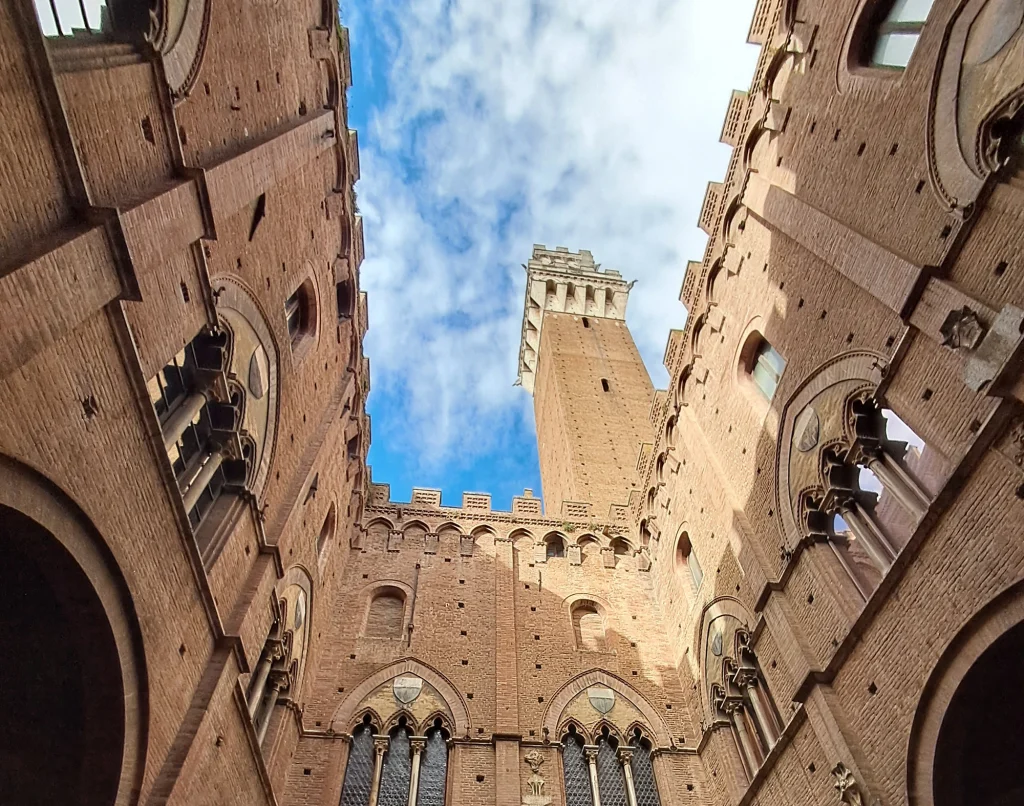
The Palazzo Pubblico is the elegant, reddish‑brown brick building that dominates the lower part of the square. Built between 1298 and around 1310 as the seat of the Government of the Nine, the Palazzo Pubblico is the symbol of Siena’s civil authority . Its Gothic facade, with trifore windows topped by arches and Guelf merlons, is slightly concave to follow the curvature of the piazza . At the centre stands a large round copper coat of arms with the monogram of Christ (IHS), placed there in 1425 by St Bernardino of Siena as a spiritual reminder . Today, the Palazzo Pubblico houses municipal offices as well as the Museo Civico of Siena .
Torre del Mangia
The Torre del Mangia is the slender tower of brick and stone that rises next to the Palazzo Pubblico on the left side of the facade. At 102 metres tall to the tip of the lightning rod, it is among the tallest ancient towers in Italy and is visible from all over Siena and the surrounding hills . It was built between 1325 and 1348 by the builders Francesco and Muccio di Rinaldo . The curious name “del Mangia” derives from the nickname of its first bell‑ringer, Giovanni di Balduccio, called Mangiaguadagni (“Earnings‑Eater”), famous for spending all his earnings on food and revelry . The tower is made of stone in the lower portion and brick above, with a crowning at the top that supports the Campanone (the great bell of 1666, which weighs about 6,760 kg) . At the base of the tower, projecting from the facade of the Palazzo, stands the small Cappella di Piazza, a marble tabernacle built in 1352 as a votive offering after the end of the plague of 1348 . For centuries, the Torre del Mangia and its bell marked the rhythms of city life and still today ring out during the highlights of the Palio .
Fonte Gaia
On the upper side of the piazza, opposite the Palazzo Pubblico but at the edge of the shell, stands the magnificent monumental fountain Fonte Gaia. It was Siena’s first public fountain: water reached it for the first time in 1346 amid the joyful (gaia) celebrations of the Sienese, from which the name derives . The fountain’s current appearance is the result of later interventions. In 1409 the city commissioned sculptor Jacopo della Quercia to decorate the basin: Jacopo worked for more than ten years and created an extraordinary sculptural ensemble with marble panels depicting the Madonna and Child, theological virtues and biblical scenes, as well as figures of Rea Silvia and Acca Larenzia (protagonists of the legend linking Siena’s origins to Remus) . Those original statues are no longer exposed to the elements: since 1859 they have been replaced by copies executed by sculptor Tito Sarrocchi, while Jacopo della Quercia’s originals are conserved in the nearby Museum of Santa Maria della Scala for preservation . The present Fonte Gaia is therefore a faithful 19th‑century reproduction of the 15th‑century fountain. When you admire it up close, note the elegance of the bas‑reliefs and imagine the wonder Sienese must have felt on seeing pure water gush forth after centuries of waiting .
Palazzo Sansedoni and other palaces
Occupying much of the curved side of Piazza del Campo opposite the Palazzo Pubblico, Palazzo Sansedoni stands out for its Gothic brick facade that follows the piazza’s curvature. It was created in the 18th century by uniting and refurbishing several pre‑existing medieval buildings . Today it houses the Fondazione Monte dei Paschi di Siena. Although not open to visitors, it impresses with its elegant bulk and the medieval tower incorporated into the structure. A detail: between Palazzo Sansedoni and the adjacent building there once existed the twelfth access to the piazza, later closed during the 14th‑century renovations .
Other notable buildings lining the piazza include:
- Palazzo d’Elci, the original seat of the city government in the 13th century, recognisable by its Guelf‑style merlons .
- Palazzo Chigi‑Zondadari, a 17th‑century reworking of an older building .
- The rear facade of the Loggia della Mercanzia, a Renaissance loggia from around 1420 visible better from outside the piazza .
Each building around the Campo has its own story and contributes to the overall stylistic harmony: the dominant elements are red bricks, Gothic bifore windows and white stone decorations. This uniformity was deliberately imposed by the Sienese rulers to enhance the beauty of the square .
In conclusion, strolling through Piazza del Campo is a journey through time among its monuments: from the civic power embodied in the Palazzo Pubblico and the Torre del Mangia, to the spirituality and ingenuity represented by Fonte Gaia, to the splendour of noble residences . The piazza is not just an empty space, but a living museum where every stone and every palace tells a chapter of Siena’s history .
What can you see inside the Palazzo Pubblico (Museo Civico)?
The Palazzo Pubblico is not only a historic building still serving as Siena’s town hall – it also houses the rich Museo Civico, an unmissable stop for those wishing to immerse themselves in Sienese art and history . Visiting the Museo Civico means walking through the same halls where medieval governors met and admiring masterpieces that have marked art history .
Among the most famous rooms is the Sala del Mappamondo (or Council Hall), dominated by The Majesty (La Maestà) by Simone Martini (1315) – a large fresco depicting the Virgin Mary enthroned and surrounded by saints, testifying to the Sienese devotion to the Virgin . In the same hall there is also the monumental fresco Guidoriccio da Fogliano at the siege of Montaperti, traditionally attributed to Simone Martini, which portrays a condottiero on horseback against a backdrop of castles and hills – an iconic image of Sienese iconography .
Even more famous is the Sala dei Nove (or Sala della Pace), where the magistrates known as the Nine held their meetings. On these walls Ambrogio Lorenzetti painted between 1337 and 1339 the allegorical cycle of The Effects of Good and Bad Government, one of the first examples of painting with a civic rather than religious theme in history . The frescoes depict, symbolically, the positive effects of a just government (a peaceful city, flourishing countryside, personifications of Virtue) contrasted with the disastrous effects of a tyrannical government (a city in ruin, violence, allegorical figures of Vice and the Tyrant) . Observing these frescoes in person is fascinating: Lorenzetti’s message of civic morality and the vivid depiction of 14th‑century Siena, with towers, shops, peasants and animals, still resonates .
Other rooms of the Museo Civico host numerous works of Sienese art: paintings, sculptures, furnishings and civic relics. Do not miss the Sala del Risorgimento, with 19th‑century frescoes celebrating episodes and figures of Italy’s unification, or the Cappella del Palazzo Pubblico, frescoed by Sodoma in the 16th century . In various rooms there are also artifacts related to the Palio and contrada traditions. Each hall is a small treasure: in total, the Museo Civico is an inexhaustible catalogue of masterpieces by Sienese artists such as Domenico Beccafumi, Jacopo della Quercia, Spinello Aretino, Taddeo di Bartolo and many others .
Visiting the museum
Visiting the Museo Civico requires at least an hour or two to calmly appreciate all the main works. Luckily, the display is well‑organised and partly follows a chronological order . Information panels in Italian and English are available, and in high season there are guided tours (including for children) to engage families .
Opening hours and tickets: The Museo Civico is open every day. Indicatively, the hours are from 10:00 to 18:00 or 19:00 depending on the season, with last entry about 45 minutes before closing . It is closed only on 25 December; on 1 January it usually opens in the afternoon . The admission ticket costs around €10 (discounted for children and students). There are combined tickets that also include the climb to the Torre del Mangia .
Entering the Palazzo Pubblico to visit the museum, remember you are entering a living place: as you climb the grand staircase, you may encounter municipal employees or councillors heading to offices. This contrast between modern function and historical memory makes the visit even more evocative . Once you have finished the museum route, it is mandatory to climb to the second floor and exit onto the panoramic loggia overlooking Piazza del Campo: the view is splendid and offers excellent photo opportunities from above .
A summary table in the article lists key attractions in Piazza del Campo with indicative times and prices :
| Attraction | What to see | Indicative hours | Ticket (full) |
|---|---|---|---|
| Museo Civico (Palazzo Pubblico) | Frescoed rooms with masterpieces like Simone Martini’s Maestà and Lorenzetti’s Good Government. | Daily. Nov–Feb: 10:00–18:00; Mar–Oct: 10:00–19:00. Closed 25 Dec. | ~€10 (reductions available) |
| Torre del Mangia | Medieval tower 102 m high with panoramic view; 400 steps; Campanone at top. | Daily (weather permitting). Mar–Oct: 10:00–19:00; Nov–Feb: 10:00–17:00 approx. Closed 25 Dec. | ~€10 (reduced ~€5) |
| Fonte Gaia | Monumental fountain with copies of Jacopo della Quercia’s statues (originals at Santa Maria della Scala). | Always accessible outdoors. | Free to see in the piazza; Santa Maria della Scala museum ~€9 (included in Duomo ticket) |
| Palazzo Pubblico (exterior) | Gothic building (1298–1310) with brick facade and tower; marble Cappella di Piazza at base. | Exterior always visible. Inner courtyard free: approx. 10:00–18:00. Museum tickets apply to interior. | Free (exterior and courtyard) |
The article notes that the above times may vary and recommends checking the updated schedule, especially for the Tower, which may close in bad weather . Children under six are generally not allowed at the top of the Tower for safety reasons, given the strenuous climb .
Can you climb the Torre del Mangia? (Practical information on the climb)
Yes, it is possible to climb to the top of the Torre del Mangia – and it is highly recommended for enjoying a breathtaking panorama of Siena! The tower has an internal staircase of about 400 narrow steps leading up to the summit, where the bell chamber with the big bell (Campanone) is located . The climb is not easy: one needs to be in good shape and not suffer excessively from vertigo or claustrophobia, as the last sections of the staircase are steep and narrow . But the reward is priceless: at 88 metres (about 102 m including the lightning rod) there is a 360‑degree viewpoint over all of Siena and the surrounding hills . From up there, the shell of Piazza del Campo can be seen from above, along with the Duomo, the Facciatone, the red roofs of the medieval city and, in the distance, the countryside of Chianti and the Val d’Orcia . On clear days the view stretches far and is one of the most suggestive panoramic points in Tuscany .
Organising your visit
The entrance to the Torre del Mangia is located inside the courtyard of the Palazzo Pubblico. There is an admission ticket (around €10, with reduced prices for young people; a combined Tower+Museum ticket is offered at a discounted price) . For safety reasons the access is limited to small groups; in high season there may be a wait for your turn. Often at the entrance there is a sign indicating the estimated climbing time when you purchase the ticket (on some busy summer days it may be necessary to reserve a time slot several hours in advance by collecting a ticket with time) . You cannot climb with bulky backpacks or large bags – it is advisable to leave them at your hotel or in lockers if available .
Hours: as indicated in the table, the Tower is open daily with varying hours: roughly 10:00–19:00 in summer and 10:00–17:00 in winter, but last admission is usually 30 minutes before closing . In case of heavy rain or thunderstorms the tower is closed for safety reasons .
Who can climb: due to the nature of the climb, small children (usually under six) are not allowed. Older children must be accompanied and held by the hand on the final steep steps . The route is obviously not accessible for people with mobility impairments, as it is a historic spiral staircase . Comfortable shoes and carrying only essentials are recommended . Once at the top, visitors can spend a few minutes (around 5‑10 minutes on busy days, to rotate the groups) enjoying the view and taking photos . Be aware of the chimes: if you are at the top when the bell strikes on the hour, you will hear the Campanone very loudly . It is exciting but sudden, so be prepared!
In conclusion, climbing the Torre del Mangia is a must‑do for anyone visiting Siena: from the height of this 14th‑century tower you truly grasp the city’s layout – the shell of the Campo below, the contrade arranged like spokes, and the rolling Tuscan hills on the horizon . A romantic tip: climb shortly before sunset to see the piazza gradually bathed in golden light and then lit by evening lights – an unforgettable spectacle, perfect for couples .
What events take place in Piazza del Campo?
Piazza del Campo is the stage for numerous events, the most famous of which is undoubtedly the Palio di Siena. But beyond the Palio, the piazza hosts other manifestations, festivals and traditional appointments worth knowing .
The Palio di Siena
The Palio is a historic bareback horse race that takes place twice a year in Piazza del Campo, on 2 July and 16 August . These dates correspond respectively to the Palio in honour of Madonna di Provenzano (2 July) and the Palio of the Assumption (Madonna Assunta) on 16 August . The Palio is much more than a race: it is an event that involves the entire city, divided into its 17 contrade (districts). Only 10 contrade participate in each Palio (the 7 that did not run the previous year plus 3 drawn by lot), and the competition is felt viscerally by every Sienese, who cheers for their contrada as for family .
How the Palio unfolds: preparations begin months in advance, but officially the Palio comes alive with the tratta (drawing of lots to assign horses to contrade) a few days before the race . In the three days leading up to the race there are morning and evening trials in which the jockeys – often professional riders from various parts of Italy or even abroad – familiarise the horses with the track . The track is set up along the outer rim of Piazza del Campo: a layer of pressed tuff is laid to form the race course, while the centre of the shell fills with spectators standing (access to the piazza for the public is free, but once inside you cannot leave until the end of the race) . Around the outer ring, stands and private boxes are assembled for those watching seated .
On race day, in the afternoon, a spectacular historic procession (Corteo Storico) takes place: hundreds of participants in medieval costume – flag‑bearers waving the flags of each contrada, drummers, pages and nobles on horseback – parade around the piazza to the sound of ancient marches, reviving the city’s glorious past . It is an emotional spectacle much loved by tourists. Then, around 7 pm (7:30 pm in August), after the blessing of each contrada’s horse in its church, the jockeys exit the Entrone (the gate of Palazzo Pubblico) and prepare to start .
The race consists of three quick laps of Piazza del Campo in a clockwise direction, totalling about one kilometre. It seems short, but the adrenaline is sky‑high: the horses, galloping on the tuff, must tackle tight corners like the bends of San Martino and Casato, where spectacular falls often occur . It is not unusual for some jockeys to fall; the rules state that a horse can still win “scosso” (without its jockey) as long as it crosses the finish line first . The competition is intense and often lasts only around 90 seconds for three laps . The winner claims the Drappellone, a precious banner painted each time by a different artist (also called il Cencio), and, above all, eternal glory for their contrada . The victorious contrada explodes into celebrations lasting days: songs, outdoor victory dinners and a solemn Te Deum of thanksgiving in the Duomo .
Watching the Palio: you must organise in advance. If you want to stand in the piazza, you must enter at least a few hours before the gates close (in the afternoon) . Alternatively, you can purchase (at a high price) seats in stands or private balconies with a view of the track, or a seat in the public grandstands in San Martino or Fonte Gaia (tickets sold by the municipality) . Note: the Palio is not a purely tourist event but a very serious local ritual; spectators must respect the religious silence before the start and the passionate (sometimes brusque) participation of the contradaioli. For this reason, bringing very small children into the chaos of the Palio is discouraged – better to enjoy the piazza on calmer days .
Other annual events in Piazza del Campo
Beyond the Palio, Piazza del Campo hosts other events, some of ancient tradition and others more recent, which add further charm to the piazza at various times of the year :
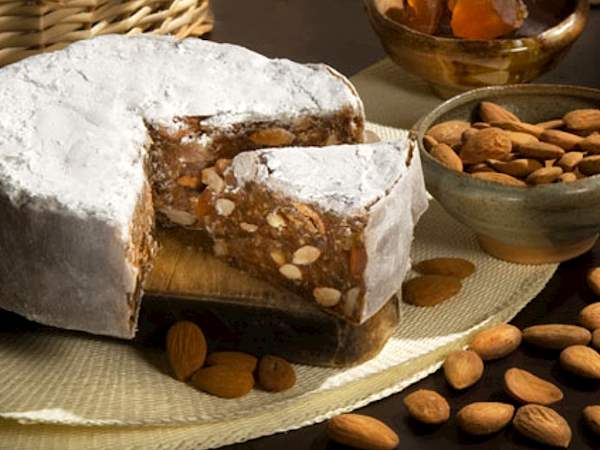
- Mercato nel Campo – This is a re‑enactment of the historic medieval market held in the Campo. Each year, on the first weekend of December, the piazza turns into a large open‑air market with dozens of stalls of typical products, crafts, foods and spices set up just as in the 14th century . The event attracts exhibitors from all over Italy and thousands of visitors. Walking among the stalls means taking a trip back in time: you can taste Sienese Christmas sweets like panforte and ricciarelli, buy hand‑painted ceramics, honey, Cinta Senese salami, pecorino cheese, spices and artistic crafts, all enlivened by costumed figures and musicians . The atmosphere is made even more magical by Christmas lights. The market usually lasts two days (Saturday and Sunday) with approximate hours 8 am–8 pm and takes place even in bad weather (except extreme conditions) . For Sienese it is an unmissable Advent appointment, and for tourists it is a great opportunity to experience the piazza in an unusual festive setting .
- New Year’s Eve in the Piazza – On 31 December Piazza del Campo becomes the focal point of New Year’s celebrations in Siena. In recent years the municipality has organised a large diffuse event: stages with live music in various squares in the centre and, at midnight, a collective toast in Piazza del Campo with a main show and fireworks . Thousands of people – locals and tourists – gather in the Campo to usher in the new year in a festive atmosphere. Each edition has a different musical theme and admission is free . Families can also participate (the event ends around 1 am) but of course must keep an eye on children among the crowd . Tip: dress warmly, because December evenings in the piazza can be cold .
- Capodanno Senese – Not everyone knows that Siena also celebrates a traditional “New Year” on 25 March: the Capodanno Senese, which was the start of the year in the Republic of Siena (coinciding with the Annunciation, nine months before Christmas). Today this recurrence has returned to popularity: a religious ceremony is held in the Church of the Annunziata and afterwards a historic procession with representatives from all contrade descends to Piazza del Campo . In the piazza, often in the Sala del Mappamondo of the Palazzo Pubblico, a public lecture or cultural event is held. The Capodanno Senese is a locally cherished celebration, less known to tourists, but if you are in Siena on 25 March you can see contradaioli parading in costume and take part in this moment of civic pride .
- Other events: During the year Piazza del Campo may host sporting or cultural events. For example, sometimes it is the starting or finishing point of running races (such as the “StraSiena”), or the setting for historical displays (e.g., the Carroccio drawn by oxen brought into the piazza for special occasions). In the past concerts by international artists have taken place here, but given the delicacy of the site, large rock concerts are now held in the Fortezza Medicea instead . A peculiar event is the victory dinner of the contrada that has won the Palio: a few months after the victory, the triumphant contrada organises a massive open‑air dinner for thousands of contradaioli and supporters, often laying long tables right in Piazza del Campo – a privilege reserved for the winners . Imagine the scene: a summer night, the piazza set for a feast with thousands of people dining by candlelight, contrada songs and toasts under the stars – unique even if you can only watch as a spectator .
A table summarises some recurring events related to Piazza del Campo :
| Date | Event | Description |
|---|---|---|
| 2 July | Palio di Provenzano (Palio di Siena) | Horse race between contrade in honour of the Madonna of Provenzano. Historic procession in the afternoon, race around 7:30 pm . |
| 16 August | Palio dell’Assunta (Palio di Siena) | Second annual Palio, in honour of the Assumption of the Virgin. Same format as July’s Palio; different contrade race . |
| 25 March | Capodanno Senese | Celebration of the traditional start of the Sienese year. Mass and procession of contrade to Piazza del Campo . |
| Early December | Mercato nel Campo | Re‑enactment of the medieval market with stalls of typical products and crafts in Piazza del Campo . |
| 31 December | New Year’s Eve in the Piazza | New Year’s celebration with live concerts in the city and a midnight toast in Piazza del Campo . |
The article notes that these dates refer to fixed annual appointments. For other special events or sporting/cultural manifestations scheduled in the piazza during the current year, check the city calendar .
How do you reach Piazza del Campo?
Piazza del Campo is located in the historic centre of Siena, which is entirely pedestrian or has limited traffic. It is easy and pleasant to reach on foot from anywhere in the centre; if you arrive from outside Siena, you need to leave your car in external car parks or arrive by public transport, then continue on foot. Here are some practical tips on how to get there :
On foot in the historic centre
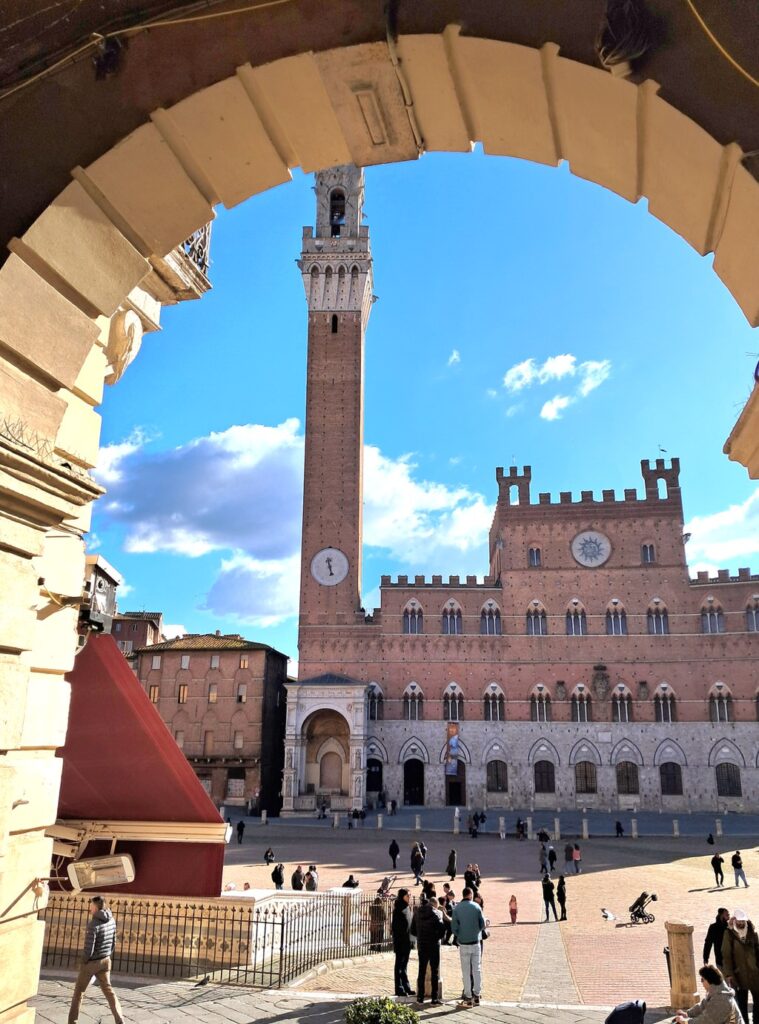
If you are already in the centre (perhaps staying in a hotel like Hotel Minerva, which is described later, or in other central accommodations), just follow the brown tourist signs “Piazza del Campo” at every corner. The streets leading to the piazza converge like spokes: for example, from the north you can descend via Banchi di Sopra and then Via Rinaldini; from the east you can arrive via Via di Città emerging at Costarella dei Barbieri; from the south you can climb Via di Pantaneto and Casato di Sotto; from the west you access via Via San Pietro/Casato di Sotto . In any case, be prepared for some ups and downs: Siena is hilly, but distances are short (from the Duomo to the Campo is 5 minutes, from Porta Camollia to the Campo 15 minutes, from the Basilica di San Domenico 10 minutes) . The beauty lies in getting lost in the alleys and then suddenly finding yourself in Piazza del Campo emerging from an arch .
By car
Siena’s centre is a strictly enforced ZTL (limited traffic zone), so you cannot drive to Piazza del Campo or circulate on nearby streets . You must leave your car in one of the permitted car parks and walk (or take shuttles). Siena, though medieval, is well equipped with parking for visitors . The main pay car parks close to the centre are:
- Parcheggio Il Campo (near Porta Tufi, a few minutes’ walk from the piazza)
- Parcheggio Santa Caterina (San Domenico area, about 10–15 min walk with an escalator to the centre)
- Parcheggio Stadio/Fortezza (large, ~800 spaces, near the Fortezza Medicea, 10 min walk from the Campo)
- Parcheggio San Francesco (with escalator leading up to Via Banchi di Sopra, ~10 min from the Campo)
- Parcheggio della Stazione FS (large and inexpensive, with escalators leading to the centre near Porta Camollia in 10–15 min)
These car parks cost about €2 per hour (day rate) with a daily maximum around €35, except the Stazione which is much cheaper (0.50 €/hour) but further away . On Sundays and public holidays, pay car parks are free . There are also some free car parks further out (e.g., Due Ponti and Palasport in Strada di Pescaia, or Via Esterna di Fontebranda near Laterina) served by shuttle buses, but these are useful only if you stay several days and want to save money . General advice: follow the signs for the car parks as soon as you arrive in the city, choose one based on your arrival side (e.g., from the south choose Parcheggio Il Campo; from the north, Fortezza or Stazione; from the west, San Francesco) and then walk to the centre .
By train
Siena has a railway station located about 2 km north‑west of the historic centre . The station is well connected with Florence (about 1 h 30 train ride, often requiring a change at Empoli) and with Empoli/Pisa on one side and Grosseto/Chiusi (line to Rome) on the other . If arriving by train, you can reach Piazza del Campo in about 30 minutes on foot: from the station you take a comfortable set of escalators and moving walkways up to Porta Camollia, then continue straight along Via Camollia and Banchi di Sopra to the Campo . Alternatively, urban buses from the station (lines S3 or S10) stop at Piazza Gramsci – from there it is a 10‑minute walk to the Campo – or you can take a taxi . Travelling by train is a good option if you come from Florence (avoid parking stress) or from Rome (there is a convenient regional train from Chiusi) .
By intercity bus
Siena is well connected by coach, especially with Florence and other Tuscan/Umbria towns. Buses operated by Tiemme or FlixBus from Florence take about 1 h 15 and arrive directly in the centre (Piazza Gramsci). There are also direct buses from Rome (around 2 h 45 via Sena/FlixBus) that stop at Piazza Rosselli (adjacent to Piazza Gramsci) . If you arrive by bus you will already be practically in the centre: from Piazza Gramsci, Piazza del Campo is less than 10 minutes on foot – cross Via Banchi di Sopra and descend towards Via Rinaldini . The bus is therefore an excellent option from Florence, quicker than the train .
By air
The nearest airports are Florence Peretola (FLR) about 75 km away and Pisa Galileo Galilei (PSA) about 120 km . From Florence airport you can reach Siena by shuttle bus (about 1 h 20) or by car/rental (1 h 10 via motorway and the Siena–Firenze link). From Pisa airport it is advisable to take the train (Pisa–Empoli–Siena line, about 2 h) or a direct bus (available only on certain tourist days) . Many international tourists visit Siena as a day trip from Florence: the typical option is to take a bus or rental car .
Once you arrive in Siena and have parked your car or exited the bus/train, moving around on foot is the mandatory (and enchanting) choice. Piazza del Campo is pedestrian and no public transport goes directly to the piazza – but that is not necessary, because distances are short . Wear comfortable shoes (the paving is brick and stone and there are hills) and follow the signs or Google Maps through the alleys if you get lost: every street in Siena’s centre is picturesque, and as you walk you will discover hidden corners, fountains of the contrade and unexpected panoramic glimpses . Remember that Siena is a safe and tranquil city, so walking around even at night is pleasant and free of particular risks . Indeed, you will enjoy a suggestive Siena illuminated by street lamps reflecting on the ancient stones .
What is the best time to visit Piazza del Campo?
Each season in Piazza del Campo has its particular charm, so much depends on your preferences and interests. The article describes how the Campo appears during different times of the year, allowing you to choose the ideal moment for your visit :
- Spring (April–June): The weather is mild, the city is in bloom and not yet as crowded as in high season. Spring in Siena offers sunny days that are not too hot – ideal for sitting in Piazza del Campo enjoying a gelato or coffee outdoors. The alleys smell of wisteria and orange blossoms, and the surrounding hills are bright green . It is a great time for visiting the surroundings (Chianti, San Gimignano) if you stay for several days. Events: at the end of March there is the Capodanno Senese; at Easter there may be processions; in June there are often concerts or smaller medieval re‑enactments. Recommended for families: children can run in the piazza without the oppressive summer crowd, and the long days allow early outdoor dinners .
- Summer (July–August): This is the liveliest but also most crowded period. The two Palio dates (2 July and 16 August) fill the city with contradaioli and passionate tourists . If you wish to experience the emotion of the Palio, summer is obviously the right time – but book accommodation well in advance and expect high prices and crowds. During Palio days the piazza is covered with tuff and entirely dedicated to the event, so you will not see it in its “normal” configuration but transformed into a racetrack . July/August in Tuscany is hot (often over 30 °C) and standing in the Campo at midday can be tiring; better to stroll early in the morning and late afternoon and rest during the hottest hours (perhaps taking advantage of an afternoon siesta at your hotel) . In the evening Piazza del Campo comes alive with cafes and outdoor restaurants, with many people sitting on the ground simply chatting in the cool . Summer events include the Palio and, in August, classical concerts of the Chigiana Festival, open‑air cinema in the Fortezza and more . Recommended for those who want a vibrant Siena rich in tradition and who are not afraid of the heat and crowds. For families with small children not interested in the Palio, June or September may be better .
- Autumn (September–October): A splendid period for colours and atmosphere. In September the weather is still pleasant and tourist flows start to decrease after summer . The vineyards around are in harvest and the air smells of must and chestnuts . Piazza del Campo in autumn, especially in October, offers golden sunsets (the brick glows with honey‑like reflections at dusk) and crisp evenings where it is pleasant to sit at a table with a light jacket . Events: at the end of October/beginning of November there is sometimes an extraordinary market or fairs; around 1 November the city may be busier for Italian holiday weekends . Recommended for those seeking a balance: good weather, a lively but not chaotic city, and the possibility of wonderful photos with autumn light. Children will enjoy roasting chestnuts in the piazza and maybe Halloween events (also starting to appear in Siena) .
- Winter (November–March): In winter Siena becomes more intimate and cosy. The days are short and often cold (January and February can have lows near zero, occasionally a dusting of snow on the square – a fairytale scene!) . In December Piazza del Campo lights up with Christmas lights and a tree, and hosts the Mercato nel Campo and the New Year’s party . In January-February there are no major events, but the advantage is the scarcity of tourists: you can enjoy the piazza almost empty at dawn or in the evening – really evocative . Museums and restaurants remain open but with slightly reduced hours. If visiting in winter, dress warmly for the cold wind that can blow across the square . Recommended for those who prefer to avoid crowds and want a more authentic atmosphere, perhaps with the chance to see the Bravìo: in early January the winning contrada of August’s Palio burns in the piazza a straw dummy called bravìo as a propitiatory rite .
In general, May‑June and September may be optimal months for an average tourist (good weather, many events, no extremes). But if your dream is to see the Palio, aim for July/August knowing what to expect. Conversely, if you dream of photographing Piazza del Campo empty in winter light, choose February. A final tip: whatever the season, the piazza at dawn or late at night has a unique charm. Try visiting at an unusual hour – for example at 7 am, when shopkeepers wash the bricks and no one is there yet – or at midnight when the moon shines on the Tower. It will stay with you forever .
Is Piazza del Campo suitable for children?
Absolutely yes! Piazza del Campo is a perfect place for families with children . Being a large pedestrian area (no cars inside), little ones can run and play in relative freedom while parents enjoy the beauty of the place . Often you see kids climbing up and down the slope of the square or chasing the pigeons that populate the Campo . The gentle shell‑shaped slope turns it into a natural “slide” where many children roll or run in circles – always with parents keeping an eye out, especially when there is a crowd .
Local children frequent the piazza regularly: for them it is like a courtyard where they meet to play football (officially forbidden, but you sometimes see kids with a ball during less touristy hours) or to eat an ice cream sitting on the paving . Speaking of ice cream, right in Piazza del Campo or in adjacent streets there are several gelaterie and bars where you can get a cone or granita for the kids and then enjoy it sitting maybe on the stone bench around Fonte Gaia or the steps of the Palazzo Pubblico .
A few caveats: during peak times (for example, after dinner in midsummer or on Palio days) the piazza can get very crowded; in those cases hold children’s hands because they can easily get lost in the crowd . Also, during the historic procession of the Palio or very crowded events, it is better to put younger kids on your shoulders or move to less dense areas so they can breathe and see properly .
Aside from the Palio, Piazza del Campo is generally not dangerous for children – indeed, without traffic and with an open space it is safer than many city streets . Just watch out for the pigeons and steps: around the Cappella di Piazza and Fonte Gaia there are marble steps that kids love to climb and sit on; supervise them to avoid falls .
A nice programme for families is, for example: in the afternoon take the kids to Orto de’ Pecci, a green park just behind Piazza del Campo (5 minutes on foot down Vicolo di Porta Giustizia). There is a medieval garden and a sort of educational farm with donkeys, goats, ducks and peacocks – children love seeing animals and running on the lawn, and parents can relax in the green with a view of the Torre del Mangia from an unusual perspective . There is also a small playground and an outdoor trattoria in the park for a snack or rustic lunch . After playing at Orto de’ Pecci, you can climb back up to Piazza del Campo and perhaps treat yourselves to an artisanal gelato: for example, in Costarella (the climb next to the square) there are excellent gelaterie. Then sit together in the middle of the Campo: it will be unforgettable for them to sit on the ground in such a big square, looking up at the sky and the Tower .
For slightly older children (from around 6–7 years up) it can be exciting to climb the Torre del Mangia – if they feel up to the 400 steps . Many are enthusiastic about climbing a “fairytale tower” and then seeing the whole city like a model from above (but hold their hands on the final steep steps). The Museo Civico can also intrigue them if presented as a journey through time: look for funny figures or details (such as animals or countryside scenes) in the Good Government paintings to keep them engaged .
In summary, Piazza del Campo is family‑friendly: it does not offer specific attractions for children (do not expect slides or rides in the piazza, rightly so), but its shape makes it a huge space where children can expend energy safely while parents enjoy the cultural visit . Many restaurants around the Campo are used to welcoming families and can provide high chairs or children’s menus (pasta with tomato sauce, cutlet, etc.) . And if your kids get tired of walking, remember that from the Campo your central hotel will never be too far away for a break: for example, Hotel Minerva is only about 15 minutes’ walk from the piazza, so it’s easy to return to your room for an afternoon nap and then come back out in the evening .
Where to eat: are there restaurants or cafés in Piazza del Campo?
Yes, Piazza del Campo is surrounded along its perimeter by numerous bars, cafés and restaurants with outdoor tables where you can eat or drink while enjoying the spectacular view of the square . However, be aware that places directly overlooking the Campo tend to be quite touristy and have higher prices than other areas of Siena – partly understandable given the unique location . Still, having a snack or aperitif in the piazza is an experience to try at least once: sitting under the Torre del Mangia sipping a local wine at sunset is priceless . For a full meal, many prefer to move just a few metres into the side streets, where excellent typical trattorie and osterie can be found .
Here are some useful tips for dining around Piazza del Campo:
- For coffee, breakfast or aperitif: choose one of the historic bars on the piazza such as Bar Il Palio or Caffè Fanfulla, which offer breakfast with a view (croissant and cappuccino while watching the piazza in the early morning – a great start to the day) or aperitifs at sunset . Note that table service often has an extra charge (sometimes 20 % more than at the counter) due to the unique setting . Alternatively, you can get something to take away from one of the nearby pastry shops/gelaterie and enjoy it sitting on the steps of the piazza like many do .
- For lunch/dinner in the Piazza: there are various restaurants on the sides of the Campo, such as La Torre, Il Bandierino, Ristorante alla Speranza, Osteria del Bigelli. They offer Tuscan menus and pizzas; quality is decent but they mainly sell the location. Expect slightly higher prices (e.g., first courses €15–18, pizzas €12–15, Florentine steak expensive by weight) . If you want to prioritise the view and atmosphere, one of these places will give you a beautiful memory – perhaps dining outdoors on a summer evening watching the people in the piazza . Among these, Il Bandierino is known for its corner location with a large terrace, and La Speranza for being one of the oldest establishments (with a historic interior) .
- Typical trattorie nearby: just a few steps from the Campo there are restaurants highly appreciated by informed tourists and locals. For example, in Via della Galluzza (a small street descending from the Campo) is La Grotta di Santa Caterina da Bagoga, renowned for authentic Tuscan cuisine – dishes like pappardelle with wild boar and the famous “gallo indiano” (an ancient spiced turkey recipe with panforte) . The ambience is rustic with brick vaults and contrada decorations, and the prices honest (€€, around 30–35 € per person) . In Via di Duprè (contrada dell’Onda, 5 minutes from the Campo) is Taverna di San Giuseppe, another top restaurant in the city: located in a building with an underground Etruscan cellar, it serves excellent Tuscan dishes (homemade pici, Florentine steak, gnocchi with truffle) and has an outstanding wine cellar . Prices are medium‑high (€€€, 40–50 € per person) but the quality and authentic atmosphere make it worth it . In Via del Porrione (one of the streets leading from the square) you find Osteria Gallo Nero and Osteria da Divo; Gallo Nero is famous for revisiting medieval recipes – e.g., soup with nettle and truffle, juniper‑flavoured wild boar – offering a true “old‑world” culinary experience in a very characteristic setting . Prices are medium (€€, 30–40 €). Finally, if you fancy fish (occasionally desired even far from the sea), there is Il Mestolo (in Via Fiorentina, a bit outside the centre) which is considered the best fish restaurant in Siena . However, it is about 20 minutes on foot from the piazza.
- Quick and cheap options: if you just want a quick snack for a reasonable price, the streets around the Campo have pizzerias by the slice (e.g., Il Masgalano in Via Rinaldini), sandwich shops and delis selling panini with Tuscan cold cuts . A classic is to grab a slice of pizza or a ciaccina (flatbread) and then sit in the middle of the piazza to savour it . There’s even a McDonald’s nearby (in Banchi di Sopra, under Piazza Gramsci) for children craving burgers, though with all the good local food it would be a shame . For gelato: besides the aforementioned Costarella (where you’ll find Gelateria Kopa Kabana), another very good gelateria is Il Bacio in Via dei Rossi (5 minutes from the Campo) .
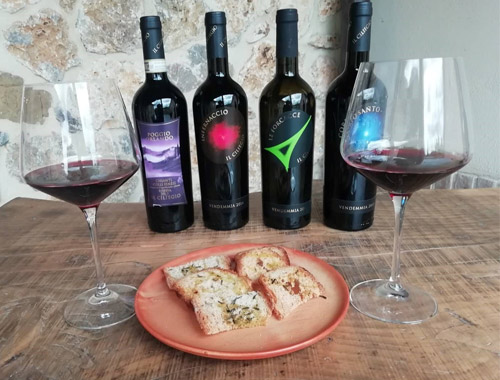
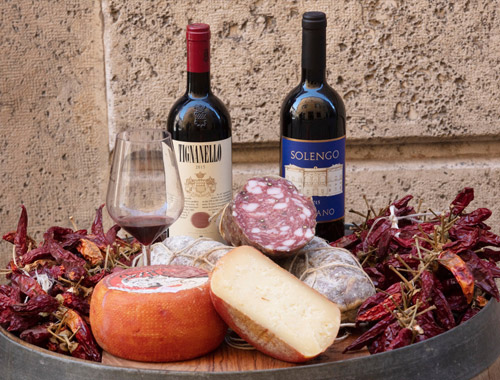
The article provides a summary table of some recommended restaurants near Piazza del Campo with information on cuisine, price range and special features . It concludes that eating in Siena is a pleasure: do not forget to try typical dishes such as handmade pici pasta with aglione or wild boar sauce, ribollita or acquacotta (vegetable and bread soups), Cinta Senese cured meats, Pecorino di Pienza, bistecca alla Fiorentina (though typical of Florence, widely served in Tuscany), and Sienese desserts like panforte, ricciarelli and cavallucci . Piazza del Campo and its surroundings offer options for all tastes and budgets: from a quick sandwich to a romantic candle‑lit dinner. The important thing is to choose wisely: enjoy a drink with a view in the piazza, and for the rest explore the hidden osterias in the alleys for a more authentic culinary experience .
Where to stay in Siena? Hotel Minerva – the ideal starting point near Piazza del Campo
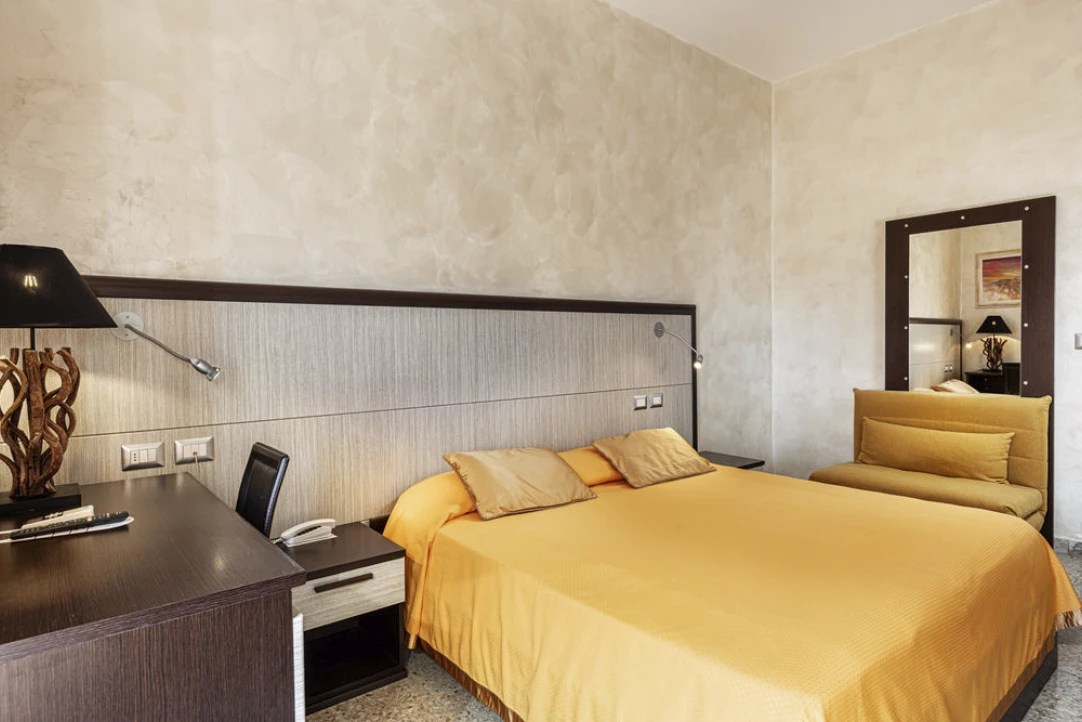
Siena offers many accommodation options, but if you are looking for a convenient, welcoming and strategically located hotel for exploring the city on foot, Hotel Minerva is an excellent choice . This three‑star hotel is located in the centre of Siena, about 15 minutes’ walk from Piazza del Campo, and is particularly suitable for families, couples and travellers of all kinds thanks to the numerous advantages offered by its property .
Why choose Hotel Minerva as your base in Siena?
- Strategic yet accessible location: Hotel Minerva is inside the ancient medieval walls of Siena, in the historic centre, but just outside the ZTL . This means that, unlike many hotels in the historic centre, it is easily reachable by car without incurring fines or requiring special permits . If you travel by car, you will appreciate that the hotel has a private covered car park with CCTV (around 20 spaces) – a real rarity in Siena . Once parked, you can forget the car for your entire stay: as the hotel itself says, “Siena unfolds all around you, ready to be discovered on foot” . In a few steps you are already immersed in the city’s streets .
- Proximity to main attractions: From Hotel Minerva you can go everywhere on foot. Piazza del Campo is about 1 km away – a 15‑minute walk through picturesque city streets full of little shops and cafés . The route to the piazza is pleasant and well signposted: just head towards Porta Ovile/Via Garibaldi and then follow the streets leading to the city’s “heart” . The Duomo is only 17 minutes away on foot (uphill with beautiful views), the Basilica di San Domenico and Santuario di Santa Caterina less than 10 minutes , and even the Fortezza Medicea – perfect for morning jogs or a glass of wine at sunset – about 13 minutes . In short, almost all of Siena’s attractions are reachable by a walk of less than 20 minutes from the hotel . This proximity allows you to experience the city without stress: for example, you can return to your room for a rest after lunch and then head out to a museum in the afternoon without using a car or bus . For travellers with children, having the hotel nearby makes it easy to manage their needs (nap, nappy change, etc.), and for those who enjoy the nightlife it means you can enjoy Siena’s evening life without worrying about long returns .
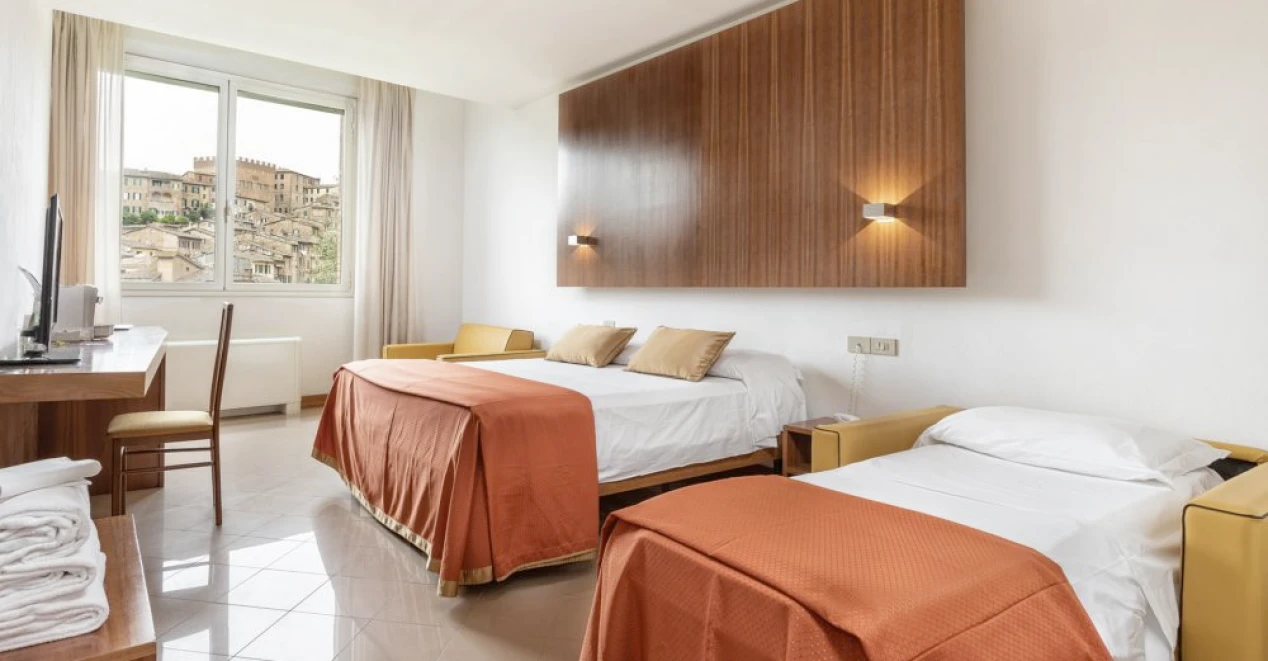
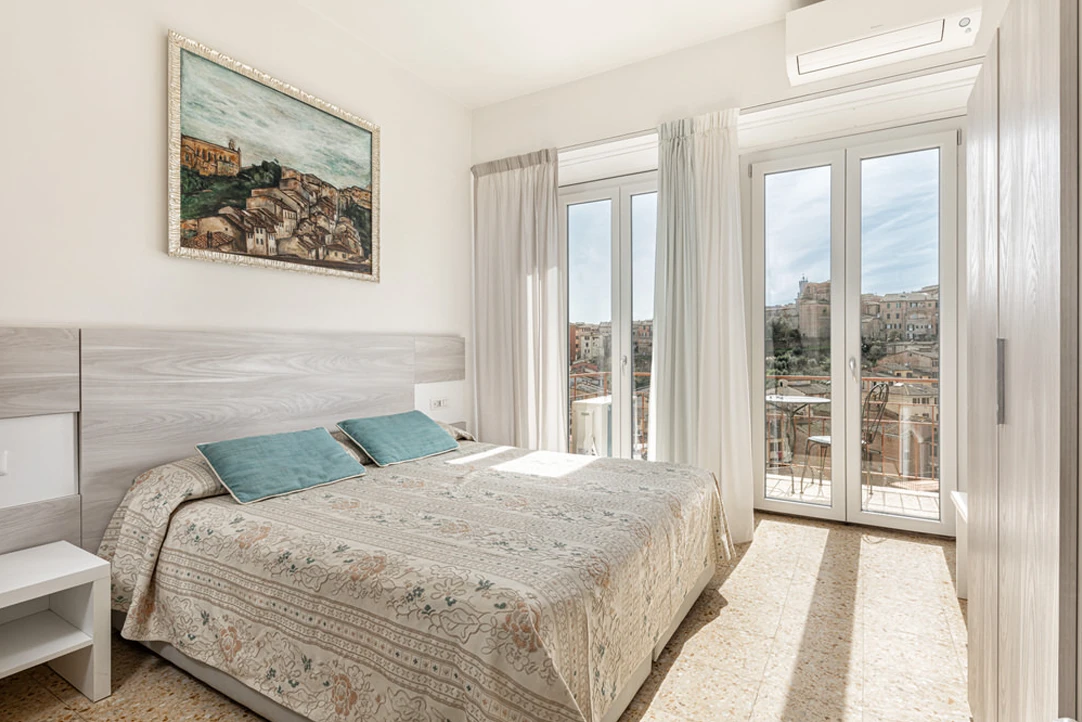
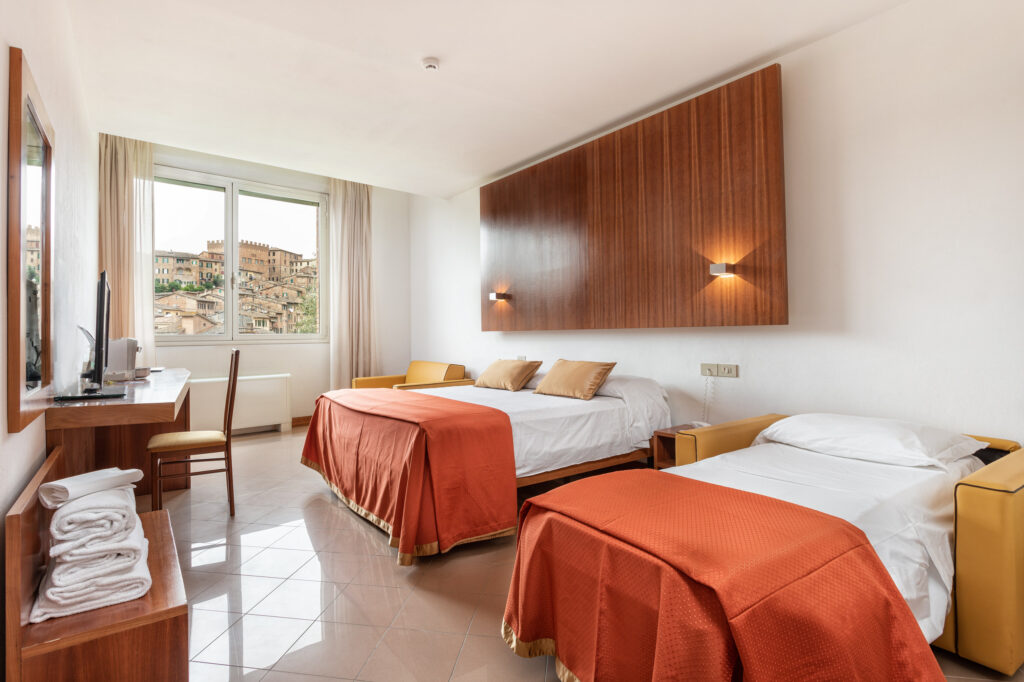
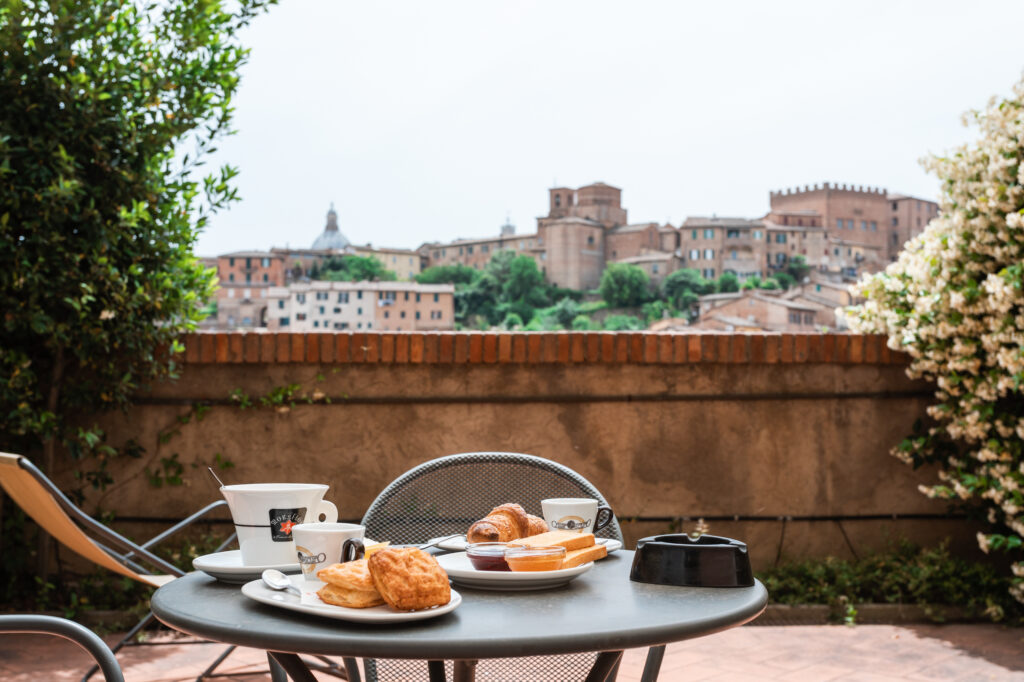
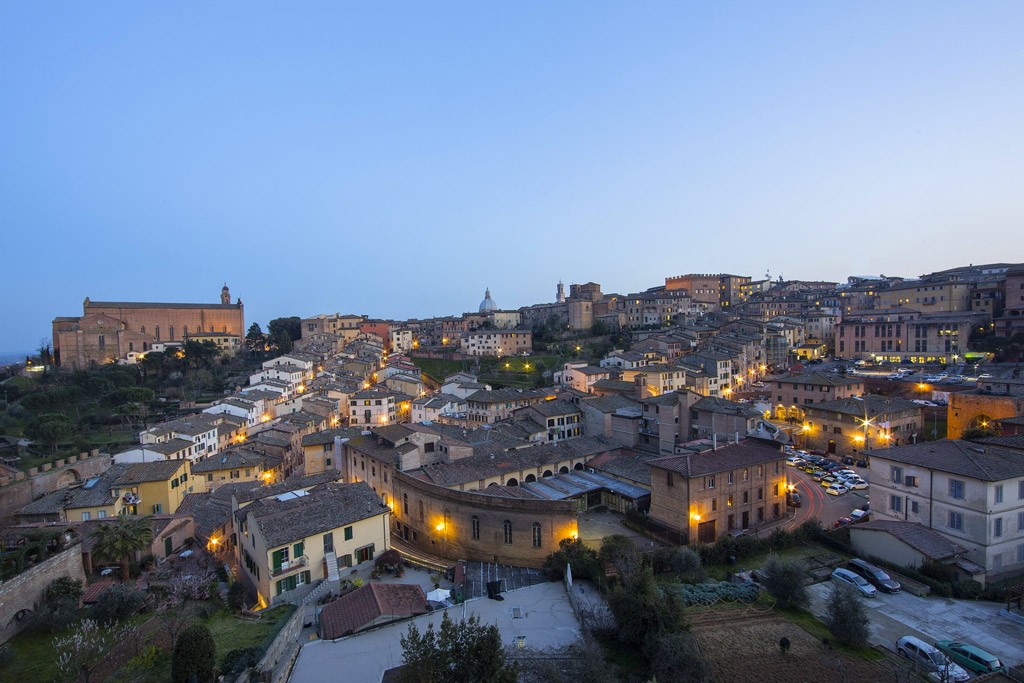
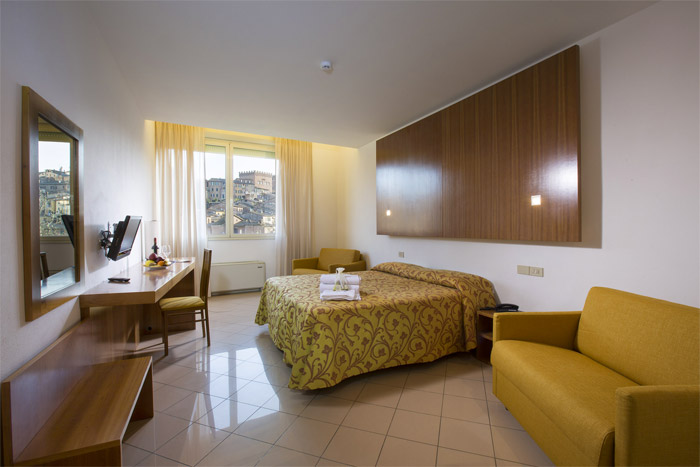
- Peace and views: Despite being central, Hotel Minerva is located in a slightly quieter area away from night‑time noise – specifically in Via Garibaldi, which is convenient and close to shops but not noisy at night . This means that after intense days of sightseeing you can rest well without noise under the windows. Many rooms at the hotel offer panoramic views over Siena’s rooftops and towers: waking up in the morning to the silhouette of the Torre del Mangia outside your window is an emotion that starts the day off right . If you love views, request (when booking) a room with a view of the historic centre – Minerva has several, especially on the upper floors facing south‑east . Imagine yourself at sunset on the balcony, the sky reddening behind the tower… postcard moments that you can experience directly from your hotel room .
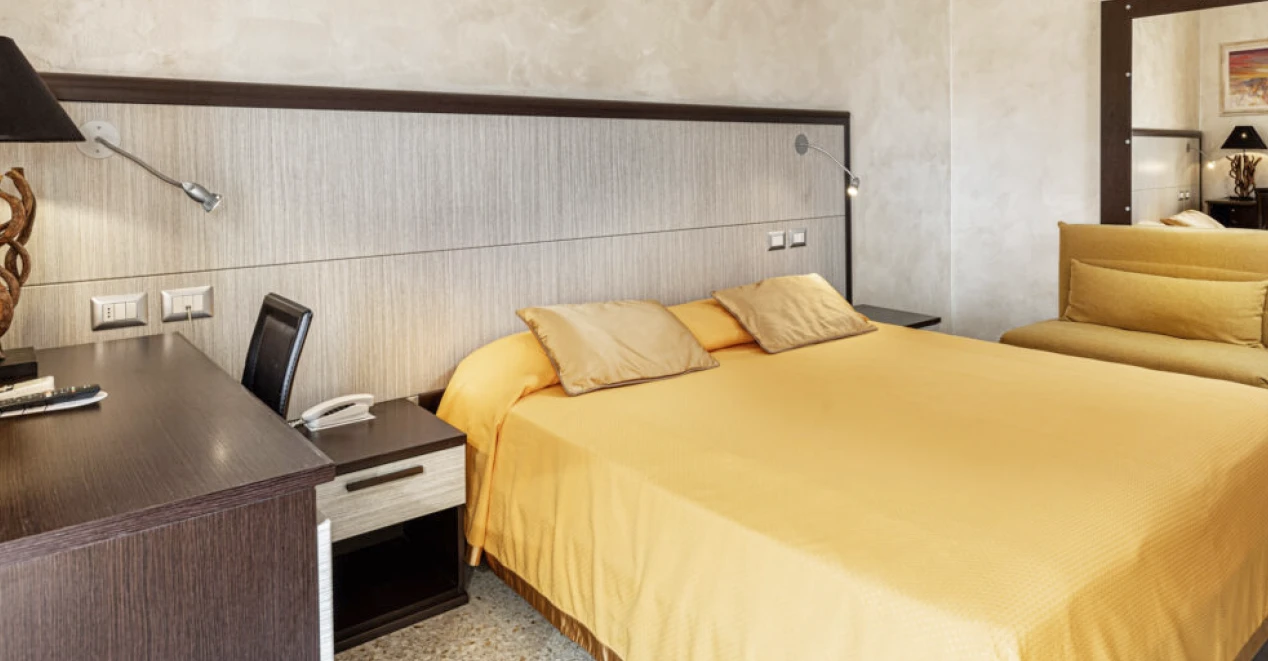
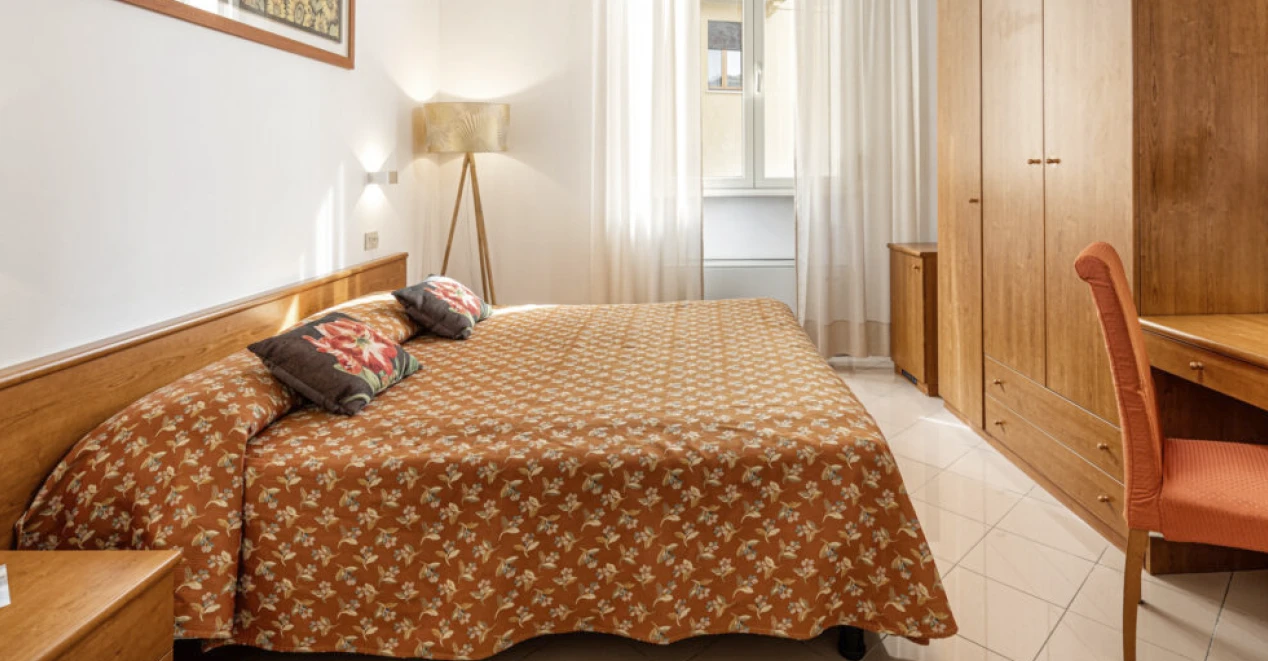
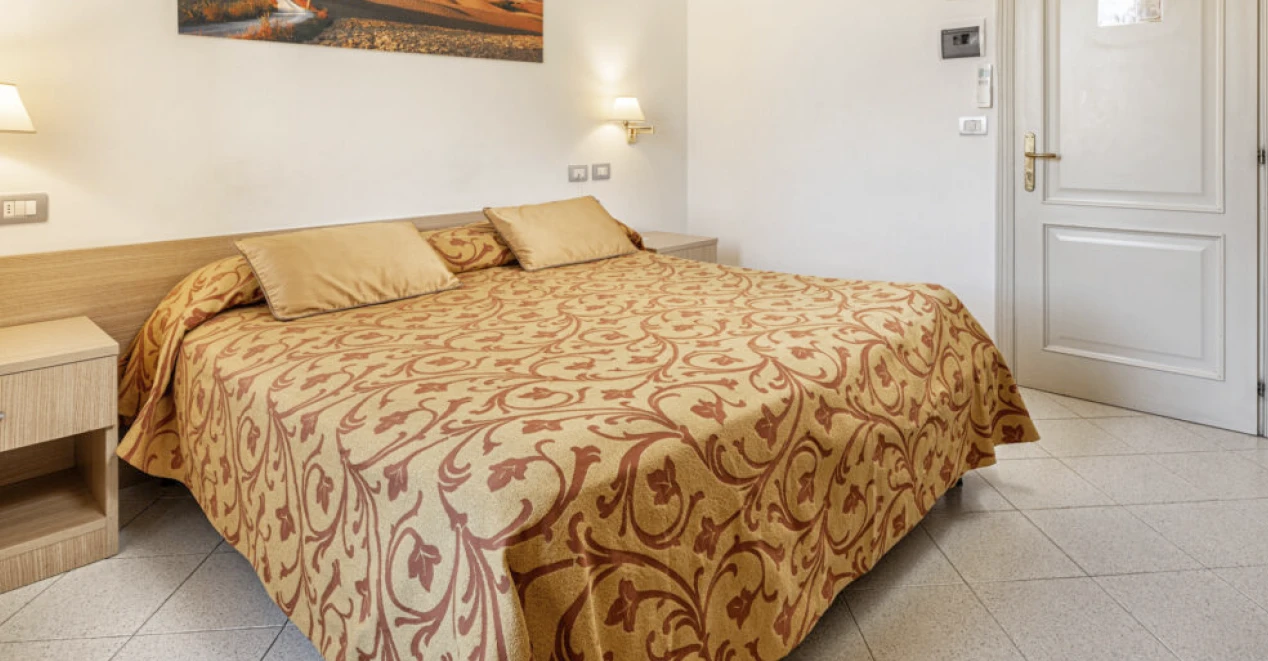
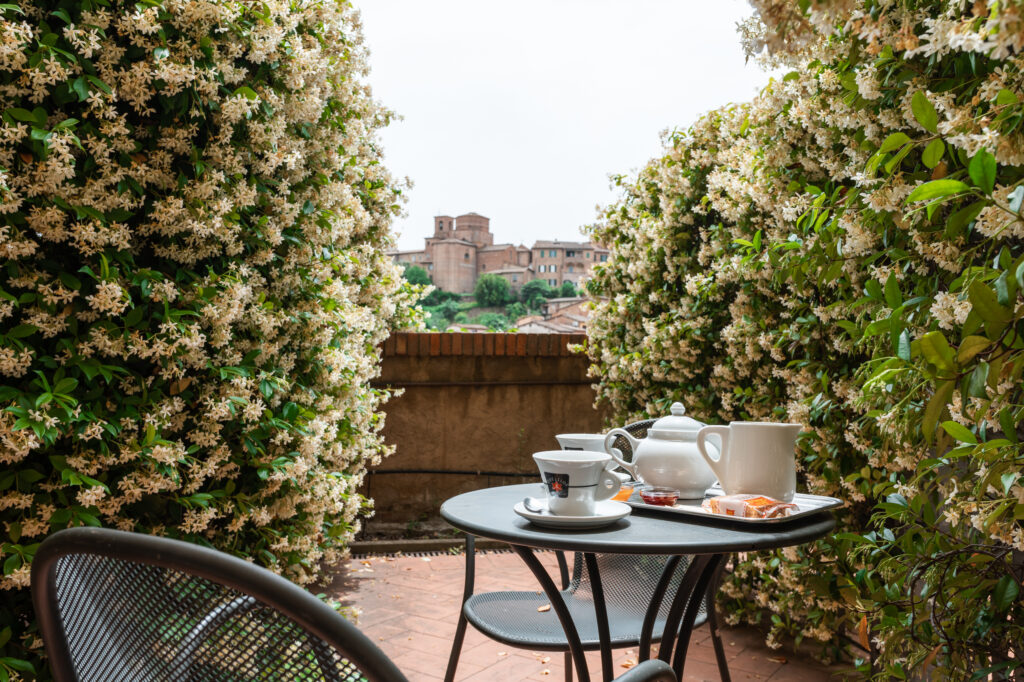
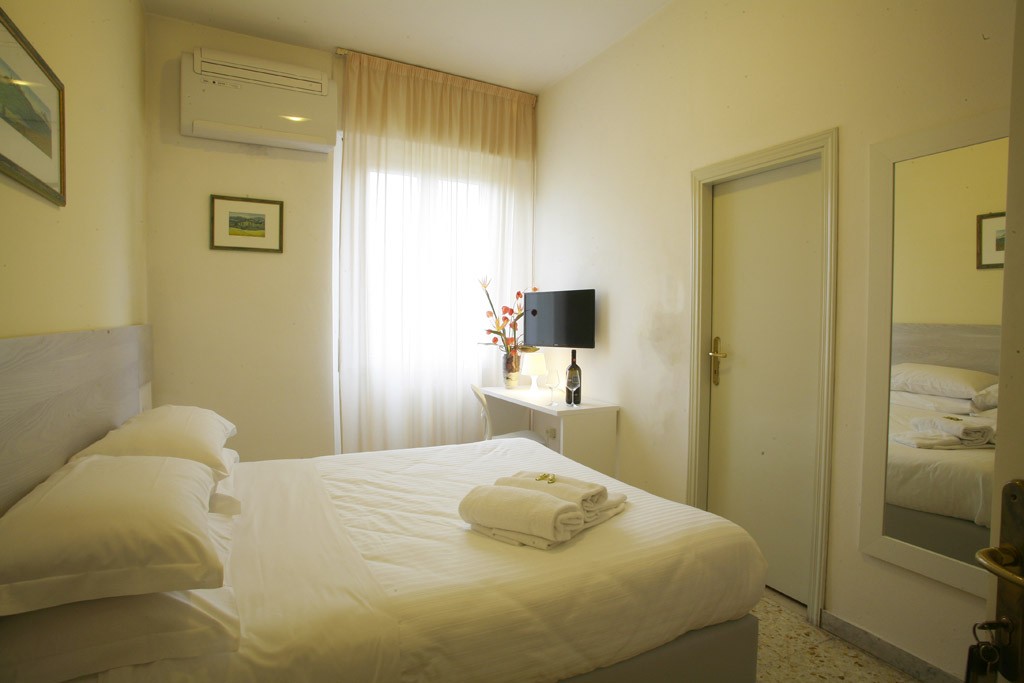
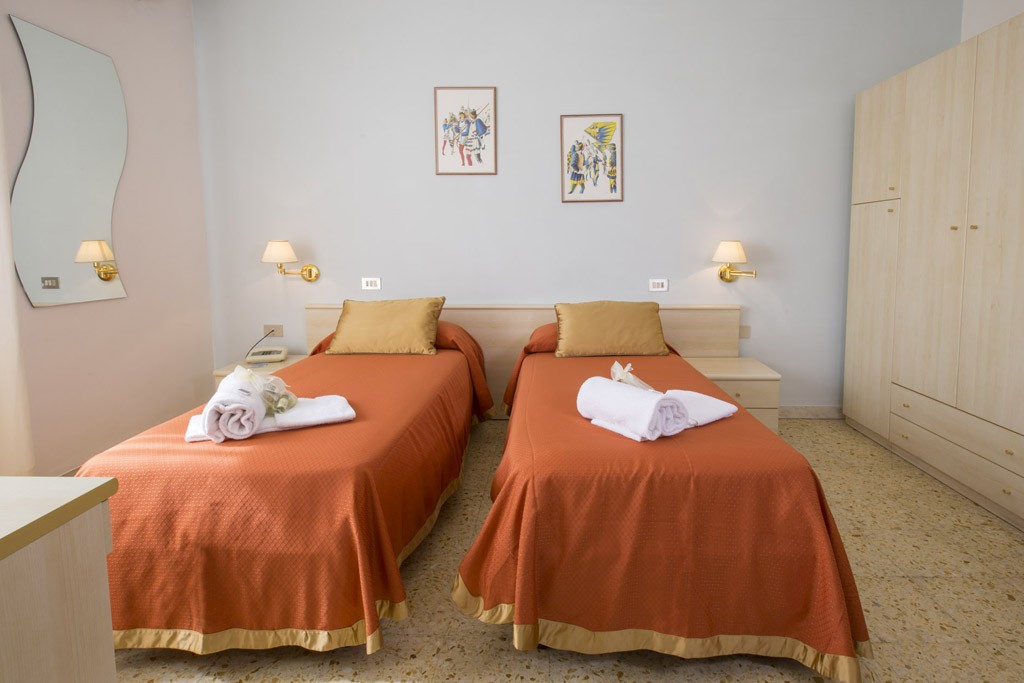
- Rooms and services for families: Hotel Minerva has a total of 56 rooms of various types . There are family rooms (connecting or quadruple) ideal for those travelling with children, spacious with extra beds on request . There are also Junior Suites for couples seeking something special, and Economy rooms for those on a smaller budget yet wanting cleanliness and comfort . All rooms are equipped with air conditioning, free Wi‑Fi, minibar and TV – essential conveniences . Breakfast is well curated: served in a breakfast room or, in fine weather, in an internal panoramic garden . You’ll find a continental buffet with fresh pastries, Tuscan bread, homemade jams, fruit, local meats and cheeses, as well as espresso drinks . For kids there are cereals, yogurt and Nutella, and on request the hotel prepares special menus (useful if you have babies and need to heat food or bottles; the staff is available) .
- Hospitality and extra services: One of the strengths reported by guests is the friendliness of the staff. Reception is open 24 hours a day , so it doesn’t matter what time you arrive or if you need information late at night: someone is always ready to assist you with a smile . The staff speak multiple languages and are generous with tips on what to do in Siena – they can point out unusual itineraries, hidden restaurants for a candle‑lit dinner or current events not to miss . Ask them if you want to try a particular experience, like a wine tasting at a Chianti winery or even a horseback ride in the hills – they often can help organise everything . The hotel offers free high‑speed Wi‑Fi throughout, ideal for posting travel photos in real time . For those coming to Siena for work or study, there is also a meeting room . And if you travel by bicycle or motorbike, the hotel is equipped to welcome cycle tourists (space for bikes in the garage, minor repairs) .
- Offers and prices: As a 3‑star hotel, Hotel Minerva has affordable rates, especially when booking directly on the official site: they often offer seasonal special offers, discounts for families or for longer stays . There may be packages including guided tours, “romantic” offers for couples (such as prosecco in the room) or non‑refundable discounts . Generally prices range from about €60 to €150 per room per night (depending on the season and room type) – very competitive considering the central location . Booking on the hotel’s site often secures the best rate and perhaps some bonus (e.g., late check‑out or a discount card for local shops) .
In short, Hotel Minerva combines modern comforts (parking, Wi‑Fi, air conditioning, 24‑hour reception) with the charm of staying in the heart of Siena. It is not a luxury 5‑star hotel, but it focuses on genuine hospitality and services designed to simplify travellers’ lives . Furthermore, its location makes it perfect for exploring Siena on foot: having Piazza del Campo and all the monuments within walking distance is a huge advantage, especially when after dinner you need only a short stroll to return to your room . Many guests note that Minerva feels almost like a historic guesthouse, with vintage photographs in the corridors and staff who remember your name from day two – in other words, more than an anonymous hotel, it is a place with a soul and a story, just like Siena .
Therefore, if you are planning a trip to Siena and want to be sure of enjoying Piazza del Campo (and its surroundings) without logistical stress, consider Hotel Minerva – it is a sound choice . Booking directly through their official website will also ensure the best price and perhaps an extra perk . Once settled there, all you need to do is… stroll and let yourself be enchanted: Siena awaits you right outside the door! .
What to see around Siena (recommended excursions)
Siena is also a great base for exploring other fascinating places in Tuscany. If you have a few extra days and are staying in the centre (for example at Hotel Minerva, which is convenient for starting trips by car outside the city), you can organise day excursions to villages, abbeys and postcard landscapes located nearby . The article suggests several destinations:
- Monteriggioni: An enchanting medieval village encircled by walls and towers, mentioned by Dante (“Monteriggion di torri si corona”). It is only 15 km from Siena (about 20 minutes by car). You can walk on the fortified walls, explore its quiet streets and enjoy a Tuscan lunch in one of the inns inside the walls . Note: from Monteriggioni a beautiful stretch of the Via Francigena starts, suitable for hiking .
- San Gimignano: Known as the “Manhattan of the Middle Ages” for its many towers (still 13), it is another unmissable UNESCO city. Famous for its intact 14th‑century atmosphere and Vernaccia white wine, it is 45 km from Siena (about 50 minutes by car towards the north‑west or direct bus 1 h 15). In San Gimignano you can climb one of the towers (Torre Grossa), visit the Collegiata with medieval frescoes and taste one of the “best ice creams in the world” at the award‑winning gelaterias . Then return to Siena for dinner .
- Chianti Classico (hill itinerary): If you love wine and bucolic landscapes, dedicate a day to exploring the Chianti region, which extends north of Siena towards Florence. You can follow the SR222 “Chiantigiana”, stopping at Castellina in Chianti (an ancient Etruscan centre with a fortress and tunnels), Radda in Chianti (delightful village with a castle and vineyard views) and perhaps Gaiole in Chianti (nearby is the Castello di Brolio, linked to the story of the “Iron Baron” and with beautiful gardens) . Along the way you will encounter numerous wineries offering tastings and direct sales of Chianti Classico, extra‑virgin olive oil and typical products . From Siena to Castellina is only 20 km; the full loop via Radda‑Gaiole is about 70 km . If no one in your group wants to drive (for obvious reasons of wine tasting), you can join organised tours departing from Siena .
- Abbazia di San Galgano: About 35 km south‑west of Siena (45 minutes by car) stands one of Italy’s most suggestive abbeys: San Galgano, famous for being roofless. This Cistercian monastery dating to the 1200s has a nave open to the sky that creates a mystical, highly photogenic atmosphere . Nearby, on a hill, is the Hermitage of Montesiepi with the legendary Sword in the Stone of San Galgano. A trip here is ideal for lovers of history and Arthurian legends . There are no convenient public transports; the car is best . You could combine it with a visit to Massa Marittima or to the Petriolo thermal baths .
- Val d’Orcia (Pienza, Montepulciano, Montalcino): If you have a full day and a desire for postcard landscapes, head south towards the Val d’Orcia, also a UNESCO World Heritage area. From Siena you are one hour away from Pienza (50 km), a splendid Renaissance town designed by Pope Pius II, famous for its Pecorino cheese . A little further is Montepulciano, home of Vino Nobile: visit the historic cellars dug into the tuff under the town and Piazza Grande with the Cathedral . Or choose Montalcino, perched and dominated by a fortress, where you can taste the famous Brunello . Doing all three in one day is demanding; better to select one or two: for example, morning in Pienza (visit the Cathedral, panoramic streets, taste Pecorino), afternoon in Montalcino (fortress and Brunello tasting). The Val d’Orcia will enchant you with its rows of cypresses, sinuous hills and golden fields . For families: near Pienza lies Monticchiello, where a popular outdoor theatre is staged in summer, and in San Quirico d’Orcia there is Il Bosco della Ragnaia, an artistic garden where children can roam freely .
- Firenze, Arezzo, Perugia: If Siena is your base and you have never been to some major cities, some are reachable in a day trip. Florence is 75 km away; about an hour by bus takes you to the Tuscan capital, where you can spend a day among the Uffizi, the Duomo and Ponte Vecchio and return in the evening . Arezzo (70 km east, about 1 h by car or 1 h 30 by train via Chiusi) offers a beautiful medieval centre and the famous fresco cycle by Piero della Francesca . Perugia in Umbria is 100 km away (1 h 30 by car), if you want to cross the regional border for another medieval gem and perhaps taste Baci Perugina . However, considering how much there is to see in Siena and its surroundings, you may not feel the need to push as far as Florence or other cities during a short stay .
The article includes a summary table of popular excursions from Siena with distances and highlights :
| Destination | Distance from Siena | Means / Time | Highlights |
|---|---|---|---|
| Monteriggioni | 15 km N | Car – 20 min; Bus – 30 min (line 130) | Fortified village with walls and 14 towers. Walk on the walls; medieval atmosphere. Small armour museum . |
| San Gimignano | 45 km NW | Car – 50 min; Bus – 1 h 15 (line 130 + 133) | Town of towers (13 medieval towers). Collegiata with frescoes, Torre Grossa, award‑winning gelato, Vernaccia wine . |
| Chianti (Castellina/Radda) | 20 km N (Castellina) | Car – 30 min (Castellina) + 15 min for Radda | Scenic Chianti road. Wine tasting of Chianti Classico in cellars. Towns of Castellina, Radda, Gaiole. Castello di Brolio near Gaiole . |
| Abbazia di San Galgano | 35 km SW | Car – 45 min | Roofless Gothic abbey in the countryside. Hermitage of Montesiepi with “Sword in the Stone”. Mystical and photogenic . |
| Pienza (Val d’Orcia) | 50 km SE | Car – 1 h 10 | Renaissance “ideal city”. Cathedral, Palazzo Piccolomini (gardens with view), typical pecorino cheese, breathtaking Val d’Orcia panoramas . |
| Montalcino (Val d’Orcia) | 40 km S | Car – 50 min | Hill town of Brunello. 14th‑century fortress (wine tastings), medieval streets, nearby Sant’Antimo Abbey . |
| Montepulciano (Val d’Orcia) | 65 km SE | Car – 1 h 15 | Renaissance town famous for Vino Nobile. Piazza Grande, historic cellars, Church of San Biagio outside the walls . |
| Firenze | 75 km N | Bus – 1 h 15 (direct); Train – 1 h 30 (with change) | Cradle of the Renaissance. Cathedral, Uffizi Gallery, Ponte Vecchio, Palazzo Pitti, Boboli Gardens . |
Distances and times are approximate. For some rural destinations there are no direct public transports, so a car is recommended. Hotel Minerva, with its parking, makes it easier to start trips by car. If you do not have a car, consider organised tours of Chianti or Val d’Orcia offered by local agencies .
As shown, within a radius of 50–70 km from Siena lies an incredible heritage of places to visit: medieval villages, wine landscapes, abbeys and natural hot springs (such as Bagno Vignoni in Val d’Orcia), major art cities. The beauty of choosing Siena as a base (especially staying in the centre) is that at night you return to a lively yet human‑scale city where you can take a digestive walk in Piazza del Campo after exploring, say, Pienza and Montepulciano during the day . You feel as if you are returning home. And Hotel Minerva embodies this idea of “home away from home” – a comfortable refuge to come back to in the evening and perhaps enjoy a last glass of Chianti at the hotel bar while reminiscing about the wonders you have seen .
Conclusion
Piazza del Campo is the heart of Siena and, as we have discovered, a place rich in history, curiosities and life. With this question‑and‑answer guide we hope to have satisfied many of your curiosities – from history and traditions to practical aspects and gastronomic tips.
All that remains is to wish you a good trip: may you soon be sitting on those red bricks of the Campo, warmed by the Tuscan sun, with the Torre del Mangia in your eyes and a little of that Sienese magic in your heart that makes this place unique in the world .