
Introduction
Siena’s medieval centre is enclosed by nearly 7 kilometres of defensive walls . According to chronicles there were once around 39 gates piercing this ring, allowing access to the city . Today many sections of the walls remain, along with several well‑preserved gates, each with its own history and legends. This guide introduces Porta Camollia—the gate facing Florence—and the other major gates of Siena. It explores their history, curiosities and how to visit them, offers questions and answers for travellers, summary tables and practical walking‑tour advice, and presents Hotel Minerva as a convenient base for exploring Siena’s gates and nearby sights .
Siena’s walls and gates
The medieval walls were expanded several times to enclose new suburbs. Unlike cities with multiple concentric walls, Siena has a single ring that was extended outward; some older gates were moved or rebuilt further out . Most surviving gates date from the 13th and 14th centuries . The main gates are:
- Porta Camollia – reconstructed in 1604 on the site of a 12th–13th‑century gate; its name comes from the legendary Roman commander Camullio; served as the entrance from Florence; features the famous inscription Cor magis tibi Sena pandit (Siena opens to you a heart larger than this gate) .
- Porta Ovile – built in the 13th century and known as Porta del Gregge because shepherds and their sheep passed here; decorated with a fading fresco of the Madonna and Child by Sano di Pietro .
- Porta Pispini – constructed around 1326, originally called Porta San Viene; adjacent to cisterns; the internal façade once bore a large Nativity fresco by Sodoma; a Renaissance bastion designed by Baldassarre Peruzzi stands beside it .
- Porta Romana – built in 1327–1328, the most imposing gate, marking the southern entrance along the Via Cassia; decorated with a monumental fresco of the Madonna by Taddeo di Bartolo, Sassetta and Sano di Pietro, fragments of which survive in the Basilica of San Francesco .
- Porta Tufi – dating to 1325–1326, made of brick with three round arches and Guelf crenellation; designed for heavy traffic; served as an entry point toward the Crete Senesi and Montalcino .
- Porta San Marco – built c. 1325–1326 on the western side; also called Porta delle Maremme because it led to the Maremma region; later fortified by Peruzzi and partially demolished in the 19th century for urban improvements .
- Porta Laterina – a smaller gate opened in the 14th century on the north‑west stretch of walls near the medieval suburb of Laterino; modest single arch; still retains a peaceful rural feel .
- Porta Fontebranda – the oldest surviving gate, built between 1230 and 1257, near the famous Fontebranda fountain; consists of a double arch to cross thick walls and once had an anti‑gate and a watchtower .
Each gate often took its name from the direction it faced or from local legends and functions . The following sections explore them individually.
Porta Camollia
History and legend
Porta Camollia greets visitors coming from Florence at the northern end of Via Camollia . It is one of Siena’s oldest and most famous gates; it was considered the first line of defence against the city’s historical rival and therefore heavily fortified . The original medieval gate was destroyed during the 1555 siege of Siena and rebuilt in 1604 by architect Alessandro Casolani, with travertine decorations carved by Domenico Cafaggi . Legend traces its name to Camullio, a commander sent by Romulus to capture his nephews Senio and Ascanio; he camped where the gate now stands, hence the toponym Campus Camullii → Camollia .
An iconic Latin inscription crowns the external arch: “Cor magis tibi Sena pandit”—“Siena opens to you a heart larger than this gate” . This phrase, carved in 1604 to welcome Grand Duke Ferdinando I de’ Medici, symbolises the city’s hospitality. The façade displays baroque travertine ornamentation with Medici and Sienese coats of arms . Just outside stand the ruins of the Antiporto di Camollia, a fortified outwork built in 1270, and the legendary Fortino delle Donne, erected in 1526 by thousands of Sienese women during the war with Florence .
Visiting
Walking through Porta Camollia is walking through history: one still sees the inscription, the carved coat of arms and the remains of defensive structures. The gate remains an everyday entrance for cars and pedestrians, reminding visitors that after this threshold lies a city “with a great heart” .
Porta Ovile
Located on the north‑east side of Siena, Porta Ovile (also called Porta del Gregge) owes its name to the sheepfolds and pastures that once lay outside . Documented from 1220, it connected the city with the countryside and the Via Francigena. The gate is built of brick with battlements and retains a crenellated antemural, forming a small defensive outwork . Inside the arch is a faded fresco of the Madonna and Child by Sano di Pietro . In 1251 the Council of the Campana ordered the gate to be reinforced with towers and a drawbridge due to fears of Florentine attacks . During the 1554 siege Porta Ovile and Porta Fontebranda were walled up to strengthen the walls . The gate suffered damage from an earthquake in 1798 but was repaired .
Today Porta Ovile marks the transition from the historic centre to a more urbanised area. Nearby are remnants of terracotta water conduits (bottini), evidence of the importance of water management in this area . The quiet atmosphere and hidden fresco make this “minor” gate a rewarding stop .
Porta Pispini
On the eastern side stands Porta Pispini, built around 1326 and originally known as Porta San Viene, recalling the legend that the relics of Saint Ansanus entered Siena through this gate in 1107 . The name Pispini possibly derives from pispini, meaning “little spouts of water,” as springs and cisterns are nearby . Architecturally, it features a large ogival brick arch topped with battlements, a massive antemural and decorative corbelled arches . The interior once displayed a Nativity fresco by Sodoma (c. 1530); fragments are now in the Basilica of San Francesco . A Renaissance fortress designed by Baldassarre Peruzzi between 1527 and 1532 stands on the left side; it is one of the best‑preserved examples of 16th‑century military upgrades . In November 2006 a landslide outside the gate reminded residents of Siena’s fragile hills, although the gate itself was unharmed . Immediately outside is the Giardino dei Profumi, a small garden with panoramic views .
Porta Romana
The southern gate along the ancient Via Cassia is Porta Romana, considered the most majestic. Built in 1327–1328 by Agostino di Giovanni and Agnolo di Ventura, it replaced the earlier Porta San Martino and served as the noble entry for travellers from Rome . The gate is a massive rectangular brick structure with a wide central arch flanked by smaller pedestrian openings and crowned by continuous Guelf crenellation and decorative blind arches . The interior was lavishly painted with a huge fresco of the Madonna enthroned with Child, produced over a century by artists including Taddeo di Bartolo, Sassetta and Sano di Pietro; fragments are now housed in the Basilica of San Francesco . Two stone she‑wolf statues by Giovanni di Stefano once guarded the exterior approach . The gate resisted cannon fire during the 1554–1555 siege and is preserved much as it was in the 14th century . Notably, on 3 July 1944 French troops entered Siena through Porta Romana, liberating the city .
Porta Tufi
Porta Tufi sits on the south‑western side along the Strada dei Tufi (now Via Mattioli). Built in 1325–1326, it is made mainly of brick with stone inserts and has a rectangular shape . Its defining feature is a three‑arched façade: a large central round arch for carts flanked by smaller side arches for pedestrians. Above runs a well‑preserved Guelf crenellation supported by decorative corbels . The gate’s design is attributed to Agnolo di Ventura, who also worked on Porta Romana . Porta Tufi primarily served practical and military purposes, handling traffic of timber, agricultural goods and pilgrims heading south‑west . In July 1552 allied troops under Enea Piccolomini and Giovanni Battista Belluzzi entered Siena through this gate to aid the besieged republic . Today a convenient car park just outside (Parcheggio “Il Campino”) makes Porta Tufi a good starting point for visits, and the climb along Via di Stalloreggi towards the Duomo offers beautiful views .
Porta San Marco
Porta San Marco, at the south‑west corner, opened the road to the Maremma and is sometimes called Porta delle Maremme . Built around 1325–1326, it consists of a large brick arch topped by battlements . Next to it once stood the Oratory of San Marco, now largely vanished, and in the 1520s Baldassarre Peruzzi designed bastions and ravelins to reinforce this gate . In the 19th century parts of these fortifications were demolished to create the modern Piazzale Biringucci; half of the gate structure was removed, explaining its asymmetric appearance today . The remaining arch still conveys the thickness of the walls and marks a scenic entrance overlooking hills. A few minutes’ walk inside leads to the Museo d’Arte per Bambini and the Santa Maria della Scala complex .
Porta Laterina
Between Porta San Marco and Porta Camollia lies Porta Laterina, a small gate opened during the 14th‑century wall expansion. It is reached via Via Paolo Mascagni and lies behind the Basilica di San Francesco . The name comes from the suburb of Laterino, meaning “to the side” of the city . Architecturally it is modest: a single round brick arch embedded in the wall, with little decoration . In 1530 Baldassarre Peruzzi added a bastion for extra defence, remnants of which survive . Outside the gate is the Laterino cemetery, established in the 19th century, which kept the gate in use for funeral processions . Today the area is quiet and off the beaten path; a panoramic walkway on the walls offers views of the surrounding countryside . Porta Laterina remains open for pedestrians and scooters (cars are prohibited) .
Porta Fontebranda
On the north‑western side, near the famous medieval fountain Fontebranda, stands Porta Fontebranda, built between 1230 and 1257 . It features a double‑arch passage through thick walls, reflecting the need to support the hillside above . The exterior shows a plain Gothic arch with battlements, while the original anti‑gate and tower are no longer visible . The gate sits between the Fontebranda fountain (three Gothic arches built in 1246) and the steep Costa di Sant’Antonio staircase that climbs to the centre. During the Middle Ages this valley was the hub of Siena’s wool industry, and the gate allowed goods such as raw wool and hides to enter while keeping the smells and noise outside . The Compagnia Militare di Sant’Antonio guarded Porta Fontebranda . Today it is a pedestrian entrance into the Contrada dell’Oca; across from it stands the contrada’s museum dedicated to Saint Catherine of Siena . During the July and August Palio, horses of some contrade pass through here on their way to Piazza del Campo .
Hotel Minerva: your base for exploring the gates
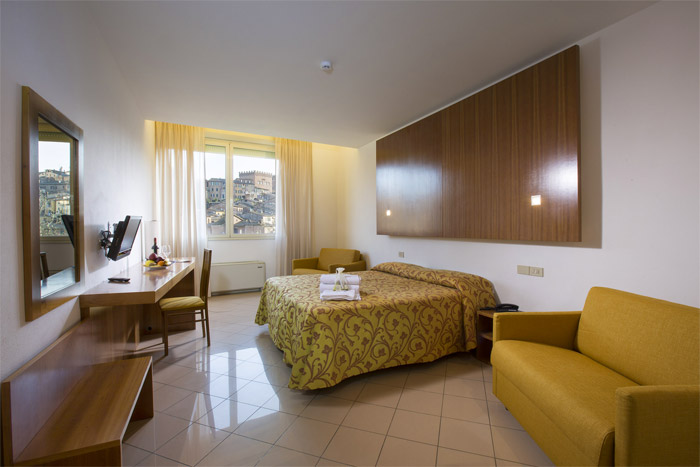
Location and atmosphere
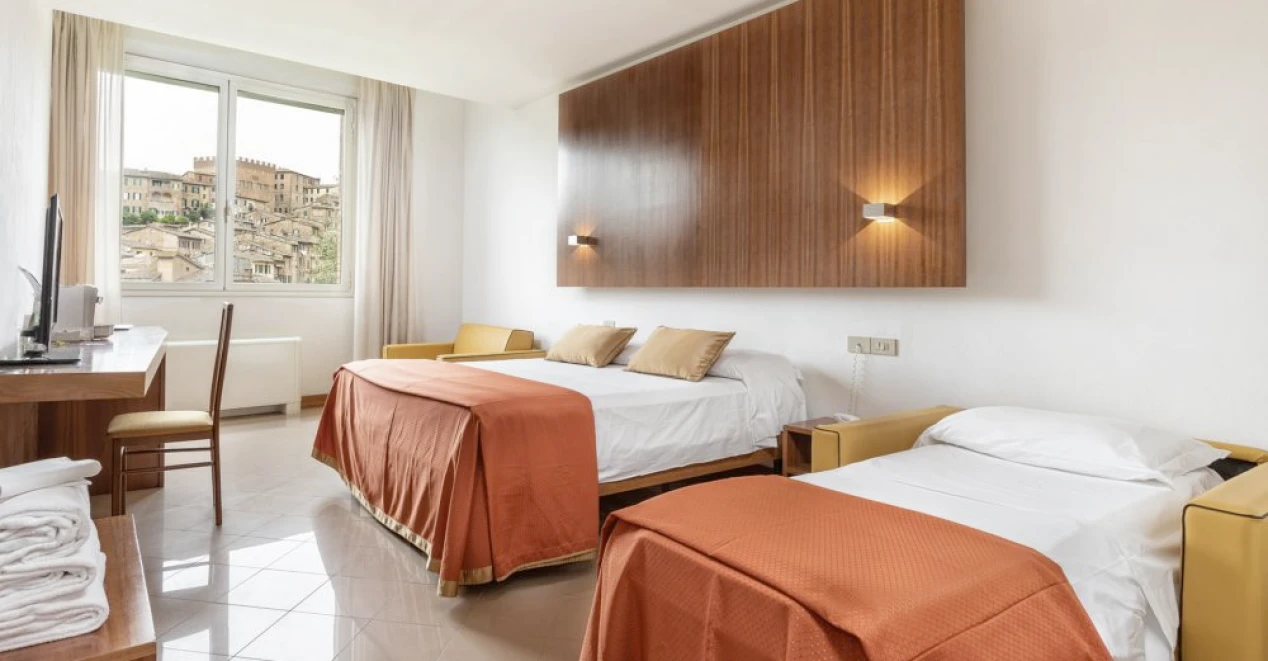
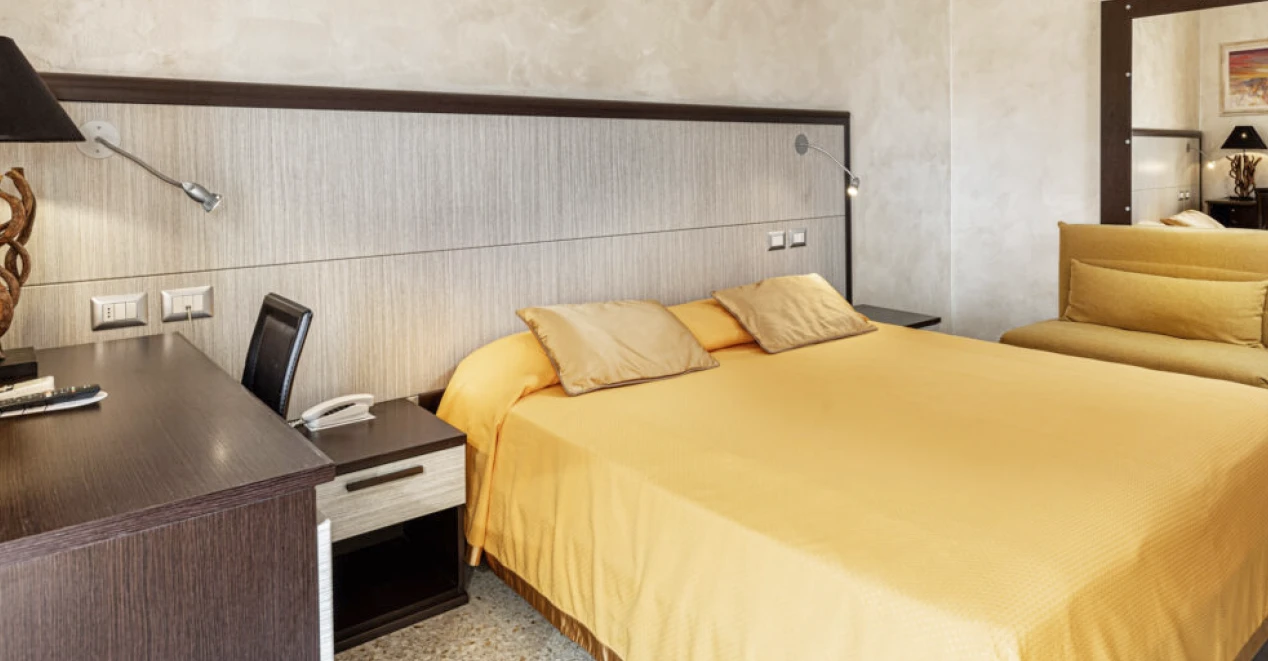
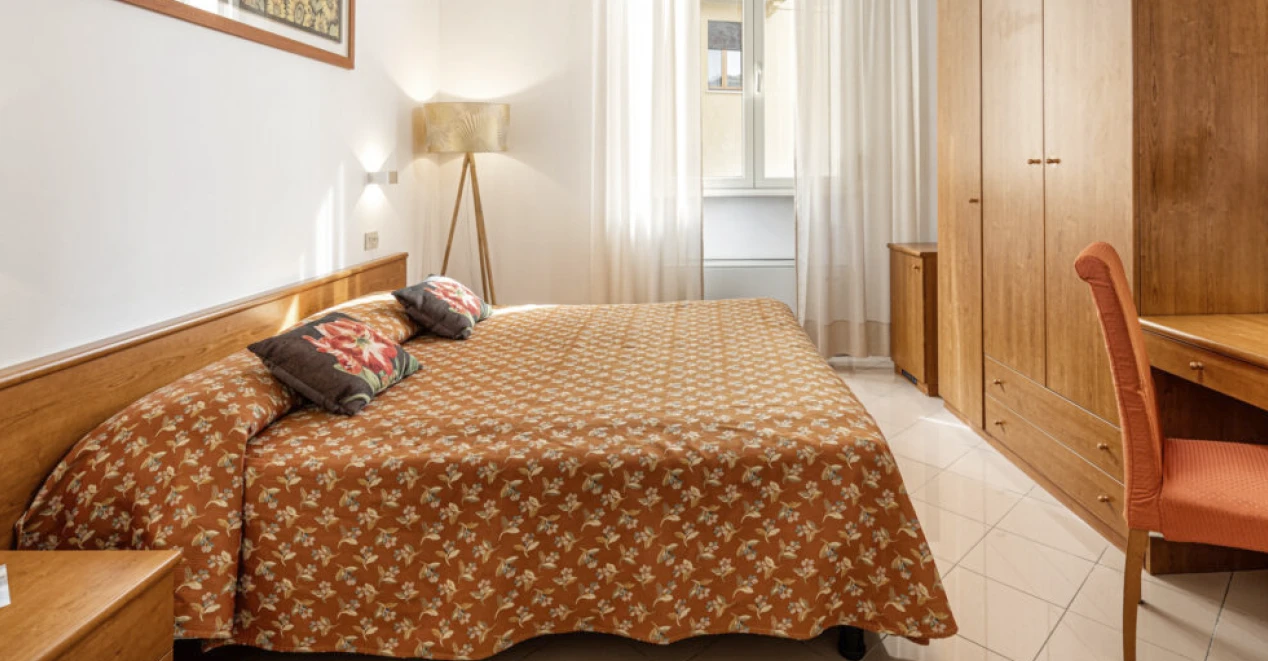
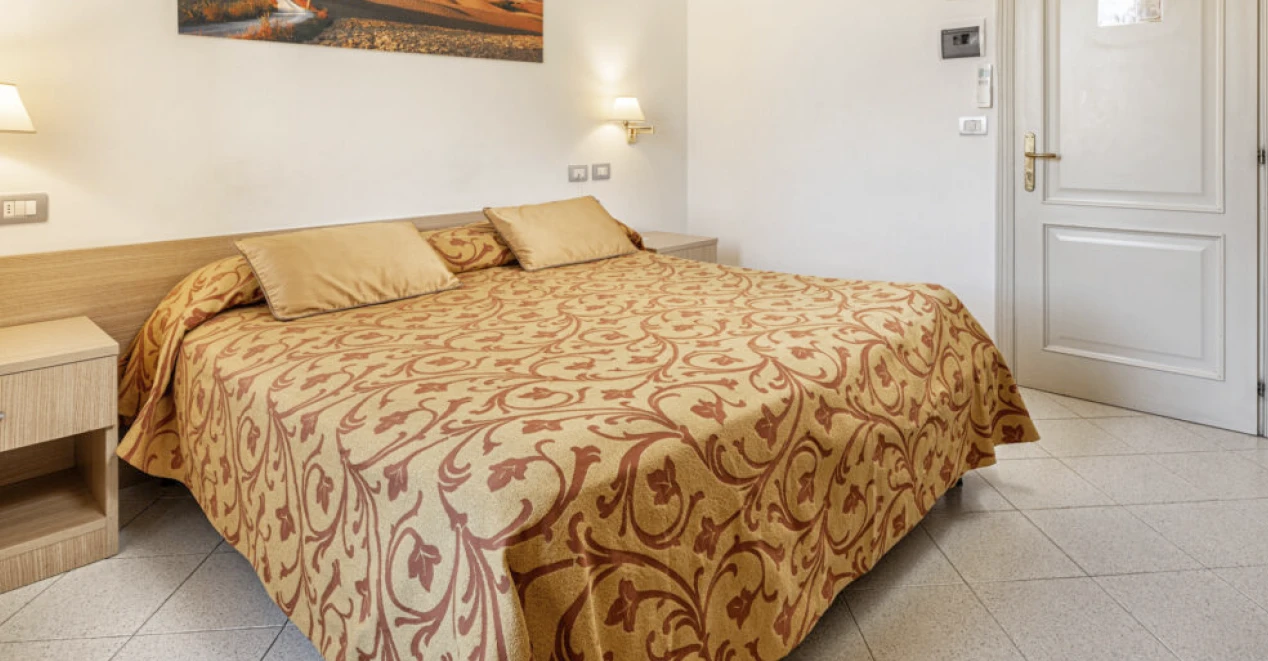
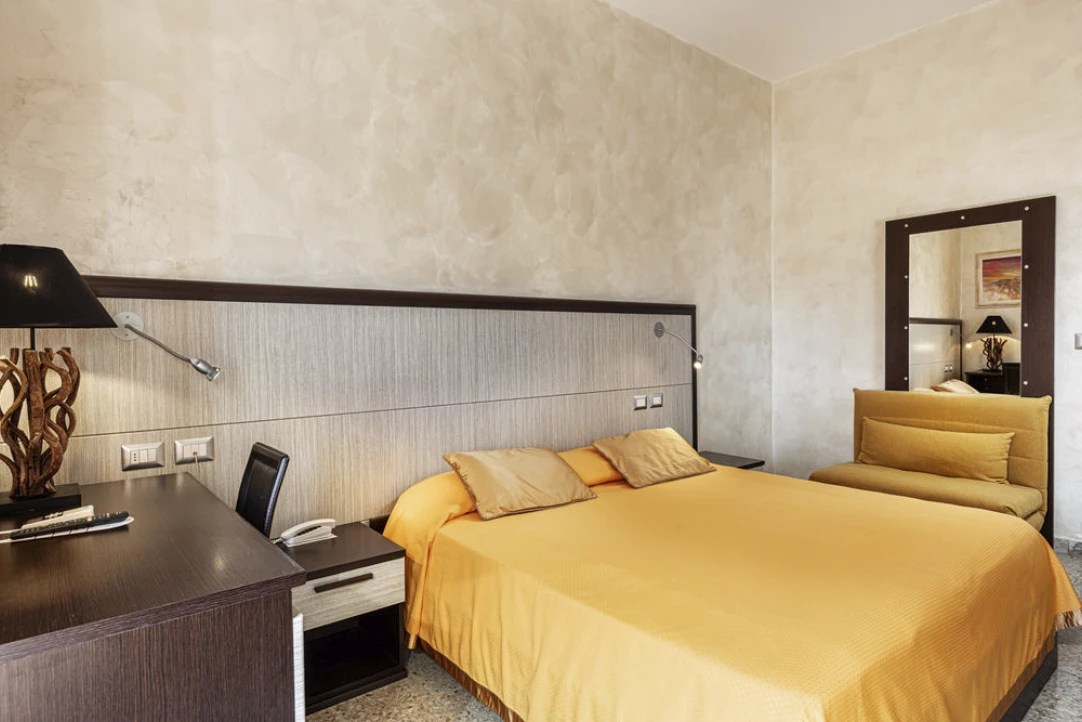
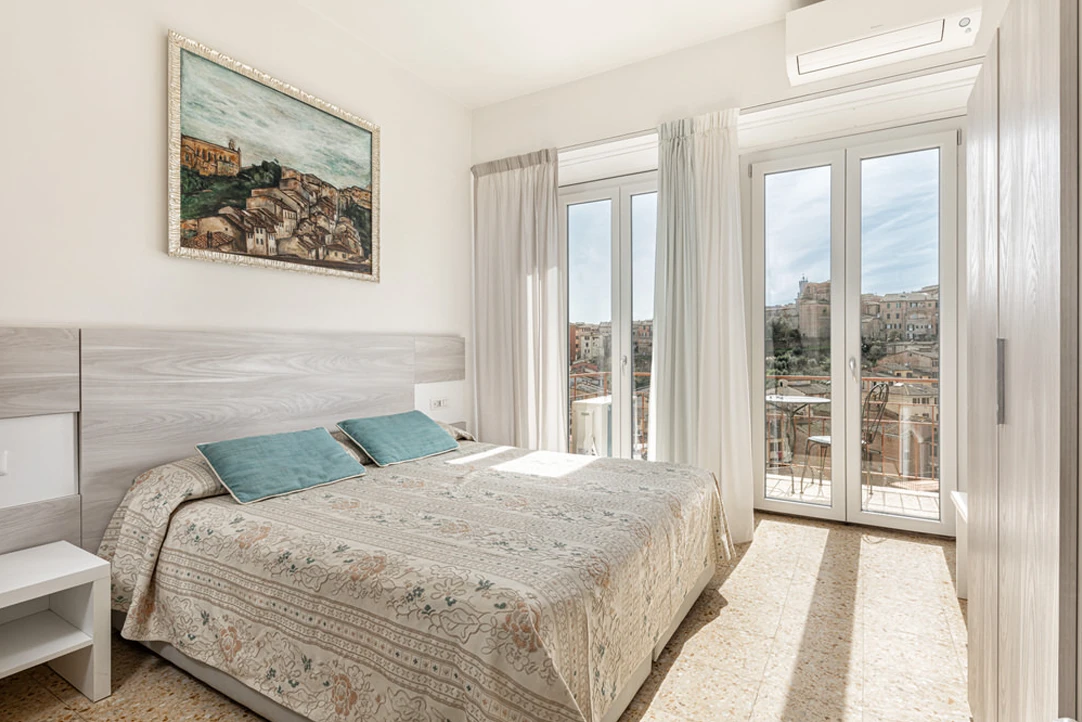
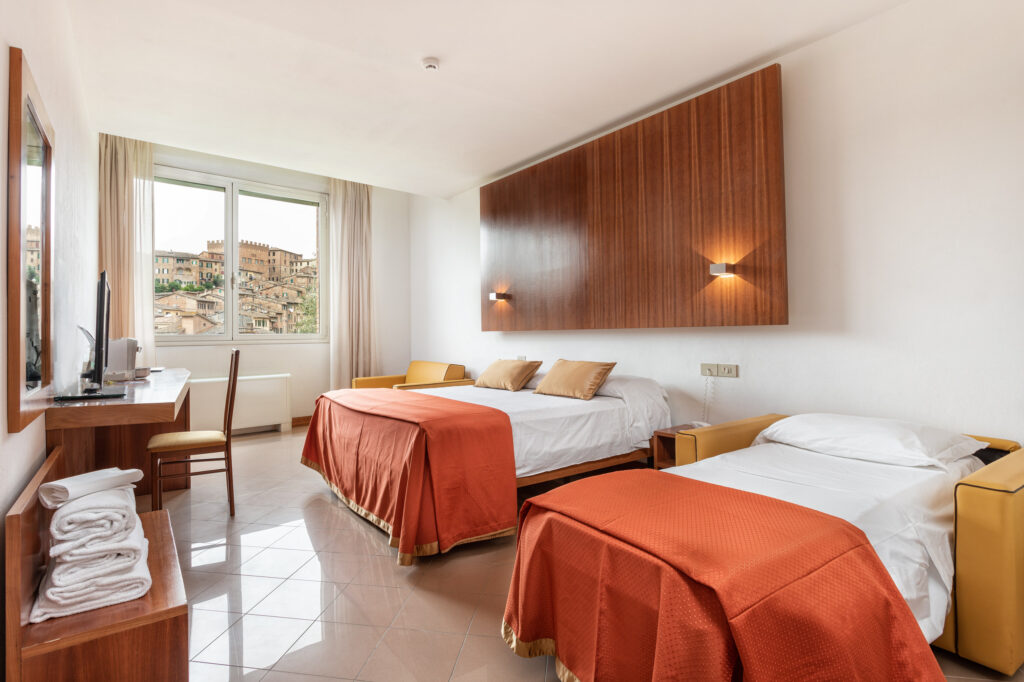
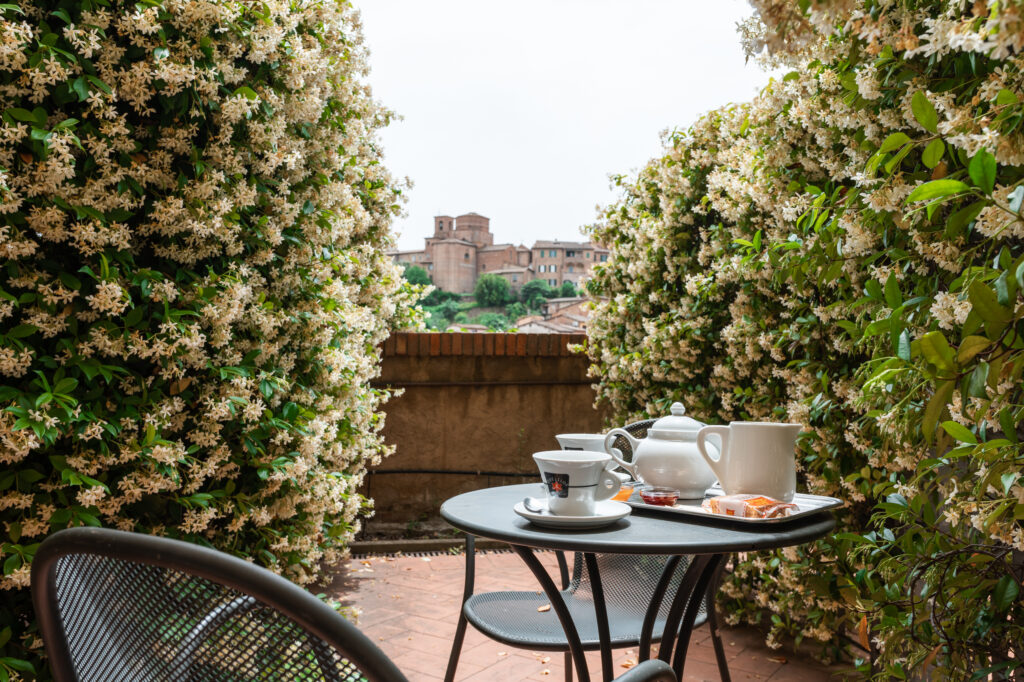
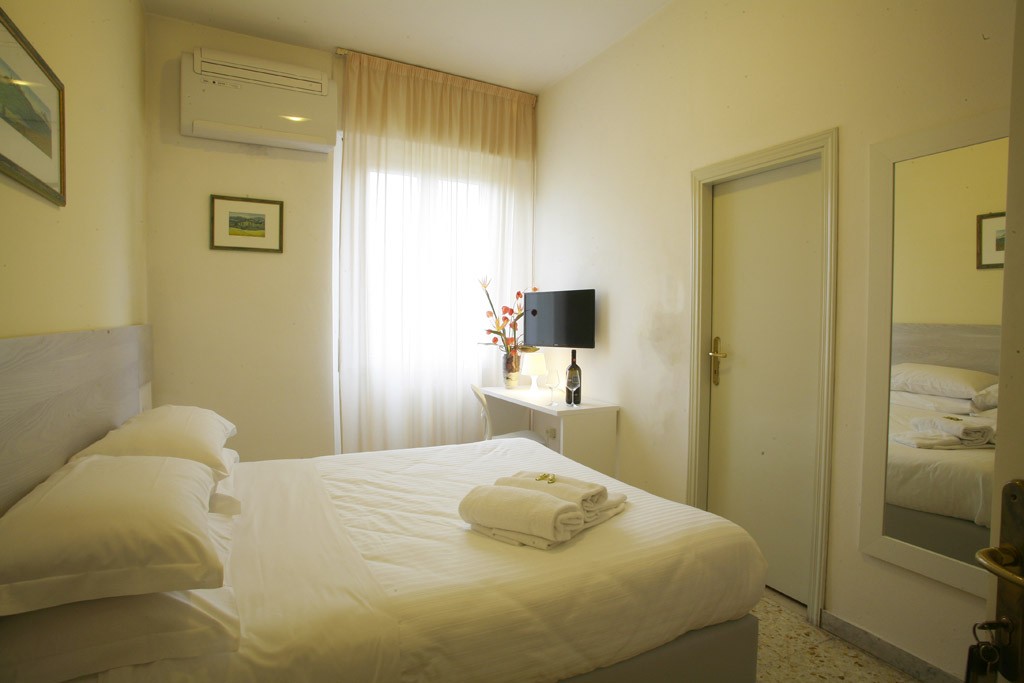
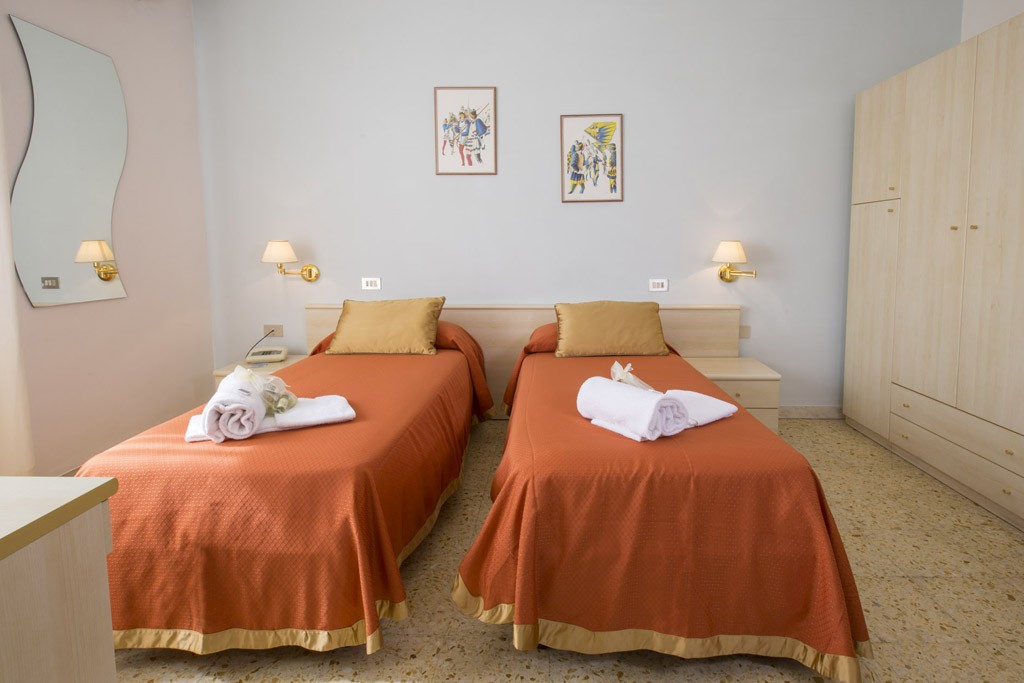
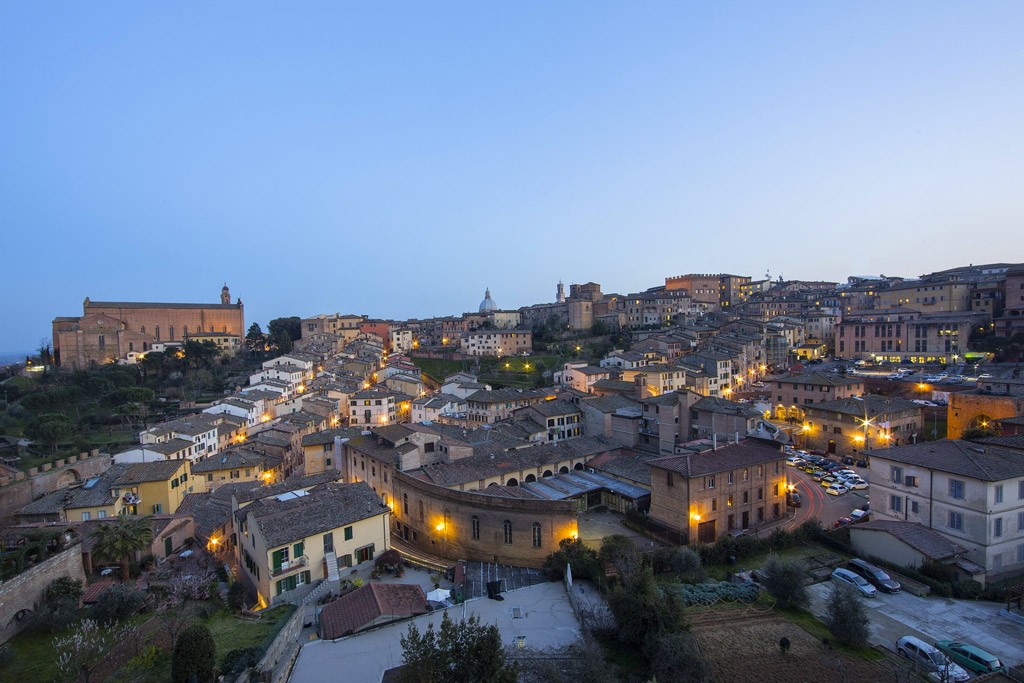
After touring the gates, you’ll need a comfortable base. Hotel Minerva is a charming three‑star hotel in Via Garibaldi 72, just outside the ZTL and close to Porta Camollia . Within a 10–15‑minute walk you can reach Piazza del Campo, the Duomo, Basilica di San Francesco, Fortezza Medicea and many of the gates . The hotel’s interior blends tradition and art: terracotta floors and exposed beams evoke Tuscany while contemporary works by local artists adorn the walls . It houses a permanent contemporary art gallery . Rooms range from Easy Economy to Elegant Standard and spacious Junior Suites; many offer panoramic views over the medieval rooftops and even the nearby gates .
Services
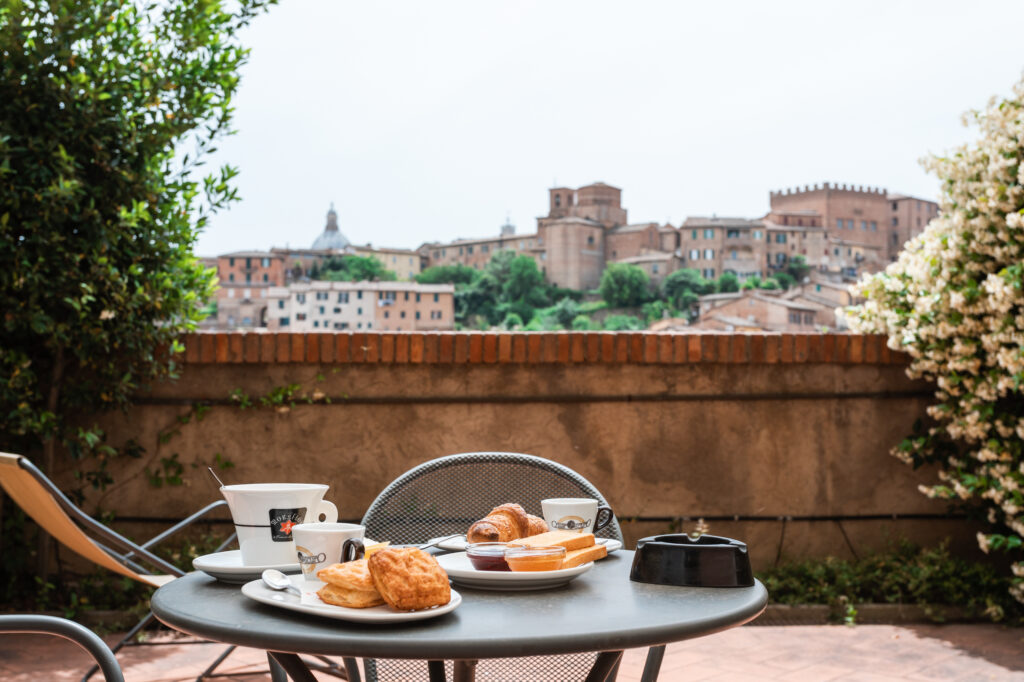
Amenities include free Wi‑Fi, flat‑screen TVs, minibars, safes and modern bathrooms. Breakfast is a generous buffet served in the dining room or garden, featuring homemade cakes, organic jams, Tuscan cold cuts and cheeses . A rare advantage is the hotel’s covered car park with 20 spaces, connected directly to the building; it allows guests to park securely and then explore the city on foot . The hotel is family friendly, providing cots, bottle warmers, sterilisers and a playroom, and is close to parks such as the Orto de’ Pecci . Business travellers can use the meeting room for up to 40 people . The staff is renowned for its friendliness and local knowledge . Special services include guided tours, wine tastings and seasonal packages .
Advantages for gate tours
Staying at Hotel Minerva places you literally on the gate trail. Porta Ovile is just 130 metres away; a short walk up Via Garibaldi leads to Porta Camollia . Some rooms have views of the gates. The central location allows you to start at Camollia and Ovile, return for rest, and continue to Pispini and Romana—all without needing transport . Reasonable room rates (around €60–150 per night) and direct booking deals add value .
Suggested itineraries
Itinerary 1: Gates of the Terzo di Camollia (north‑east)
- Start: Hotel Minerva / Porta Ovile. Reach Porta Ovile in 2 minutes; admire the fresco inside and, if you wish, detour 100 m outside the gate to see the modern Pescaia fountain .
- Porta Camollia: Walk up Via Garibaldi to Porta Camollia (5 minutes). Read the Cor magis tibi Sena pandit inscription and look for the Antiporto ruins nearby .
- Fortezza Medicea (optional): From Porta Camollia, detour left along Viale Vittorio Veneto to the fortress (10 minutes) for panoramic views .
- Porta Pispini: Return along Via Camollia and cross the city via Via Montanini, Banchi di Sopra, Piazza del Campo and Via Pantaneto to Via dei Pispini (about 20 minutes). Admire the gate and the Peruzzi bastion; enjoy the small garden outside .
- Lunch: Nearby eateries include Osteria da Gano and La Taverna di San Giuseppe .
Itinerary 2: Gates of the Terzo di San Martino (south)
- Start: From Porta Pispini, walk south along the walls or via Pantaneto to Porta Romana in about 10 minutes . Observe iron hooks for the portcullis and fragments of frescoes, and see the stone she‑wolves outside .
- Porta Tufi: From Porta Romana, follow the walls or streets back towards the Duomo and down Via di Stalloreggi to Porta Tufi (15 minutes). Appreciate its quiet surroundings and three arches .
- Porta San Marco: Take the walkway along the walls from Porta Tufi to Porta San Marco (about 10 minutes) . Imagine its missing half and enjoy gelato at Gelateria Il Pinguino just inside .
- Porta Laterina (optional): From Basilica di San Francesco, descend Via Paolo Mascagni to Porta Laterina for a quick visit .
- Return: From Porta Laterina or San Francesco it is only 5–7 minutes back to the hotel .
This circular itinerary covers most of the gates and passes by many of Siena’s highlights; it can be completed in a day (5–6 km) or split over two days . Cycling enthusiasts can follow stretches of the perimeter on an external cycle‑pedestrian path; a route called Pedali sulla Francigena runs from Porta Camollia to Porta Tufi .
Frequently asked questions (Q&A)
- How many gates remain? Of the roughly 39 gates mentioned in 14th‑century records, about ten main gates survive (those described here plus minor arches) .
- Which is the oldest gate? Porta Fontebranda (1230–1257) is the earliest still standing, while Porta Camollia existed earlier but was rebuilt in 1604 .
- Which is the largest? Porta Romana has the most imposing dimensions, with a wide arch and extended curtain wall. Its former drawbridge made it even more monumental .
- Why were there frescoes inside the gates? Siena often placed sacred images of the Madonna or patron saints on gates to protect the city and greet travellers .
- Were the gates closed at night? Yes. Until at least the 18th century the gates were shut at sunset and reopened at dawn; only special permits allowed entry at night, ensuring security .
- Can you walk the entire wall circuit? Not continuously. Some sections are accessible via urban paths, such as from the Fortezza to Porta Pispini and from Porta Tufi to Porta San Marco. A complete circuit requires combining roads and paths (about 7 km) .
- Where can you view multiple gates at once? Panoramic points include the terrace of Santa Maria dei Servi, the bastions of the Fortezza Medicea and the Facciatone of the Duomo. From these you can spot various gates dotted along the walls .
Nearby attractions from Hotel Minerva
Within minutes of the hotel are many sights:
- Basilica di San Francesco (5 minutes) – Gothic church housing fragments of frescoes from Porta Romana and Porta Pispini .
- Oratory and House of Saint Catherine (8 minutes) – spiritual complex built around the saint’s home .
- Fontebranda (10 minutes) – medieval fountain with three Gothic arches; a cool oasis .
- Fortezza Medicea (13 minutes) – 16th‑century fortress and park with the Enoteca Italiana; superb sunset views .
- Pinacoteca Nazionale (12–15 minutes) – museum with the richest collection of Sienese 14th–15th‑century painting .
- Orto de’ Pecci (15 minutes) – medieval garden and urban park with animals .
- Via Camollia (2 minutes) – lively street with shops, bars, artisans and enotecas; features San Pietro alla Magione church and Renaissance palazzi .
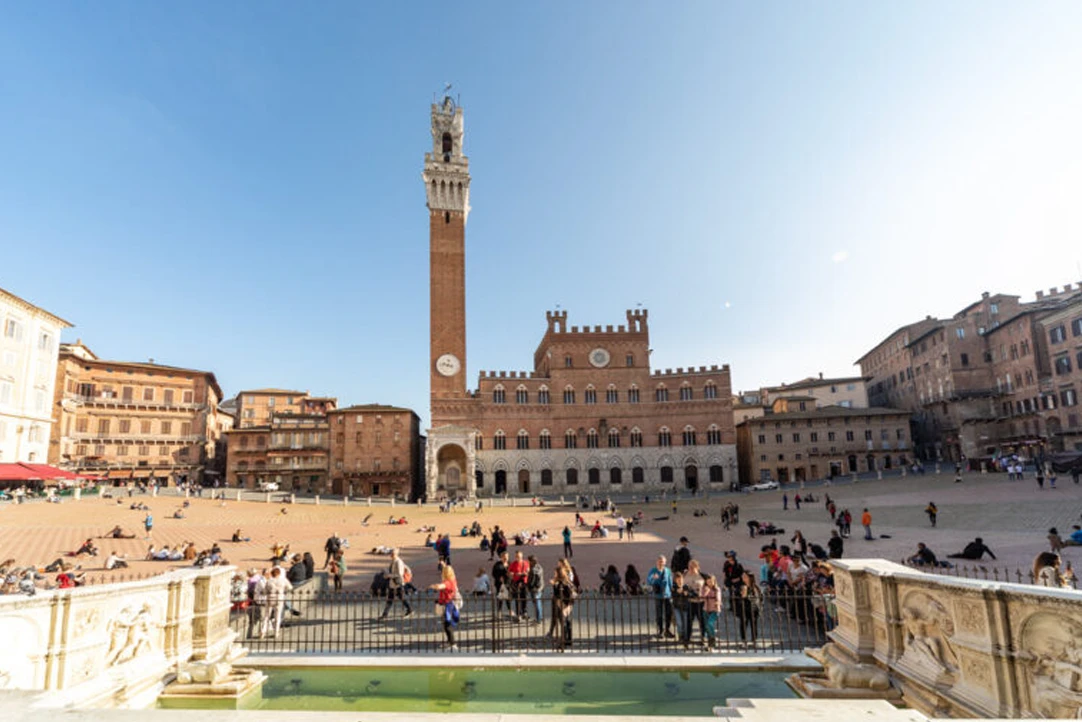
These attractions, along with the gates, can be combined flexibly depending on your interests .
Conclusion
Siena’s gates are far more than openings in a wall: they are storytellers. Each narrates episodes of war, devotion, everyday life and independent pride . Exploring them helps you grasp the soul of Siena: from the defiance against Florence to the sacred images that protected travellers, from the welcoming motto of Porta Camollia to the industrious wool‑workers of Fontebranda. After a day full of history, Hotel Minerva offers modern comfort within this medieval atmosphere, making exploration easy and restful . Siena invites you to experience the city as an open‑air museum where curiosity guides your steps. Walk through these gates and you become part of a living tradition . As you stand under Porta Camollia at dusk and read the glowing inscription “Siena opens its heart to you,” you will understand why this city continues to welcome travellers with open arms .