
Introduction
Siena is a medieval city with a timeless charm. Its cobbled streets and sunset‑tinged bricks tell stories of saints, art and centuries‑old traditions. One of Siena’s most illustrious figures is Saint Catherine of Siena, patron of Italy and Europe, whose spiritual legacy left a profound mark on the city. This guide will accompany visitors through the Caterinian sites—starting from the sanctuary preserving the saint’s birthplace and the basilica that holds her relics, and moving on to other places associated with her life—offering historical context, curiosities and practical advice .
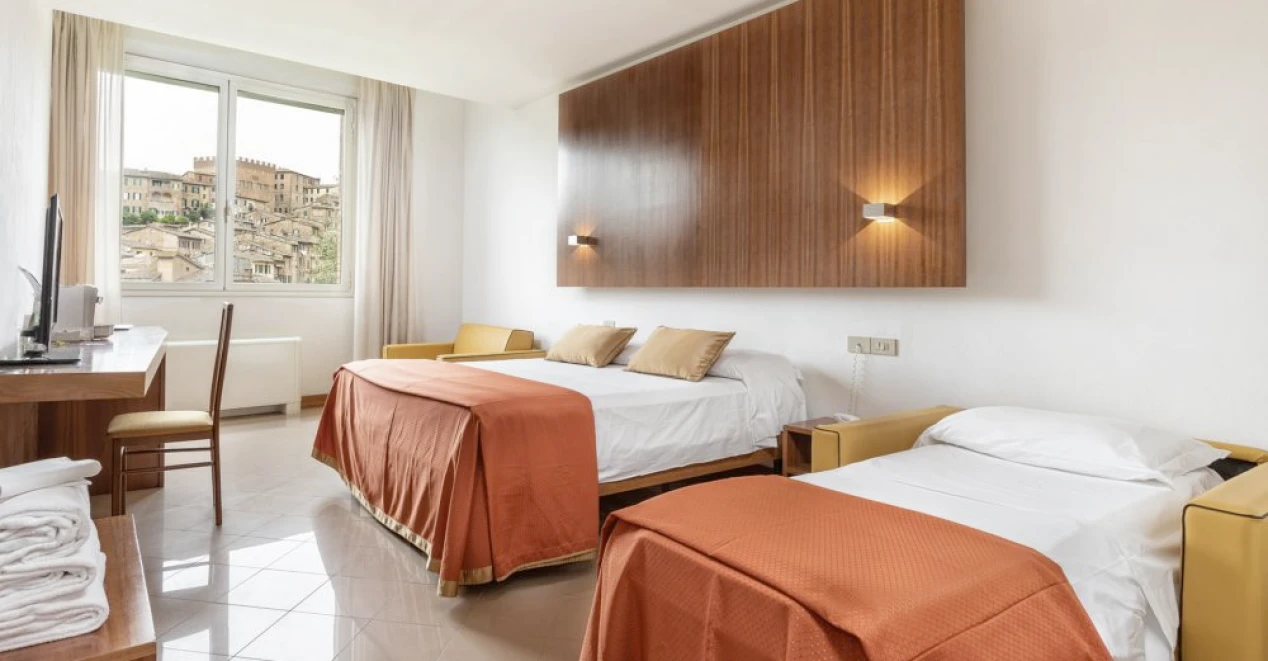
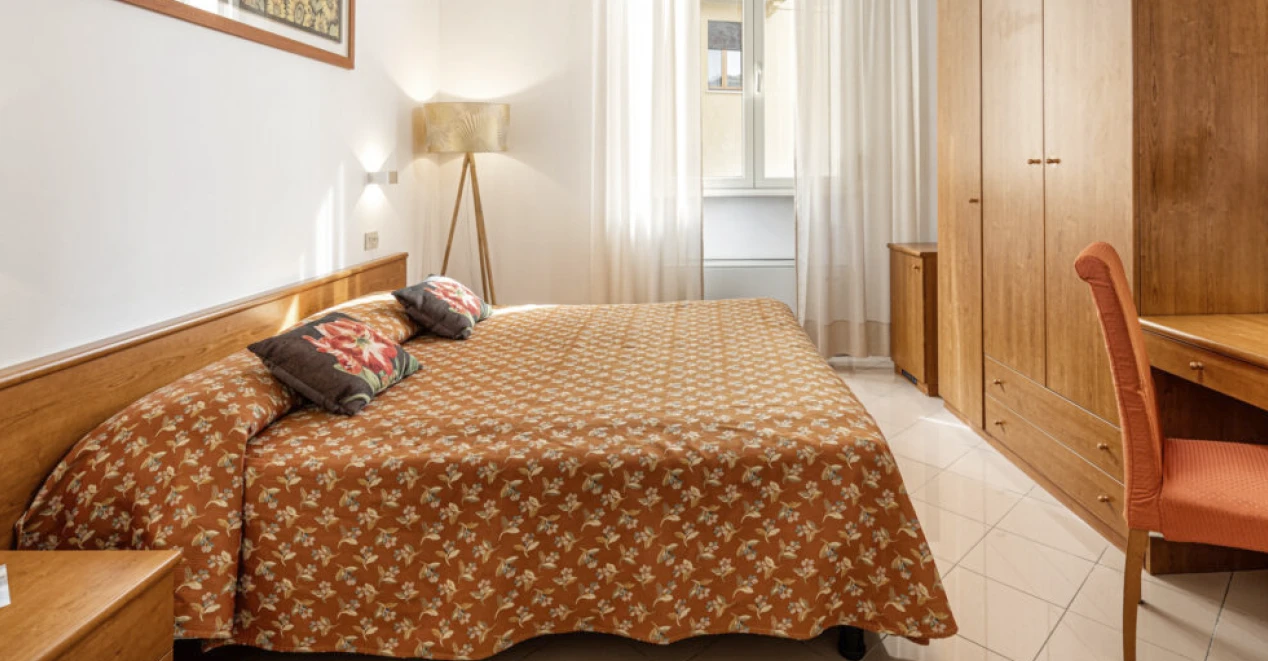
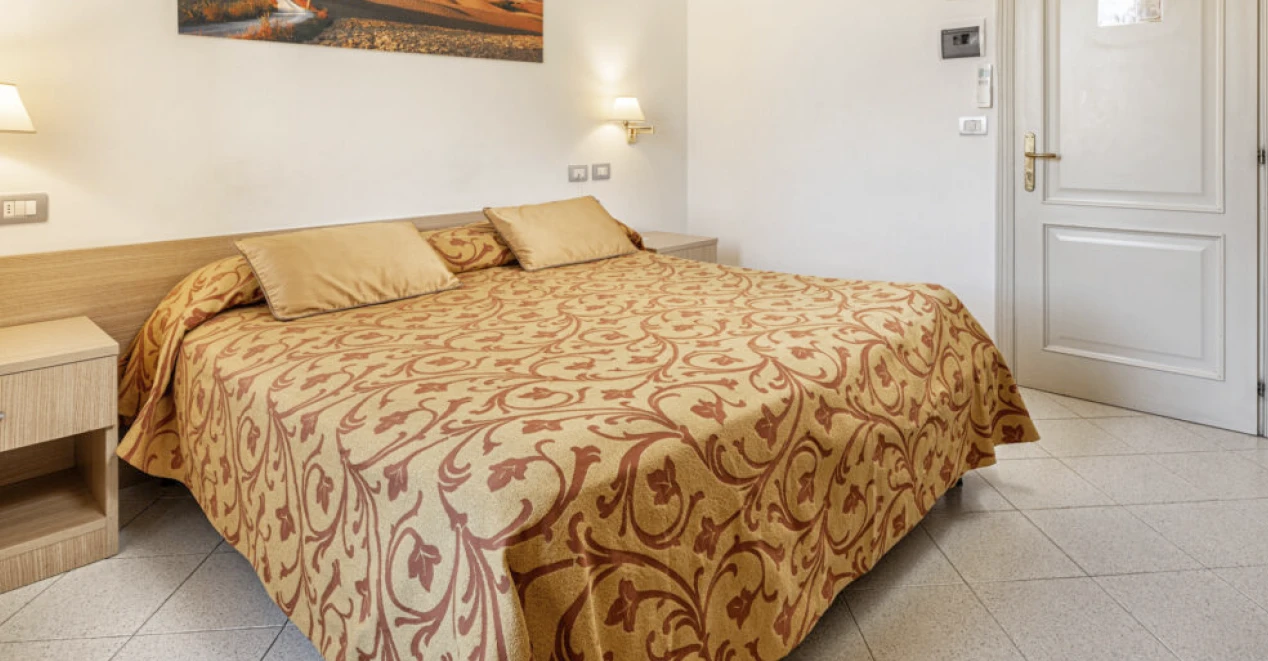
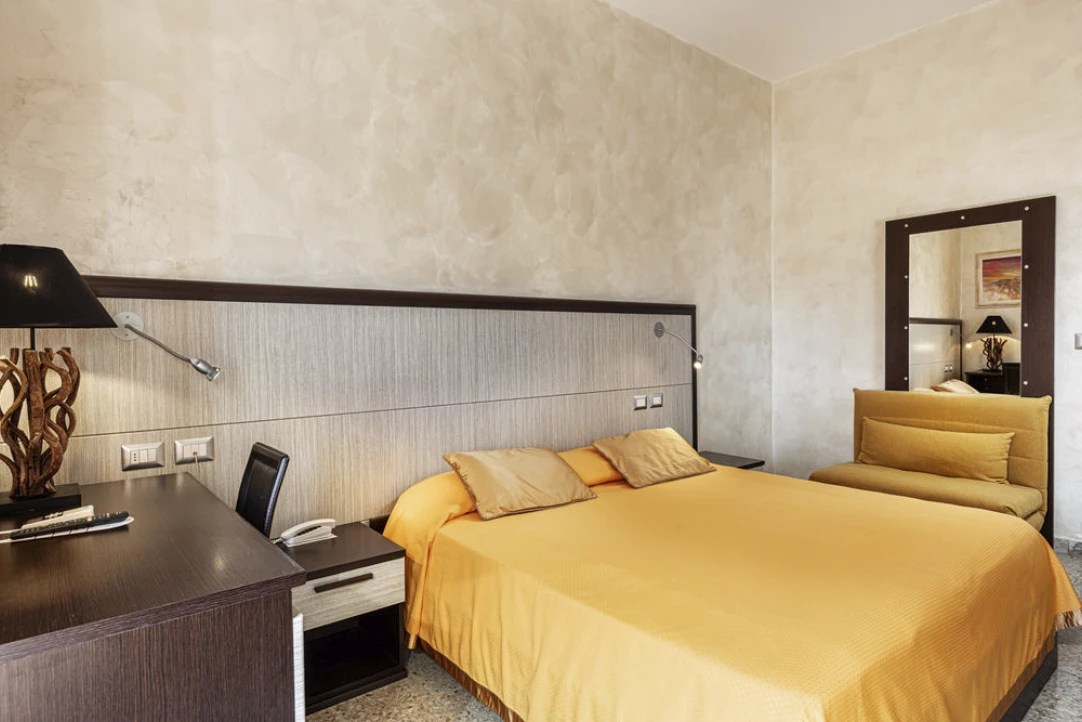
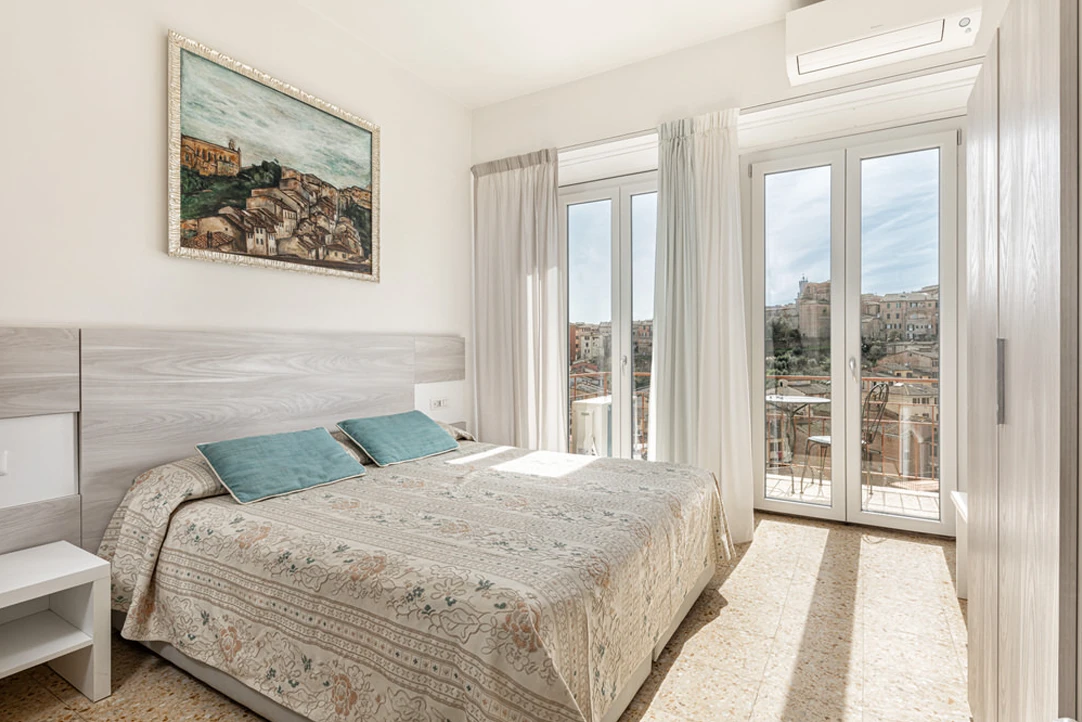
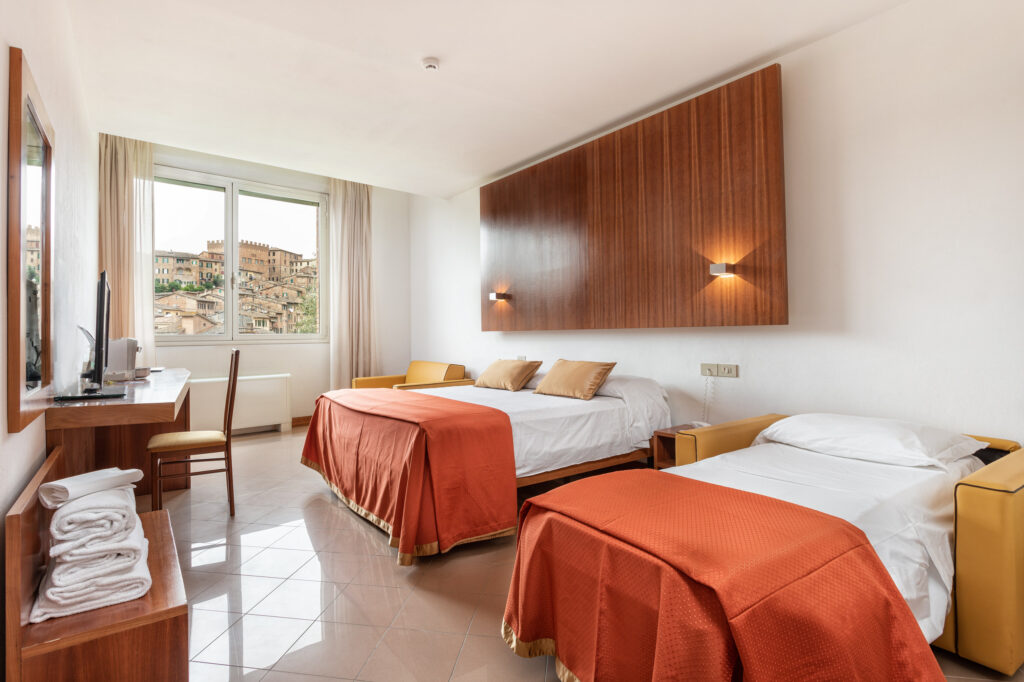
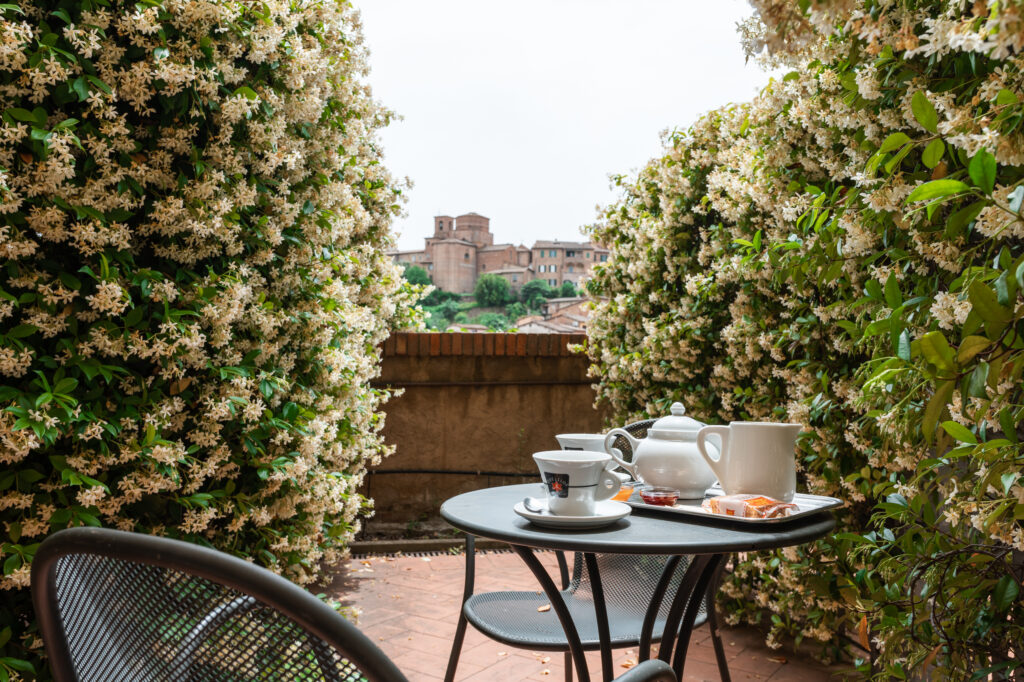
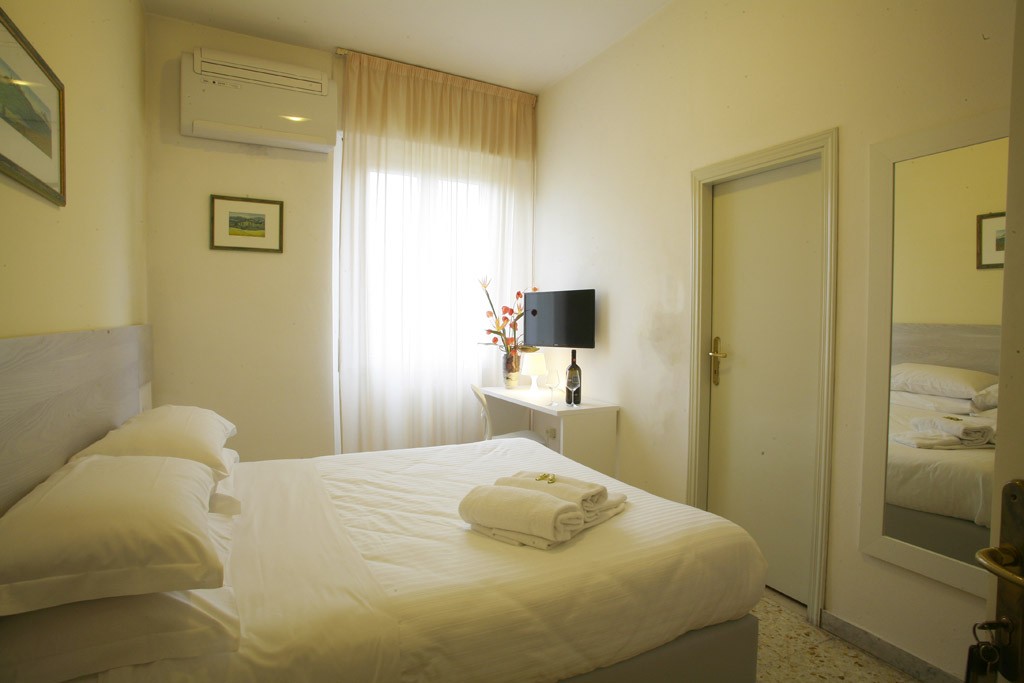
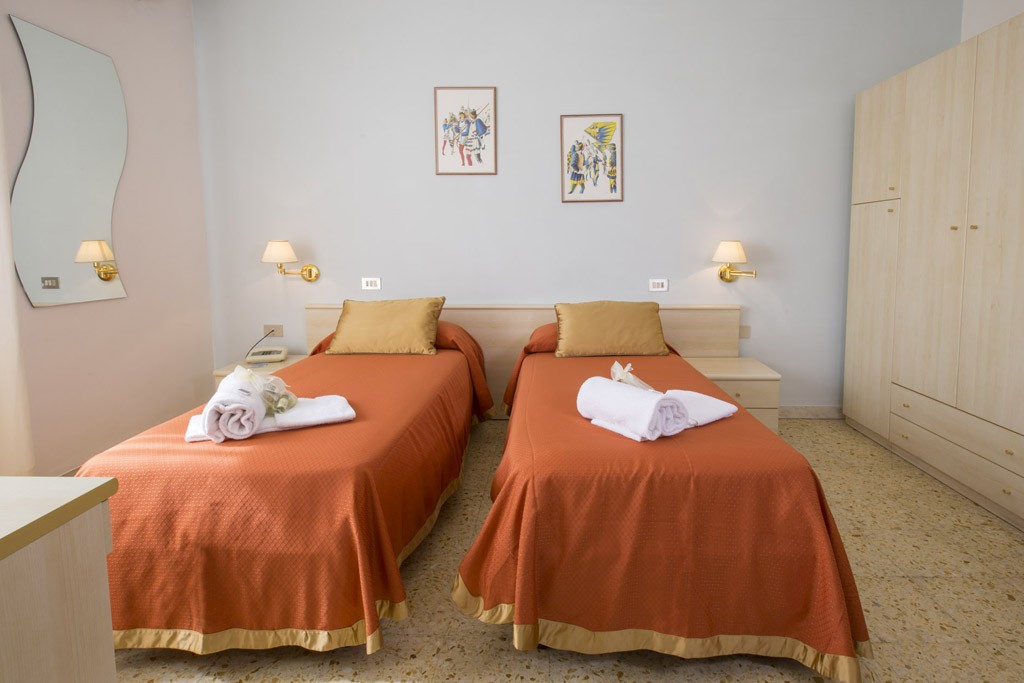
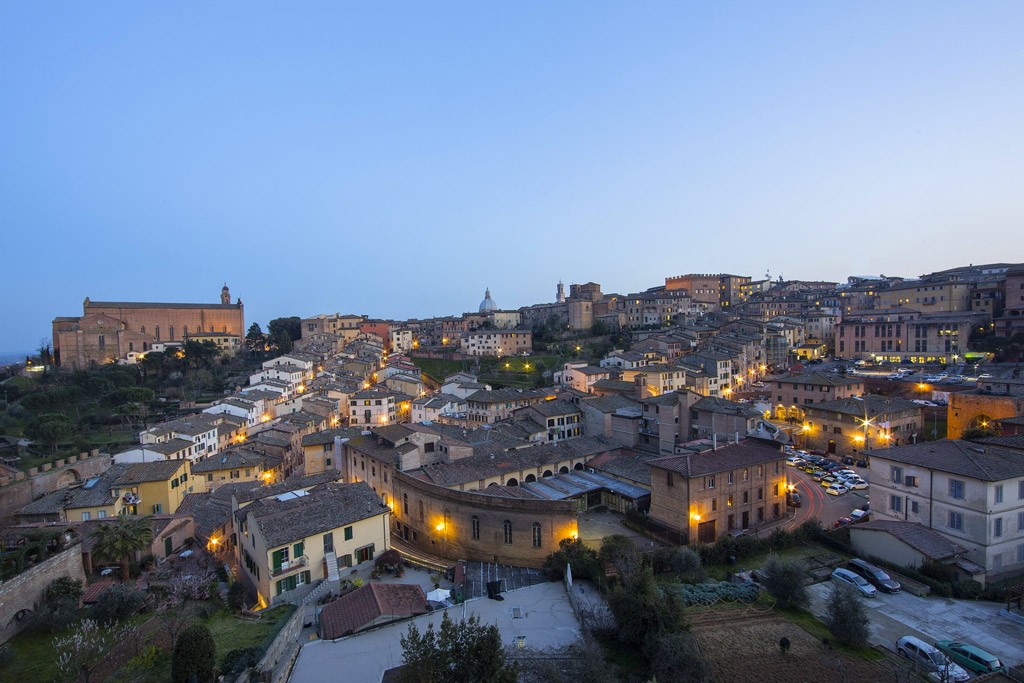
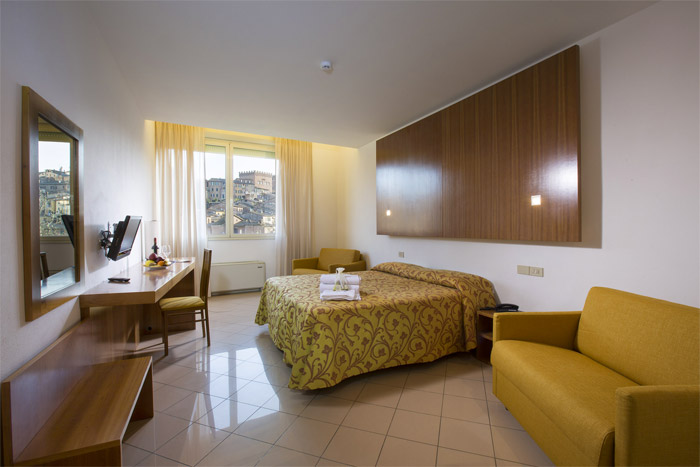
Hotel Minerva will be our ideal base for exploring these holy sites and Siena itself. Located within the ancient walls near Porta Camollia, Hotel Minerva is only about ten minutes’ walk from Piazza del Campo and the main attractions . This historic three‑star hotel combines authentic charm with modern comforts, welcoming guests with warmth and panoramic rooms overlooking the medieval rooftops. Its central position allows immersion in the atmosphere of Siena and, above all, easy access to Catherine’s places: the Basilica of San Domenico and the Sanctuary of Saint Catherine are around a ten‑minute walk away . The hotel also offers private parking just outside the limited traffic zone—an advantage for those arriving by car—and spacious family rooms, so that if children need a nap or a break during the day you can return to the hotel in moments .
In the following sections we will explore the life of Saint Catherine, propose a complete itinerary through the sanctuary, basilica and other Caterinian sites in Siena, provide tips for extending the visit to the surroundings, and conclude with a FAQ section—practical questions and answers about schedules, costs, transport and curiosities—to help plan your trip . Ready to follow in Saint Catherine’s footsteps? Let’s begin!
Saint Catherine of Siena: historical outline and spiritual importance
Saint Catherine of Siena (1347–1380) is a central figure of the Italian Trecento and of the Catholic Church. Born on 25 March 1347 in Fontebranda, a working‑class district of Siena, she was the daughter of the dyer Jacopo Benincasa and Lapa Piacenti . From childhood she showed an extraordinary spiritual vocation: at only seven years old she had her first mystical vision—she saw Christ in pontifical robes sitting on a throne above the Basilica of San Domenico, accompanied by Saints Peter, Paul and John the Evangelist . This event marked her deeply, prompting her to devote herself entirely to God. As a teenager she refused the marriage arranged by her family and, at 16, entered the Dominican Third Order, taking the habit of the Mantellate . She lived for years in prayer, penance and service to the needy, gathering around herself a community of followers affectionately called the “Caterinati” .
During her short life—she died at 33, the same age as Christ—Catherine stood out for her active charity and political‑religious involvement. She assisted the sick and poor daily at the Hospital of Santa Maria della Scala, where she gained fame as an tireless volunteer filled with love . At the same time she maintained a rich correspondence with people of all ranks—craftsmen, soldiers, cardinals and even popes. A convinced supporter of Church unity, Catherine played a key role in persuading Pope Gregory XI to return from Avignon to Rome in 1377, ending the so‑called “Avignon captivity” . In her final years she worked to heal the Western Schism, strongly supporting the legitimate Pope Urban VI and suffering greatly over the divisions within Christianity . Her letters and her main work, The Dialogue of Divine Providence, bear witness to a deep theology lived with passion .
Catherine’s renown of holiness led to rapid veneration. She was canonised in 1461 by Pope Pius II Piccolomini (also a Sienese) . Over the centuries her spiritual prestige received extraordinary recognition: in 1939 Pope Pius XII proclaimed her Patron of Italy (together with Saint Francis) ; in 1970 Paul VI raised her to the rank of Doctor of the Church—she was the first woman ever to receive this title ; and in 1999 John Paul II appointed her Patron of Europe . These honours testify to the universality of Catherine’s message, whose spirituality based on love of God and neighbour has transcended the centuries . She is still a model of lay holiness (she was a tertiary, not a nun), of female engagement in the Church and of peacemaking in times of conflict .
Visiting Catherine’s places in Siena thus means retracing her human story and capturing the soul of the city in the Trecento. As a biographer wrote, “the saint’s passage indelibly marked the very stones of Siena, its streets and buildings.” We will now discover these places—the sanctuary and home, the basilica, fountains and oratories—to relive Catherine’s extraordinary story and the mystical atmosphere that still resonates there .
The Shrine of Saint Catherine (Birth House of the Saint)
The portico and courtyard of the Sanctuary of Saint Catherine in Siena (Casa Santuario)
The Sanctuary of Saint Catherine lies in the Contrada dell’Oca, on Costa di Sant’Antonio, the steep street that climbs from the medieval fountain of Fontebranda toward San Domenico . This complex of sacred buildings incorporates the ancient house of the Benincasa family, where Catherine was born and lived with her large family of dyers . Immediately after the saint’s canonisation, in 1466, the Municipality of Siena purchased the birth house—spurred by popular devotion—so it could be opened to worship and preserved forever . In the centuries that followed, thanks to lay confraternities and generous donations, the simple dwelling was gradually transformed into a true sanctuary enriched with loggias, chapels and oratories .
Today the Sanctuary presents itself as an intimate place full of spirituality, ideal for understanding the life and mystical experiences of the young Sienese woman who became a saint . Access is through the evocative Portico of the Municipalities, built in 1939 when Catherine was proclaimed patron of Italy . This portico, adorned with coats‑of‑arms, was so named because it was built with bricks donated by almost all the Italian municipalities, in homage to the beloved saint . Passing through the portico, you enter a small medieval courtyard surrounded by arches (the one seen in the photo) from which one reaches the various rooms of the sanctuary .
Inside the sanctuary—free and open for visitors—you will find four main oratories, each linked to episodes of Catherine’s life :
- Church of the Crucifix (Upper Oratory): This is the spiritual heart of the sanctuary . It houses the celebrated wooden crucifix from which, according to tradition, Saint Catherine received the stigmata in 1375 . It is a medieval crucifix from the Sienese school; the saint, while praying, saw five rays of light issue from it, striking her and imprinting on her the wounds of Christ. The walls’ frescoes depict the saint’s ecstasies and swoons (works by the Sodoma) and help create a mystical atmosphere . This oratory is considered the principal chapel: at the centre, behind a grille, stands the small cell where Catherine rested and prayed, preserving the stone she used as a pillow . Here she spent her “nights in prayer” after caring for the sick, and it is easy to imagine her gathered in contemplation .
- Kitchen Oratory: Located in what was the Benincasa family’s ancient kitchen . The remains of the domestic hearth are preserved here; according to an hagiographic account, Catherine fell into the fire in a mystical ecstasy but came out unharmed . The oratory commemorates the saint’s humble daily life: here she once cooked for her family and baked bread to give to the poor . Today you can see minor relics and period objects in a simple room inviting reflection on domestic virtues elevated to sanctity by Catherine .
- Chamber Oratory (or St Catherine’s Room): Contains the small cubicle where Catherine slept and prayed since childhood . It is perhaps the most moving space: entering, you see the dark stone on which the saint rested her head as a pillow—a symbol of her asceticism and voluntary penance . The walls are adorned with sacred images; silence is profound and many pilgrims stop for personal prayer. Imagining Catherine as an adolescent, who served the sick by day and prayed on that stone by night, helps one grasp the intensity of her faith .
- Church of Saint Catherine in Fontebranda (also called Oratory of the Dye Works): This small place of worship next door is today the seat of the Contrada dell’Oca . Originally it was probably the room where Catherine’s father dyed clothes (hence the name Tintoria). Popular devotion transformed it into an oratory dedicated to the saint. Today it belongs to the contrada where Catherine was born (the Contrada dell’Oca, whose symbol is a white goose) and is not always open to the public, but from outside you can see its simple façade . It represents another link between the saint and the working‑class neighbourhood that gave her birth .
Visiting the Sanctuary of Saint Catherine is a moving and intimate experience: the setting is modest but steeped in mysticism. One can almost feel the presence of the young Catherine within these walls . Entrance is free every day (typically from about 8 am to 6 pm); on arrival be prepared to descend a few steps to reach the inner courtyard since the house is built against the steep hillside . Appropriate clothing is recommended (it is still a place of worship): cover your shoulders and maintain respectful silence in the oratories . The complex is largely accessible for free; you may leave a donation if you wish, to support maintenance . Photography: generally permitted without flash in the courtyard and exteriors, but not in the more sacred chapels—for example it is forbidden to photograph the crucifix of the stigmata and the pillow cell .
After your visit, before ascending, look for any custodians or information panels in the courtyard or at the exit: there are often multilingual boards summarising Catherine’s life and explaining the locations . Notice also the frescoes and commemorative inscriptions in the portico—for example a plaque bearing words about the saint taken from the Legenda Maior by Blessed Raymond of Capua, her confessor and biographer . These details enrich the experience with historical curiosities .
Curiosities: Inside the sanctuary are preserved some objects linked to the saint, such as the lantern, the mantle and the small jar of essences with which she used to care for the sick . There is also an ancient bone fragment (a small part of Catherine’s scapula) kept here in a display case . Most of the saint’s relics are elsewhere, but Siena retains this “flake” precisely in her sanctuary, symbolising that a fragment of Catherine remains in her birthplace . After leaving the sanctuary, walk a few steps downhill toward nearby Fontebranda before continuing the itinerary: you will find yourself immersed in the same views Catherine saw every day—between the sound of the water at the fountain and the sight of the severe profile of San Domenico above you—truly a journey back to 14th‑century Siena .
Basilica of San Domenico (Caterinian Basilica)
View from below of the Basilica of San Domenico, also called the “Caterinian Basilica,” which dominates the medieval fountain Fontebranda in Siena.
Perched on a hill overlooking the city, the Basilica of San Domenico is one of Siena’s most imposing churches and plays a special role in Saint Catherine’s life. Built in solid brick starting in 1226 and enlarged in the 14th century , the basilica has a simple and austere Gothic architecture. Its sober, almost fortified forms—with a plain façade devoid of rich decorations—rise high above the valley of Fontebranda and seem to reflect the spirit of the Dominican friars, devoted to preaching and poverty . Not surprisingly it is also called the Caterinian Basilica, because of its very close association with the saint: Catherine participated in Mass here daily, received the habit of the Dominican Third Order in her youth, and in a chapel of this church she experienced some of her most intense mystical experiences .
Inside, the basilica is stark and solemn. A single large nave with exposed wooden trusses draws the eye toward the altar . This architectural simplicity enhances the preciousness of what the basilica holds: the most important relics of Saint Catherine . In a decorated chapel (the Chapel of the Vaults) stands the head relic of Saint Catherine—the so‑called Capo of the saint . It is the saint’s mummified skull, visible behind a grille above the side altar dedicated to her . Surrounding the relic, frescoes by Sodoma narrate episodes such as Catherine’s Ecstasy and the Swoon at receiving the stigmata, offering a highly evocative artistic context while the faithful and visitors stand in silence . Next to the head, displayed in a reliquary, is also a finger of Saint Catherine—another important relic venerated in Siena . Tradition says it is the right thumb, used to bless Italy and the armed forces during celebrations in honour of the saint . Alongside the finger are some cords (penitential instruments the saint used to discipline herself) and an ancient bronze bust that once contained the head, all enclosed in a modern artistic case by Sienese architect Sandro Bagnoli .
The relics arrived in Siena shortly after the saint’s death. Catherine died and was buried in Rome, in the Basilica of Santa Maria sopra Minerva, where her body still lies . In 1381 Pope Urban VI allowed the head to be taken and delivered to the Sienese, who solemnly carried it to San Domenico in 1385 in a procession attended even by Catherine’s mother, Monna Lapa . Since then the saint’s head has been deeply venerated in Siena, and every year on 29 April (her feast day) special celebrations take place: often the Archbishop of Siena holds the relic of the finger to impart a solemn blessing upon the city and the nation . This moment is deeply felt by the Sienese, who regard Catherine as their protector .
Besides the Caterinian relics, San Domenico houses various artworks connected with the saint. In the Chapel of the Vaults, in addition to the reliquary, one can see a fresco by Andrea Vanni—painter and contemporary friend of Catherine—depicting the saint in life alongside a devotee . It is considered a truthful portrait, painted while Catherine was still alive; it is thrilling to observe the saint’s features captured by someone who personally knew her . Also preserved are a painting by Francesco Vanni showing the saint freeing a possessed woman (an episode attributed to her intercession), an ancient wooden crucifix from the 14th century, and some seventeenth‑century canvases illustrating miraculous events after her death .
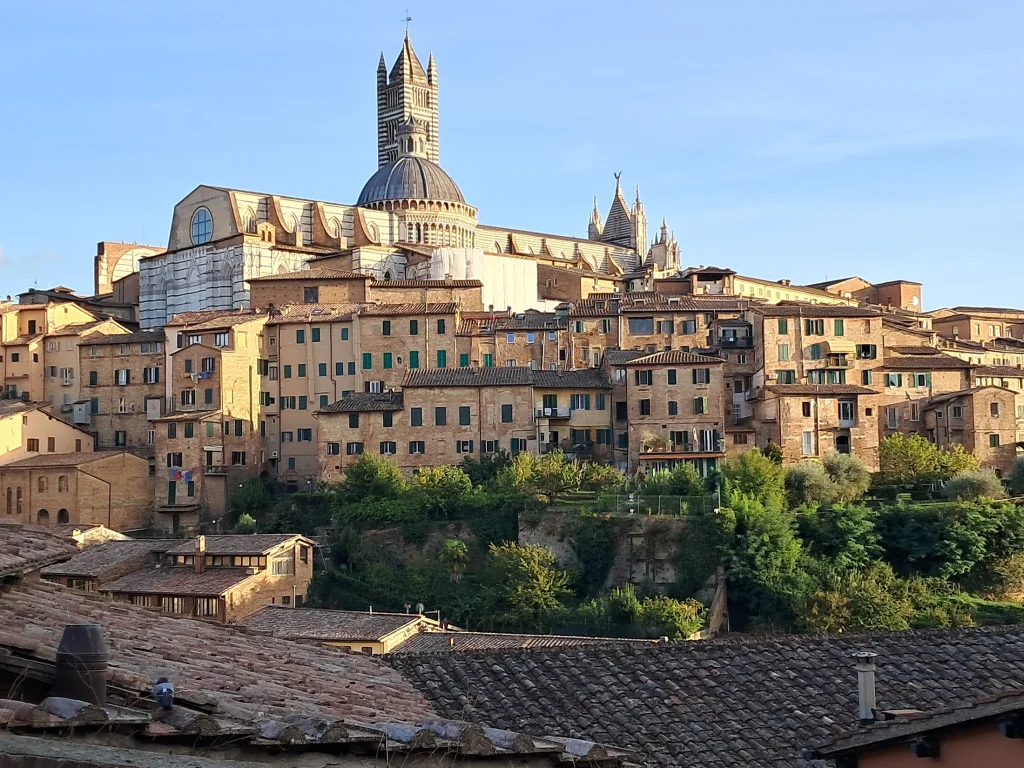
However, the most significant experience for pilgrims is to spend a few minutes before Saint Catherine’s altar . A votive lamp usually burns there and someone may be softly praying. Standing just a few steps from the relic of the head, knowing that from those lips came advice to popes and the words of the Dialogue, arouses a special feeling . Even non‑devotees sense the historical and spiritual value of the place . From the panoramic forecourt in front of the Basilica of San Domenico one also enjoys a splendid view of Siena: directly opposite, on the other side, rises the Duomo with its bell tower, and further away stands the Torre del Mangia . This is one of the most beautiful viewpoints at sunset, when the city is tinged with red and gold . A stop here also offers an overview of the Caterinian itinerary: below you will see the loggia roof of the Sanctuary of Saint Catherine nestled in the Fontebranda neighbourhood, and just below, the Gothic arches of Fontebranda itself . This scene summarises Catherine’s life: the urban monastery (San Domenico) above and the popular neighbourhood (Fontebranda) below, connected by the steep road Catherine walked daily .
Practical information: The Basilica of San Domenico is open every day roughly from 7:30 am until 6:30 pm, with a lunchtime closure around 12:30–2 pm . Admission is free (it is an active place of worship). During Mass (especially on Sunday mornings) tourist visits are suspended or limited, so plan your visit outside of worship times . Appropriate dress may be requested at the entrance (no bare shoulders or very short shorts) . Photography inside the basilica is generally permitted without flash, but it is prohibited to photograph Saint Catherine’s relics up close . Signs and custodians will remind you not to use your camera in front of the relic—respect this rule.
For those with limited mobility, the basilica has access ramps and internal routes suitable for wheelchairs . The square in front can also be reached by car or taxi to drop off persons with reduced mobility . From San Domenico back to the sanctuary: going back down the steps and alleys toward Fontebranda takes about 5–7 minutes (downhill is quick, uphill is harder). The road is steep and has steps (Costa di Sant’Antonio); those with strollers or knee problems should descend carefully . Alternatively, you can take a slightly longer but step‑free route following Via Camporegio and then Via del Tiratoio . In short, visiting both the sanctuary and the basilica will fill a morning immersed in Caterinian Siena; the two places—though different (the first intimate and collected, the second imposing and public)—complement each other to provide a complete picture of the saint . Recommended visiting time: ~30 minutes at the sanctuary, ~30 minutes in the basilica, plus time for the walk and panoramic stop .
Other Places Linked to Saint Catherine in Siena
Besides her birthplace and the basilica where her relics are kept, Siena preserves other sites closely tied to Saint Catherine’s life and cult. Some are minor stops but significant for completing a Caterinian itinerary .
- Fontebranda: Located just below the sanctuary, Fontebranda is Siena’s most famous medieval fountain and is even mentioned by Dante in the Divine Comedy . It comprises Gothic arches of brick enclosing basins of spring water . Catherine came here daily to draw water for her family—this fountain was the public laundry where clothes were washed and animals watered . For this reason Catherine is popularly called “the Saint of Fontebranda”: her nickname in town recalls the humble neighbourhood of her birth and the fountain as the meeting place of her youth . Today the fountain is freely accessible and worth a visit: under its 14th‑century vaults you will see emerald‑green water teeming with fish and ancient wet stones that reflect the light . A local tradition (somewhat joking) says that “whoever drinks Fontebranda’s water will become cheerful and carefree like a Sienese”—that is, a little “toccatello,” crazy, because Sienese people are reputed to have light hearts . Don’t worry: you can sip some fresh water to refresh yourself! Fontebranda was so important to Catherine that her contrada, the Oca, has included it in its emblem. When leaving the fountain, look up to see the Basilica of San Domenico towering right above you—it’s a spectacular view for photos . On the small piazza of Fontebranda there is also a secondary entrance to the Museum of Santa Maria della Scala (see below) that leads to the Oratory of Saint Catherine of the Night .
- Hospital of Santa Maria della Scala & Oratory of Saint Catherine of the Night: Opposite Siena’s Duomo is the ancient hospital of Santa Maria della Scala, now used as a museum . Catherine spent enormous energy here as a volunteer, caring for the sick, lepers and abandoned poor . The large hospital—one of the oldest in Europe—was a hospice for pilgrims and orphans as well as a hospital for the sick . Catherine, with her tireless work, became a reference point in the wards; stories tell that she lovingly tended even the most repulsive cases, seeing the face of Christ in her patients . Every night after service, she would descend into a small underground oratory to pray and rest briefly before resuming work. This oratory still exists and can be visited as part of the museum: it is the Oratory of the Company of Saint Catherine of the Night . It is so called because the lay confraternity that managed it changed its name in 1479 in honour of Catherine, in memory of her night watches . Visiting Santa Maria della Scala, ask about the Oratory of Saint Catherine: you will be led through evocative underground rooms. The oratory has a single nave with wooden stalls along the walls and paintings of scenes from the life of Christ and the saint . The most moving feature is a small side cell, visible through a grille: it is the little room where Catherine found a moment of rest during her nights at the hospital . Inside stands a polychrome terracotta statue depicting Saint Catherine asleep, lying exhausted (traditionally attributed to sculptor Vecchietta but actually a later work) . Seeing it conveys the saint’s humanity: after expending all her strength for others, she too collapsed from fatigue on a wooden board . The oratory also contains frescoes narrating episodes such as Catherine drinking Christ’s blood from His side (symbolising her spiritual nourishment) and Catherine comforting the condemned Niccolò di Tuldo before his execution . To visit the oratory you need a ticket to the Santa Maria della Scala museum (around €9). Opening hours: generally open daily except Tuesday, 10 am–7 pm . The entrance to the museum is on the opposite side, in Piazza Duomo, but the Oratory is deep underground—reached by descending stairs and corridors . Don’t forget this place: it is a real hidden gem that tells the story of Catherine’s charity toward the sick and the devotion of the confraternity that preserved her memory .
- Church of San Domenico – Chapel of Saint Catherine: Though we have already talked about it at length, a special mention goes to the Chapel of Saint Catherine inside San Domenico . This chapel, also called the Chapel of the Vaults, is the centre of the Caterinian cult in Siena. Interestingly, it originally served as the room where Catherine withdrew to pray when she came to church (it was a sort of meeting room, later transformed into a chapel) . Because it became the location of the relics, it was splendidly decorated: besides the Andrea Vanni fresco mentioned earlier (authentic portrait of Catherine), there are two frescoes by the Sodoma, The Ecstasy of Saint Catherine and Saint Catherine swoons after receiving the stigmata, which frame the small altar where the head is displayed . On the right wall, an additional fresco by Francesco Vanni depicts the saint freeing a possessed woman, testifying to the thaumaturgic power attributed to her . In a corner stands a case with ex‑voto and minor relics. This chapel should be experienced slowly: sit on the wooden benches, observe the mummy of the head protected by the grille and reflect that there lies the material and spiritual remains of one of the most extraordinary women of the Middle Ages . Many describe this experience as intimate and powerful. A practical tip: if you find the chapel crowded with tourist groups, come back shortly before evening closing when it is quieter to enjoy a more private moment of recollection .
- Salita del Costone: This is an outdoor place, less known but meaningful: it is where, according to tradition, the little Catherine had her very first vision . The Salita del Costone is a little street (now with steps) connecting Fontebranda to San Domenico. Precisely while she was walking here with her brother returning from the fountain, Catherine saw above the basilica the vision of Christ on a throne with saints . To commemorate this miraculous event, Sienese people placed a votive fresco on a wall of the Costone as early as the 1700s . The fresco, redone several times because of exposure to weather, is now protected by glass and accompanied by an explanatory plaque in Italian (an inscription on yellow Siena marble with words from the Legenda Maior) . If you climb or descend from the sanctuary along Via della Sapienza and then Via del Costone, stop to find this fresco: it represents Jesus in papal vestments with saints, just as described in the sources . It is a hidden yet evocative corner that will allow you to imagine the seven‑year‑old Catherine, standing in the middle of the street with her face lifted toward the sky while her brother tugged at her dress, not understanding what was happening . This scene is considered Christ’s first “call” to Catherine and the prelude to her mission . The Salita del Costone is steep but offers panoramic views over Fontebranda; a brief stop here enriches the Caterinian route with an intimate and poetic detail .
- Statues and Signs of Catherine: Wandering through Siena you may notice other references to Saint Catherine: for example, statues. A marble statue of the saint, with her arms raised to heaven, stands just below San Domenico . Another modern statue of Catherine praying is located in Piazza Italia near the Fortezza Medicea, and a plaque commemorates her on the facade of her birthplace . These sculptural tributes highlight how proud the city is of “its” saint .
- Caterinian Route: For the more passionate, there is a route in Siena called the Via Cateriniana with marked stages linking the various sites (San Domenico, the sanctuary, the Duomo, the hospital etc.) . You can ask the local tourist office if brochures or maps of this faith itinerary are available . In any case, with the information above you will have covered the main places connected with Saint Catherine in the city .
Recommended Itinerary Following Saint Catherine’s Footsteps
After presenting the various Caterinian places individually, we propose a walking itinerary that links them in a logical sequence, starting from Hotel Minerva and also touching the other main attractions of Siena along the way. This itinerary will allow you to explore the historic centre combining spirituality, art and the pleasure of discovery .
Starting point: Hotel Minerva – Leaving the hotel on Via Garibaldi, head toward the heart of Siena. In about ten minutes you will reach the Basilica of San Domenico, ideal as a first morning stop . The fresh air of the early hours and the grazing light make the basilica view even more evocative . Enter (it opens early, around 7:30 am) and go straight to the Chapel of Saint Catherine; at that time you will find few people and can calmly admire the head and finger of the saint . Take 15–20 minutes for prayer or mental photographs (remember not to use your camera on the relics) . Leaving the basilica, stop at the panoramic square: the view of the Duomo is splendid and, if the sky is clear, take photos of Siena beneath your feet .
Stage 2: Sanctuary of Saint Catherine – From the basilica descend toward the sanctuary. From the San Domenico square, take Via Camporegio downhill, then the steps of Costa di Sant’Antonio. In 5–10 minutes you will reach the entrance to the Sanctuary of Saint Catherine . Enter through the Portico of the Municipalities and dedicate at least half an hour to the visit . Follow whichever order you prefer among the various oratories (often there is a suggested route with arrows). Do not miss the Church of the Crucifix with the stigmata crucifix and the Chamber Oratory with the pillow stone . Take time to read any panels to contextualise each space . Entrance is free and you can take some photos in the courtyard (perhaps of the commemorative plaque or loggias) but remember to respect the spiritual quiet of the place . Tip: at the entrance to the sanctuary, on the columns of the portico, look for the names of the Italian municipalities engraved as a record of the brick donations—it’s an interesting game to identify them (there are dozens) . After finishing the tour of the sanctuary, descend a few more steps to reach the underlying Fontebranda, which you will already see from the courtyard .
Stage 3: Fontebranda – It takes just two minutes to descend to the fountain . Enter under the Gothic arches of Fontebranda and feel the coolness of the water . This place is free and public, and you will often find some ducks swimming in the basins . Drink some fresh water from the side fountains (fill your water bottle); looking up you will see exactly San Domenico from where you came—an ideal scene to understand Catherine’s daily route . Take a souvenir photo: it is one of Siena’s most photogenic places . You are in the heart of the Contrada dell’Oca, Catherine’s contrada: you may see white‑and‑green flags with a goose, especially around Palio time .
From Fontebranda, climb back toward the city centre along Via di Fontebranda which becomes Via Santa Caterina —you are walking along the road Catherine walked thousands of times. After a few minutes the road ascends and you will find the Salita del Costone on the right. If you have the breath and curiosity, walk a few metres up the Costone to see the vision fresco (as described earlier) . Then return to Via Santa Caterina and continue uphill until you emerge onto Via delle Terme. From there, follow the signs to Piazza del Campo (just another five minutes) .
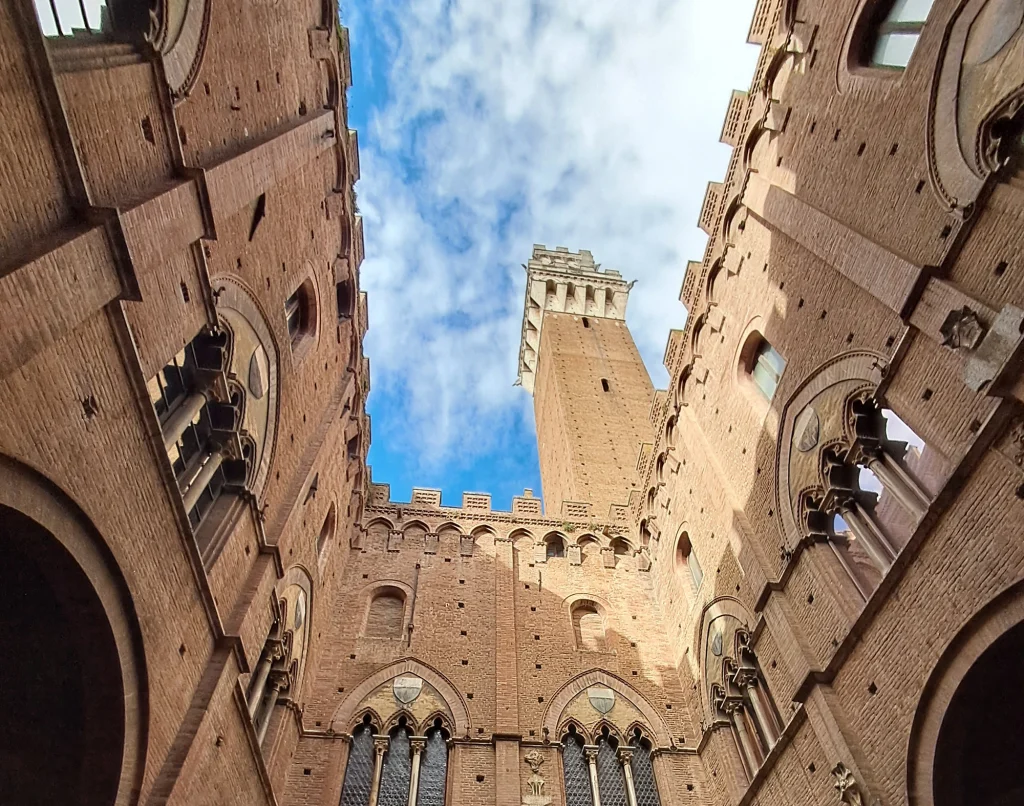
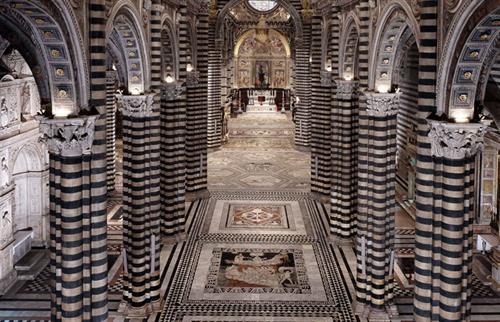
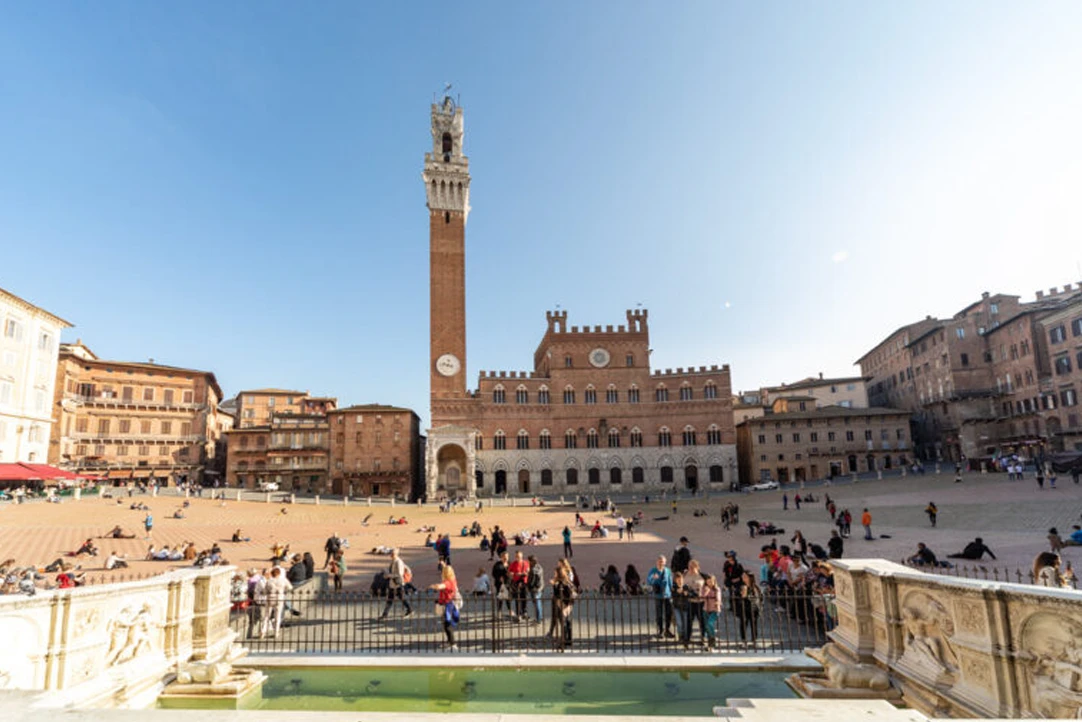
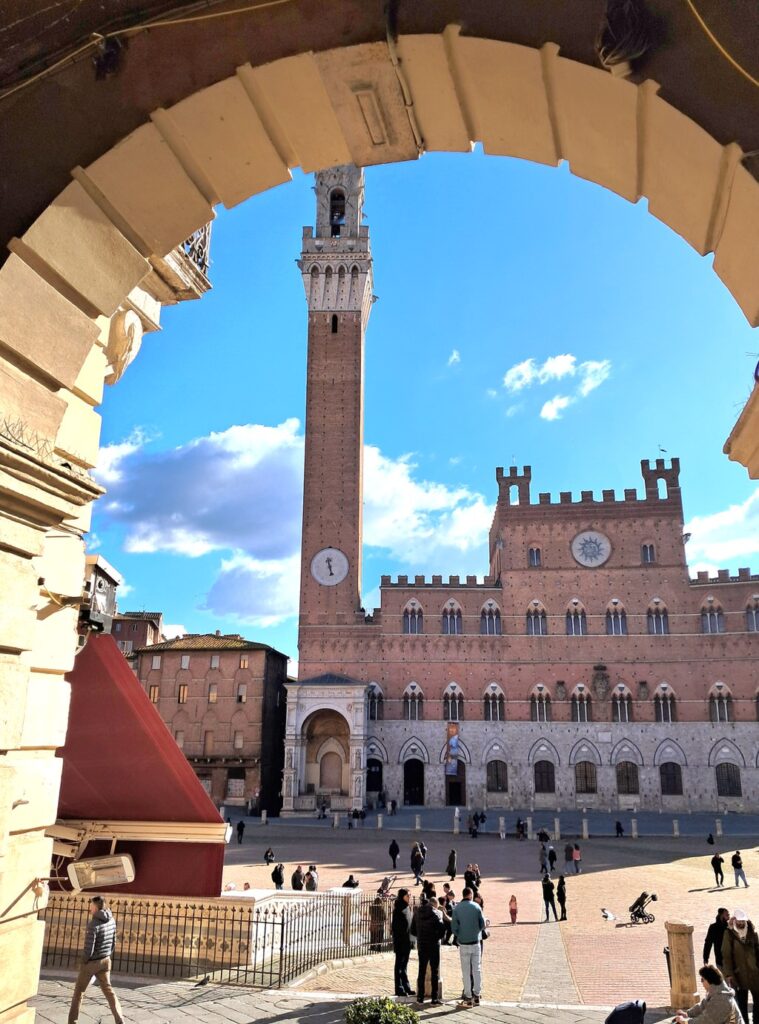
Stage 4: Piazza del Campo and the Duomo (outside the Caterinian sites) – Although not directly linked to Saint Catherine, you are now in the heart of Siena and it would be a shame not to include its civil and religious wonders . Thus, stop in Piazza del Campo, perhaps sitting on the tufo brick pavement as the Sienese do . Enjoy the panorama of the Palazzo Pubblico and the Torre del Mangia. If you wish, you can climb the Torre del Mangia (400 steps, around €10) for a bird’s‑eye view—allow about an hour and check times (the tower usually opens at 10 am and the last climb is around 6:15 pm) . Alternatively, visit the Museo Civico inside the Palazzo Pubblico to admire the frescoes of the Allegory of Good Government by Ambrogio Lorenzetti . After the Campo, walk up alleys toward the Duomo of Siena (Cattedrale di Santa Maria Assunta): it’s a five‑minute walk and its white‑and‑black marble façade is unmissable . Catherine herself prayed in the Duomo often and venerated the Eucharistic miracle of Siena preserved in the Basilica of San Francesco (another nearby church, optional if you have time). Visit the Duomo (entrance around €8, open roughly 10 am–7 pm, closed to tourists Sunday morning) to admire the floor, the Piccolomini Library and sculptures by Michelangelo .
Lunch break: At this point, after the sanctuary, Fontebranda, the Campo and the Duomo, it will be lunchtime . Being near the Duomo/Piazza del Campo means you have many choices: traditional trattorias, sandwich shops, osterie. To stay in the “Caterinian” theme, you might opt for a frugal lunch as the saint would have: for example, a sandwich with panforte or ricciarelli (Sienese sweets) eaten on a bench . Or treat yourself to a ribollita soup or the famous pici all’aglione in a local osteria (e.g., Osteria Il Carroccio or Antica Trattoria Papei, both mentioned in Hotel Minerva’s itineraries) . Recharge because the afternoon still holds visits.
Stage 5: Hospital of Santa Maria della Scala & Oratory of the Night – After lunch, if you are near the Duomo, dedicate an hour to the museum complex of Santa Maria della Scala, directly opposite the cathedral . Descend into the evocative frescoed halls (such as the Sala del Pellegrinaio) and follow the signposted route toward the Oratory of Saint Catherine of the Night . It is a different experience from the sunny exterior of Piazza del Campo: here you will be underground, in penumbra, surrounded by stories of charity . If you are passionate, you might consider a guided tour (some are available and explain the medieval hospital well). Keep in mind that a full visit to the museum requires more than an hour; if you are pressed for time, focus on the highlights (at least do the oratory and the Pellegrinaio hall) .
Stage 6 (optional): Basilica of San Francesco – If you have time and desire, about five minutes from Hotel Minerva (toward Via dei Montanini) is the Basilica of San Francesco . It is famous for the Eucharistic miracle of the Sacred Particles: 223 consecrated hosts from 1730 that have never decayed . Why mention it here? Because Saint Catherine was very devoted to the Eucharist and in some periods survived solely on it (the phenomenon of “mystical fasting”) . In addition, the miracle of the incorrupt hosts is a sign of holiness that Sienese people ideally associate with their patron. The basilica is open mornings and afternoons (closed at lunchtime), entrance free; if you arrive at the right times, you can see the hosts exposed in a side chapel . Otherwise, be content to admire the vast Gothic interior and—the moment you leave—the gardens of the former convent .
Return to the hotel: After completing the tour, you can return to Hotel Minerva for a well‑deserved rest . If you have followed all the stages, you will have done quite a bit of walking! Fortunately your accommodation is central: from the Duomo or Piazza del Campo it takes only 10–15 minutes on foot to get back to Via Garibaldi (partly downhill). Along the way, perhaps stop for a homemade gelato—Gelateria Il Masgalano on Via Camollia is on the return route, close to the hotel, and the flavours crema senese or caramel with Chianti will be a sweet finale .
Summary table of the suggested itinerary
| Stage | What to see/do | Estimated time | Admission cost | Distance/How to get there |
|---|---|---|---|---|
| Hotel Minerva (Via Garibaldi) | Starting point. Panoramic view over Siena. | – (start) | None | – (600 m from the station; 10 min on foot from the centre) |
| Basilica of San Domenico | Gothic church; relics of St Catherine (head, finger); panoramic view. | 20–30 min | Free (church) | 800 m – 10 min on foot from the hotel |
| Sanctuary of St Catherine | Birth house; oratories and chapels (Crucifix, Kitchen, Chamber). | 30 min | Free | 500 m – 8 min on foot from San Domenico (downhill) |
| Fontebranda | Medieval covered fountain; St Catherine’s birth district. | 15 min (stop/relax) | Free | 100 m – 2 min on foot from the sanctuary |
| Piazza del Campo | Main shell‑shaped square; Palazzo Pubblico, Torre del Mangia. | 30–45 min (stroll) | Free (square) | 1 km – 15 min on foot from Fontebranda (uphill) |
| Torre del Mangia (optional) | Climb 400 steps for a 360° view of Siena. | 30 min (climb + photos) | €10 (tower, reduced for <11 free) | – (in Piazza del Campo) |
| Duomo of Siena | Gothic cathedral; marble façade, interior (floor, Piccolomini Library). | 45–60 min | ~€8 single; OPA pass €15 (Duomo+Museums) | 400 m – 5 min on foot from the Campo |
| Hospital of S. Maria della Scala | Former hospital and museum; frescoes; Oratory of St Catherine of the Night (saint’s cell). | 60 min (partial visit) | €9 full (reduced €8) | 50 m – 1 min on foot (opposite the Duomo) |
| Basilica of S. Francesco (optional) | Gothic church with Eucharistic miracle (incorrupt hosts). | 15 min (quick) | Free | 500 m – 7 min on foot from the hotel (in opposite direction) |
| Hotel Minerva (return) | Relax at hotel; view from your room of Siena’s rooftops. | – (at leisure) | – | 0 (the hotel is central, convenient for returning during breaks) |
Note: You can adapt the itinerary to your own pace. If you prefer to concentrate on the Caterinian sites in the morning (San Domenico, the sanctuary, Fontebranda) and leave the Duomo and Campo for the afternoon, that is fine— or vice versa. Keep in mind the closing hours of the churches (many close around 6 pm) and the Santa Maria museum (last entry often at 6 pm). The important thing is to enjoy Siena without haste, savouring both famous sites and silent alleys .
What to Visit in the Surroundings of Siena
Once you have discovered Saint Catherine’s places and the wonders of Siena itself, you may wish to extend your trip by exploring the surrounding areas. The province of Siena offers enchanting medieval villages, breathtaking landscapes and unique food‑and‑wine itineraries . Here are some recommended destinations, easily reachable using Hotel Minerva as your base (which, as a reminder, has parking for travellers by car and is close to the station for those using public transport) .
- San Gimignano – Known as the “Manhattan of the Middle Ages” for its soaring towers, San Gimignano is an UNESCO World Heritage village not to be missed . It is about 40 km from Siena (50 minutes by car). If you don’t have a car, you can take the bus 130 from Siena (terminus in Piazza Gramsci) which takes about 1 hour 15 minutes via Poggibonsi . The town preserves 14 medieval towers (there were once 72!) that create a unique skyline. Must‑sees: the Collegiate church (San Gimignano’s Duomo) with 14th‑century frescoes (entry around €5) and climbing the Torre Grossa (54 m high, €10) for a fabulous view over towers and hills . Stroll along Via San Matteo and Via San Giovanni admiring ceramic shops and stores selling local products (here saffron and the white Vernaccia di San Gimignano DOCG wine are famous) . For lunch try a Tuscan platter in an enoteca or an award‑winning ice cream at Gelateria Dondoli in Piazza della Cisterna (try the “Crema di Santa Fina” flavour with saffron and pine nuts) . On the way back to Siena, if you are driving, stop at Monteriggioni: a tiny castle village surrounded by intact walls, visible from the Siena‑Florence highway . Monteriggioni is small (an hour is enough) but evocative: you can walk along the wall walkway and imagine being in a fairy‑tale castle . By bus, line 130 stops on the Cassia road 3 km from Monteriggioni (Colonna di Monteriggioni); from there you can reach the village on foot, but it is quite a stretch, so a car or organised tour is more convenient .
- Val d’Orcia (Pienza, Bagno Vignoni, Montalcino) – South of Siena stretches the Val d’Orcia, a hilly landscape declared a UNESCO heritage site. If you have a day and a car, drive along the Via Cassia across gentle hills dotted with cypresses to postcard‑worthy places . Pienza (50 km, ~1 hour by car) is the Renaissance “ideal city” designed by Pope Pius II: visit its harmonious historic centre with the square, the Duomo and views over the valley . Taste the famous pecorino di Pienza in local shops . A few kilometres away is Bagno Vignoni, a unique spa village because its square features a large steaming thermal pool . Did Catherine stay here? Not directly, but there is a lodge called “of Saint Catherine” to recall that she loved thermal baths (it is likely she used them to treat the sick during her travels) . Dip your hands and feet in the free pools by the mills below the village—the warm water will fascinate young and old alike, but remember not to enter the historic basin (it is forbidden) . Finally head to Montalcino, homeland of Brunello wine. This hilltop medieval town (~40 km from Siena) offers a visitable fortress and numerous wine shops where you can taste the DOCG Brunello . Perfect for wine lovers! The Val d’Orcia is beautiful all year round, but especially in spring (green hills) and autumn (golden vineyards) . If you don’t have a car, consider organised tours: many depart from Siena and take you to Pienza–Montalcino–Bagno Vignoni in one day .
- Chianti Classico – North of Siena lies the Chianti region, famous for its vineyards and fairy‑tale landscapes. A recommended route by car is the Chiantigiana road (SR222) toward Castellina, Radda and Gaiole . For example, Radda in Chianti is 35 km away (about 50 minutes) from Siena: it’s a delightful village with medieval walls and views over the vine rows . Stop at a farm or winery to taste a glass of Chianti Classico Gallo Nero. Even without planning, driving through the Chianti hills is a pleasure: sinuous roads, woods, Romanesque parish churches popping up and signs inviting you to discover castles and wineries . An interesting stop is the Castle of Brolio (near Gaiole), belonging to the Ricasoli family: from here the historic formula for Chianti originates, and you can visit the garden and do tastings . If you prefer not to drive, in summer there are buses or wine tours from Siena that take you to Chianti villages .
- Abbey of San Galgano – For something different (and legendary), consider the Abbey of San Galgano, about 30 km south‑west of Siena (near Chiusdino) . It is famous because it is a roofless abbey: the Gothic ruins with their open‑sky naves create a mystical atmosphere . Here, according to legend, Saint Galgano planted his sword in the rock (a sort of Italian “sword in the stone,” visible in the nearby chapel of Montesiepi) . It’s not related to Catherine, but it’s a suggestive visit for history and photography lovers . The abbey is reached best by car (40 minutes) and is open every day with an entrance fee of around €5 . It is particularly evocative at sunset and in summer even at night, when musical events are held.
In summary, the surroundings of Siena offer a lot: whether you want to continue a spiritual pilgrimage (abbeys, parish churches), taste wines and cheeses, or simply enjoy postcard views, you will be spoilt for choice . Hotel Minerva, thanks to its active reception and tourism experience, can also help organise excursions or suggest reliable tours . Below is a summary table of some destinations in the surroundings, with distances and main attractions .
| Nearby destination | Distance from Siena | How to get there | Main attractions |
|---|---|---|---|
| San Gimignano (N) | ~45 km – 1 h by car; 1 h 15 min by bus | Car (SS68 via Poggibonsi) or bus 130 (from Piazza Gramsci) | Medieval UNESCO village with 14 towers; frescoed Duomo; Civic Museum; Vernaccia wine |
| Monteriggioni (N) | 15 km – 20 min by car; 30 min by bus | Car (Via Cassia Nord SR2) or bus 130 (stop Colonna, 3 km walk) | Small fortified village with intact walls; wall walk; armour museum (great for children) |
| Pienza (SE, Val d’Orcia) | 50 km – ~1 h by car | Car (SS2 Cassia southbound) | Renaissance “ideal city” of Pius II; Duomo and Piccolomini Palace; panoramic views; pecorino cheese |
| Bagno Vignoni (S, Val d’Orcia) | 50 km – ~1 h by car (near Pienza) | Car (SS2 + detour SP) | Spa village with large central thermal pool; free pools by the mills; thermal spas; St Catherine lodge |
| Montalcino (S, Val d’Orcia) | 40 km – 50 min by car | Car (SR2 + SP45 from Buonconvento) | Hill town home of Brunello; 14th‑century fortress; wine shops and Glass Museum; nearby Abbey of Sant’Antimo |
| Chianti (e.g., Radda, Castellina) | 30–40 km – ~50 min by car | Car (SR222 Chiantigiana) | Chianti Classico wine route; vineyards and villages (Radda, Castellina, Gaiole); castles (Brolio); winery tastings |
| Abbey of San Galgano (SW) | 30 km – 40 min by car | Car (SS73 toward Monticiano) | Cistercian abbey in ruins, roofless; evocative atmosphere; Montesiepi chapel with sword in the stone |
As noted, many destinations require your own vehicle or a tour, because public buses to the countryside are not frequent . However, organising is doable: San Gimignano and Monteriggioni, for example, are accessible by bus, and some agencies offer minivan tours for Val d’Orcia . If you travel with family, consider travel times and breaks: children will appreciate experiences like walking on the walls of Monteriggioni (it feels like a fairy‑tale castle to them) , or seeing animals in the fields of San Galgano or in Chianti farms . A fun idea is also the Saltalbero Adventure Park (between Siena and Montalcino) if you want to give children some hours of climbing and play after so many churches and museums . In any case, returning to Hotel Minerva after an excursion will be pleasant: you can relax in the hotel’s panoramic garden while sipping a glass of wine discovered during the day—perhaps a Brunello or a Chianti—and review the photos taken . The hotel staff will be curious to hear your stories and may suggest the next day’s itinerary—because surprises never end in Siena and its surroundings .
Frequently Asked Questions (FAQ)
Q: How much does it cost to visit the places of Saint Catherine?
A: Very little or nothing. Entrance to both the Sanctuary of Saint Catherine and the Basilica of San Domenico is free, as they are places of worship open to the public . You may leave a voluntary offering if you wish. Fontebranda is also a public, free place. The only paid site on the Caterinian route is the Oratory of Saint Catherine of the Night inside the Santa Maria della Scala museum, which requires the museum ticket (~€9) . However, if you are not interested in the entire museum, you can limit yourself to the free sites. Also, climbing the Torre del Mangia or entering the Duomo incurs costs (around €10 for the tower, €8–15 for the Duomo depending on the ticket), but these are not strictly related to Saint Catherine—it depends on your general interest in Siena . In summary, the Caterinian route itself is economical, suitable even for low‑budget travellers .
Q: What are the opening hours of the sanctuary and basilica?
A: The Basilica of San Domenico keeps broad hours: it opens early in the morning (around 7:30 am every day) and closes around 6:00–6:30 pm. Note the closure between about 12:30 and 2:00 pm (many churches in Siena close at midday) . The Sanctuary of Saint Catherine is open roughly from 8:00 am to 6:00 pm every day, without midday closure . These hours may vary slightly depending on seasons or special celebrations, but in general you will find them open during the day. If possible, visit in the morning to avoid potential early afternoon closures . Remember also that the Duomo of Siena is closed to tourist visits on Sunday mornings (until about 1:30 pm) because of services, and civic museums generally close around 6 pm . Shops in the centre follow the typical Italian schedule with midday closure (1–3 pm), so plan any shopping stops accordingly .
Q: How do I reach Siena and Hotel Minerva by public transport?
A: Siena is well connected by train and bus from major Tuscan cities. From Florence there are direct regional trains (about 1 h 30 min) and regional buses; from Rome there are direct buses (3 hours) and trains with a change at Chiusi . Siena’s railway station is 2 km from the historic centre . From the station you can take a taxi (5 minutes) or the urban “Pollicino” minibus which goes toward the centre . Hotel Minerva in particular is convenient: it’s about 15 minutes on foot from the station (uphill; alternatively several urban bus lines stop on Via Garibaldi near the hotel) . For those arriving by car: Siena is off the motorway but reachable via the Florence–Siena expressway (RA3) or the SS2 Cassia from the south . Hotel Minerva has a paid covered car park located just outside the ZTL, very practical . Those arriving by plane can land at Florence or Pisa and then continue by train. In summary: with public transport you arrive in Siena (train/bus), then a short urban journey takes you to the hotel without problems. Minerva’s location is valued precisely because it is central yet close to arrival routes .
Q: Is Hotel Minerva suitable for families? Are there specific amenities for children?
A: Absolutely yes; Hotel Minerva is very family‑friendly. They have spacious Family rooms designed to accommodate parents with children in total comfort . These rooms have multiple beds or cots on request, separate spaces for children and sturdy furniture. In addition, the hotel offers useful services such as high‑chairs at breakfast and, on request, bottle warmers or extra cribs . The hotel’s central location is ideal for families because, as mentioned, if little ones need an afternoon nap you can take a break and return to the room in just a few minutes . Even in the evening, returning does not involve long treks with tired strollers. Regarding strollers: Siena has hilly, cobbled streets, but with a sturdy stroller you can get around fine (perhaps choose a light, foldable model for the hills and a few steps) . On the Caterinian route, the only real difficulty for strollers is the stairs at the sanctuary—consider using a baby carrier for that stretch . In general, Siena is safe and quiet for children: they will love chasing pigeons in Piazza del Campo (perhaps do so at less crowded times for safety) . Near the hotel there is also a small playground at the Giardini della Lizza (near the fortress) where they can have fun . So you can rest assured: you can do Siena with kids—just plan gelato breaks, some green spaces (like the Orto de’ Pecci or the fortress walls for running around), and choose a child‑friendly accommodation like Minerva that serves as a “family refuge” .
Q: Are there events or special periods related to Saint Catherine in Siena?
A: Yes. The most significant period is around 29 April, Saint Catherine’s feast day . On that date Siena honours its patron with solemn religious functions: in the Basilica of San Domenico there is usually a solemn Mass with the exhibition and blessing with the saint’s relic (the finger) and the Contrada dell’Oca organises celebrations in the sanctuary . Sometimes the so‑called “Feast of the Mantellate” with spiritual meetings is also held. Every year the Cateriniano (lay order linked to Saint Catherine) organises pilgrimages and conferences . Outside of April, another curious moment is mid‑September: although “Catherine’s Day” in the Anglican calendar is actually 29 April, in Siena on 15 September people remember the translation of the head (which took place in 1385). It is not a major public festival, but inside the basilica there may be a small historical commemoration . Otherwise, visiting Siena in any season reserves surprises: for example, if you come at the beginning of May, you might encounter a procession for Saint Catherine in Rome (but that is in Rome, at Santa Maria sopra Minerva where her tomb is). In Siena the greatest attention goes to the Palio (2 July and 16 August) rather than to saints; however, since Catherine is co‑patron of Italy she is also remembered on 4 October during the celebrations of Saint Francis . In short, if you are devout and want to experience intense moments, late April is the best time in Siena . Otherwise, any day is good for a personal spiritual journey in the saint’s places, as they are never too crowded (except for normal summer tourist flows) .
Q: May I take photos inside the churches?
A: In general, yes, but with tact and some exceptions . In the Basilica of San Domenico it is allowed to photograph the interior and works without flash; however, it is not permitted to photograph the head relic of Saint Catherine up close . There are clear signs about this and often an attendant watches. Unfortunately some visitors disregard this, but remember that it is a sacred relic for the faithful, so it is good manners to refrain . In the Sanctuary of Saint Catherine, you may take photos in the courtyard and under the portico, but inside the oratories it is best to avoid them—not so much because of strict prohibitions, but out of respect (these are small spaces meant for prayer) . If you really want a memory, take a picture from the entrance of the Kitchen or Crucifix Oratory, but without disturbing those who are praying . In the Duomo of Siena photography is allowed, except in some chapels where it is expressly indicated (e.g., the Piccolomini Library can be photographed, but without flash so as not to ruin the colours of the frescoes) . In the Oratory of Saint Catherine of the Night, being museum spaces, photos are usually allowed without flash (there are no bodily relics there, only artworks and the sleeping statue) . Summing up: bring your camera, because Siena is beautiful to capture, but remember to turn it off at appropriate moments . And maybe, once in a while, do as Catherine did: put aside human tools and contemplate with your eyes and soul what surrounds you—the most beautiful memories often remain imprinted in the heart, not on an SD card .
Q: What is the best time of year to visit Siena and these places?
A: From the standpoint of climate and crowding, the best periods are spring and early autumn . April–June and September–October offer mild temperatures and—apart from Easter week and the April 25/May 1 bridge, which are very popular—a manageable number of visitors . In summer (July–August) it is rather hot in Siena and there is a lot of crowding, especially around the two Palios (2 July and 16 August) . In those days the city is packed and quietly visiting the basilica and sanctuary may be difficult (although precisely during the Palio many tourists are concentrated elsewhere and places of worship remain oases of peace) . In winter, Siena is quiet: December is charming for Christmas lights, and November 1st (All Saints) sees a popular long weekend. Saint Catherine herself is not “seasonal”: her places are open all year . Personally I recommend May: you will find Siena in bloom, the Caterinian celebrations (29 April) just ended with fresh flowers in the basilica, and you may catch the historical pageant on May 6th (Feast of Saint Ansano) or other spring events . October is also beautiful: harvest time in the countryside, autumn colours, fewer queues everywhere . In any case, thanks to the position of Hotel Minerva, even if you come in high season you can go out early in the morning and enjoy the sanctuary and basilica almost alone, before the arrival of mid‑morning tour groups .
Q: Does Saint Catherine have other relics or places outside Siena?
A: Yes, and this is a curiosity for indefatigable travellers: Catherine’s body (without her head or a finger) is in Rome, in the Basilica of Santa Maria sopra Minerva (near the Pantheon) beneath the main altar . Rome is therefore an important Caterinian site: the cell where she died no longer exists, but the tomb is a pilgrimage destination . Another significant piece is Catherine’s left foot, preserved in Venice in the Church of Saints Giovanni e Paolo; tradition holds that the Sienese shared some relics with Venetians in friendship . A rib of the saint, once kept in the Duomo of Siena, was donated in 1984 to a shrine in Belgium (Sanctuary of Saint Catherine at Astenet) . Thus, Catherine is somewhat “dispersed” across Europe, reflecting her role as patron of the continent . There are also Caterinian trails in Avignon (where she visited the pope) and in the Val d’Orcia (it is said she visited thermal baths as mentioned, and also the nearby Rocca d’Orcia). However, the “core” is in Siena and Rome. If your journey continues to Rome, you can complete the homage by visiting the basilica above Minerva—you will find a statue of the saint by Melchiorre Cafà and her burial slab . If you go to Venice, the Church of Saints Giovanni e Paolo displays the saint’s foot in a reliquary . These are details not necessary to enjoy Siena, but good to know for the particularly devout or curious .
Q: Final tips to fully enjoy the experience?
A: Here are some practical final suggestions :
- Comfortable footwear: Siena has many hills, descents and ancient paving stones . Choose suitable shoes (especially for going down to Fontebranda and up to San Domenico). Avoid stiletto heels on cobbles!
- Water and a hat in summer: In July–August it can be hot in Siena and the sun beats down on the tufo bricks . Bring a bottle (which you can fill at Fontebranda or public fountains) and a hat. At the sanctuary and in church obviously remove your hat as a sign of respect.
- Silence your phone: When entering sacred places, silence your phone so as not to disturb . If you absolutely must answer, step outside.
- Pilgrim’s canteen: If you are around the Duomo at lunchtime and want an inexpensive meal, know that under Santa Maria della Scala there is an ancient pilgrims’ refectory now serving as a café/restaurant . Today it is a restaurant called “Ristorante del Pellegrino” where, with tourist menus, you can dine in a setting reminiscent of old hospitality .
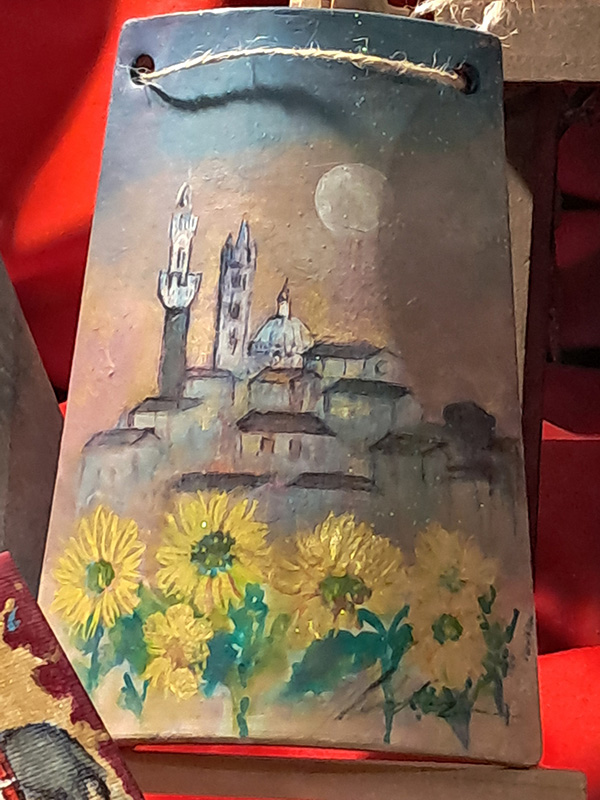
- Religious souvenirs: Near San Domenico there is a small shop of religious articles (in front of the steps) where you can buy rosaries, medals or books about Saint Catherine . At the sanctuary there is sometimes a stall with devotional material. A nice souvenir could be a small tile painted with an image of Saint Catherine (a craft item found in some shops) or a bottle of Fontebranda Water (sold as a curiosity) .
- Watch your step!: A note of colour—walking around Siena you will see on many metal drain covers the emblem of Saint Catherine (a rose and a cross) because the main aqueduct is called “Fontebranda” and brings water also to the sanctuary . So Catherine’s presence is truly under your feet… literally!
We hope this guide helps you live an unforgettable experience following in Saint Catherine of Siena’s footsteps. Whether you are devout pilgrims, lovers of medieval history or just curious travellers, Siena will touch your soul with its beauty and spirituality . As Catherine wrote in one of her letters: “If you are what you should be, you will set all Italy on fire.” So let the flame of enthusiasm of this city also ignite in you a love for art, faith and the intense life you breathe here . Happy travels and enjoy your stay in Siena, with the comfortable embrace of Hotel Minerva awaiting you each evening upon your return . Buen camino in Saint Catherine’s footsteps—Siena and its treasures await you with open arms, just as the saint embraced her fellow citizens, with sincere love and passion .
Hotel Minerva and Special Offers
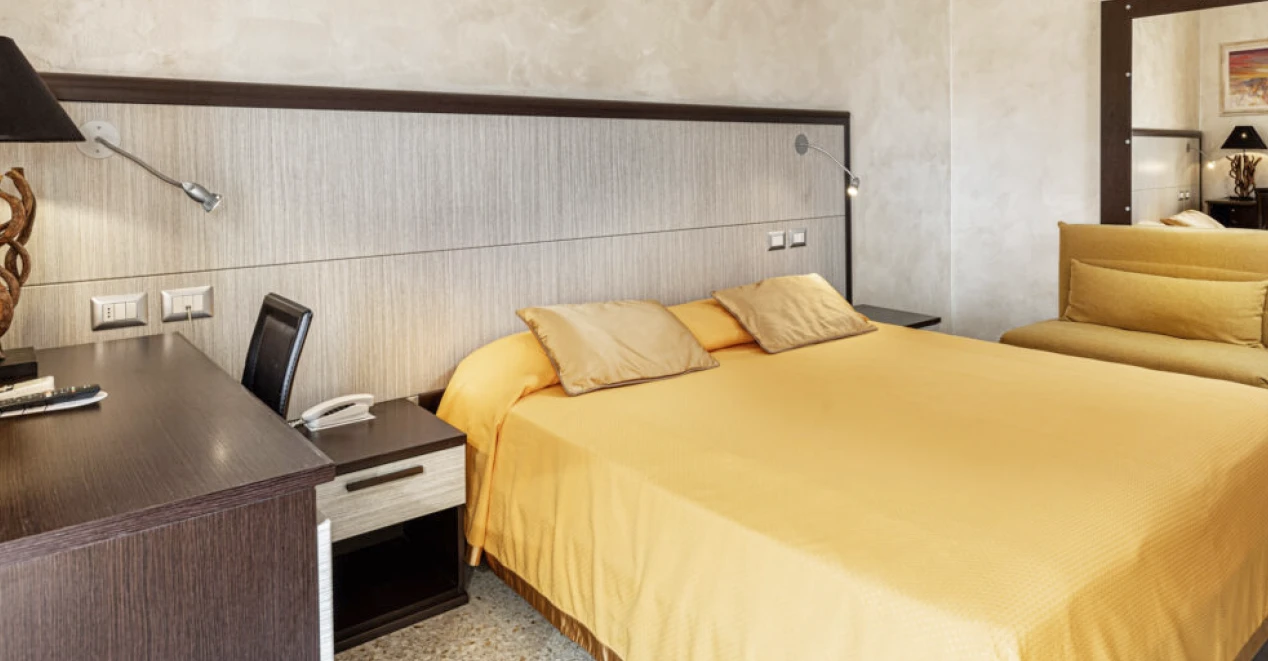
The article ends with a section dedicated to the latest offers of Hotel Minerva, detailing the hotel’s accommodations and services. The hotel provides a range of room categories:
- Junior Suite: Completely renovated, spacious, elegant and functional .
- Camera Superior: Rooms with views over Siena’s historic centre .
- Elegant Standard: Intimate and cosy rooms, also with views of the historic centre .
- Easy Economy: Ideal for business travellers .
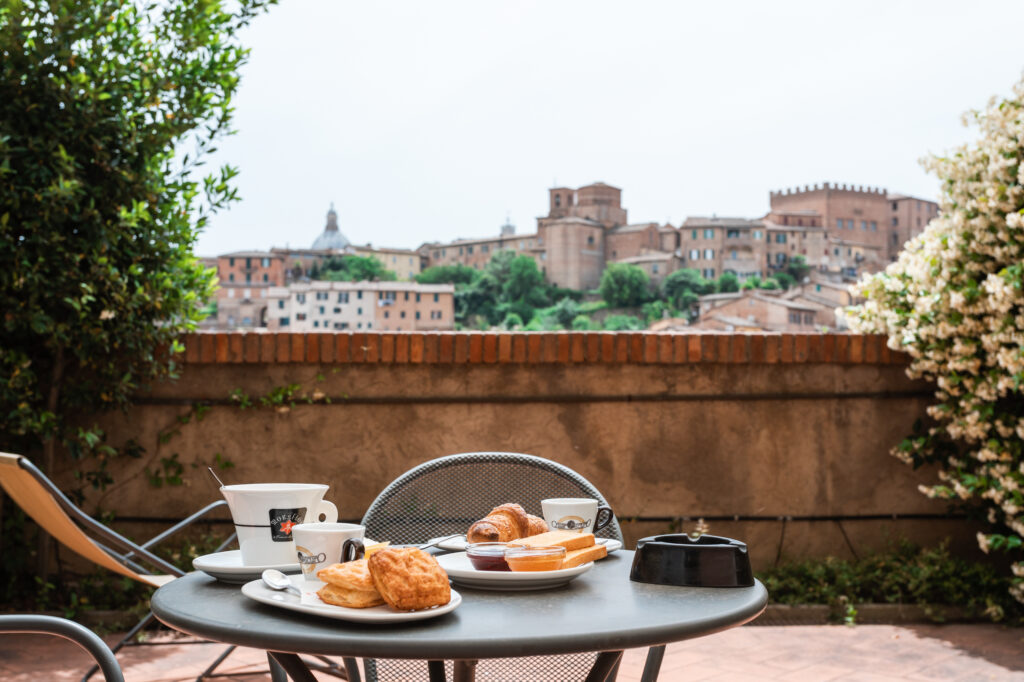
The hotel offers various amenities: a guarded garage with 24‑hour porter, breakfast included (Italian and international), a panoramic garden overlooking the historic centre, a bar for a relaxing break, 24‑hour reception seven days a week, a meeting room accommodating up to 40 people, and a relax area for discussions and unwinding . They also mention the possibility of horseback rides among the Sienese hills . For more details, offers and contact information, you can visit the hotel’s site or contact them directly—Hotel Minerva is located at Via Garibaldi 72, 53100 Siena, Tuscany, Italy , and offers rooms in the price range of €60–€150 .