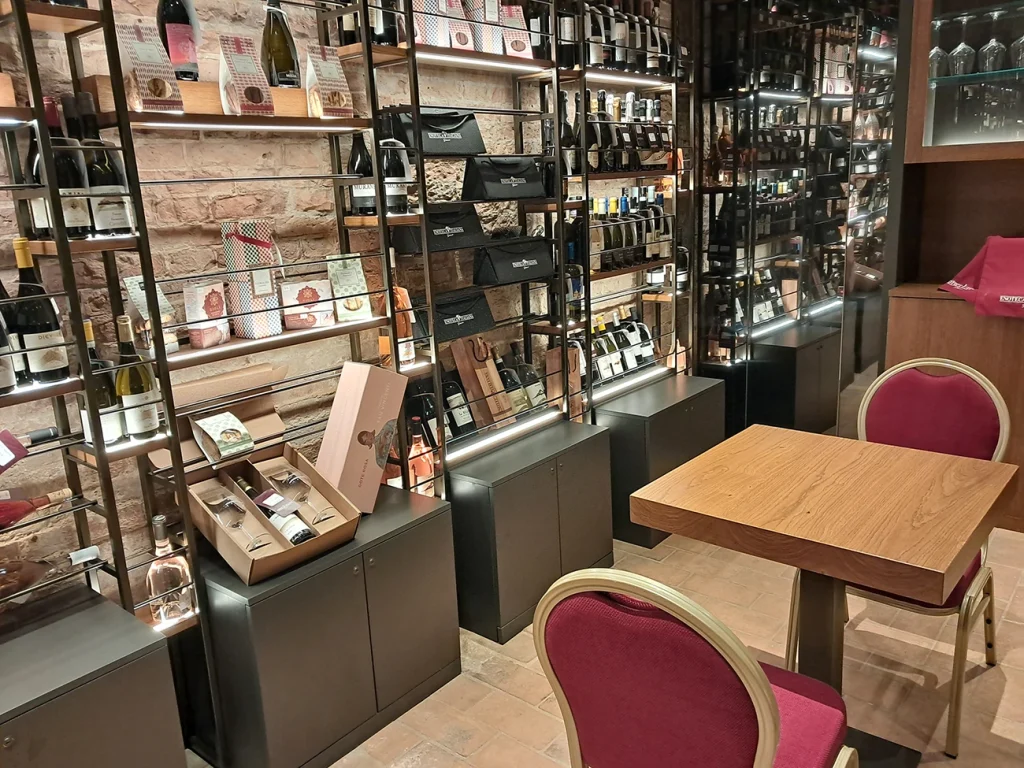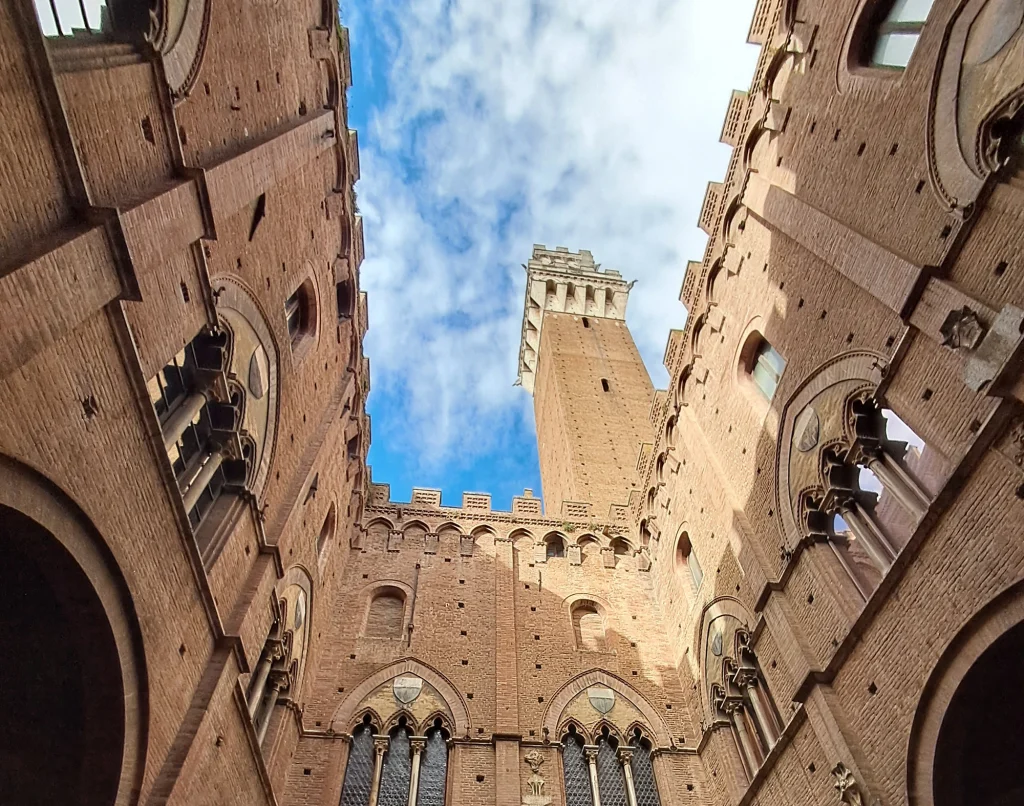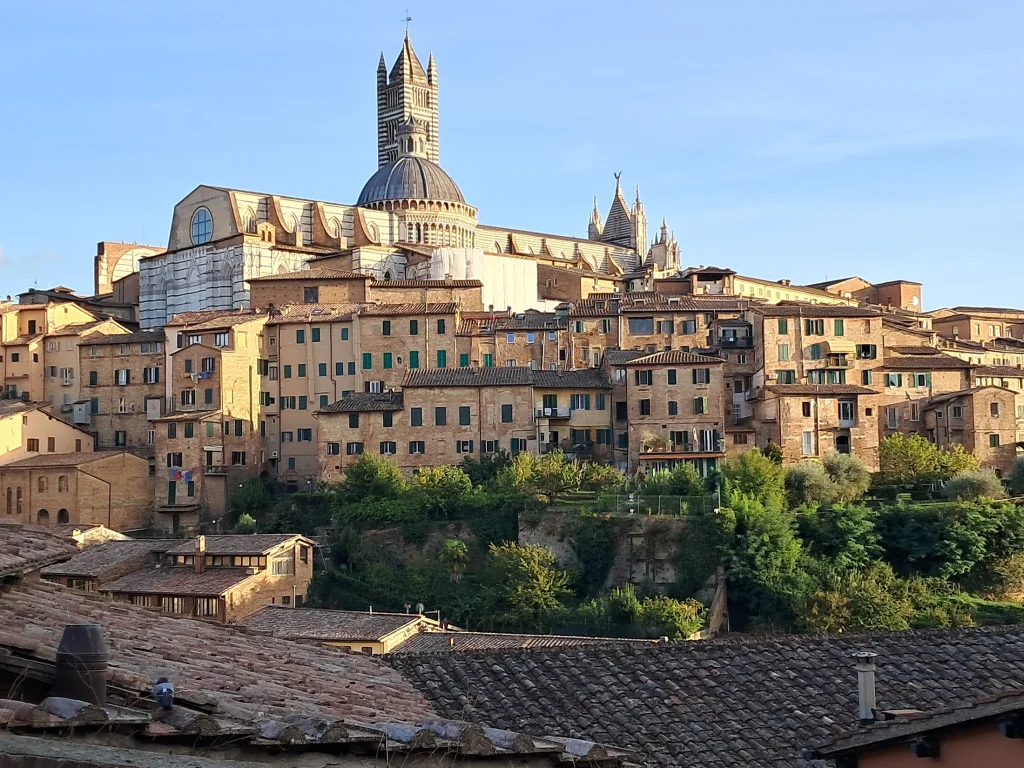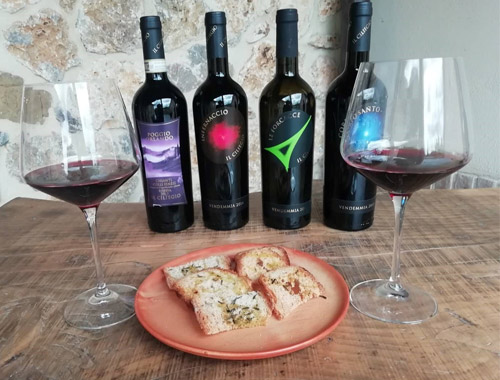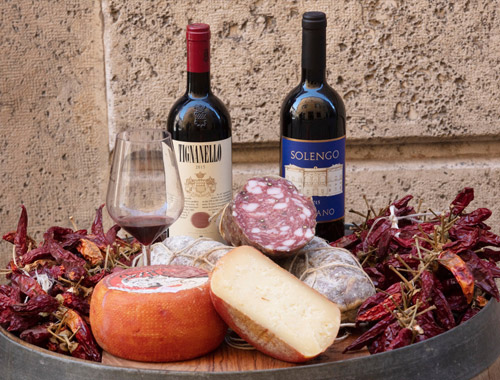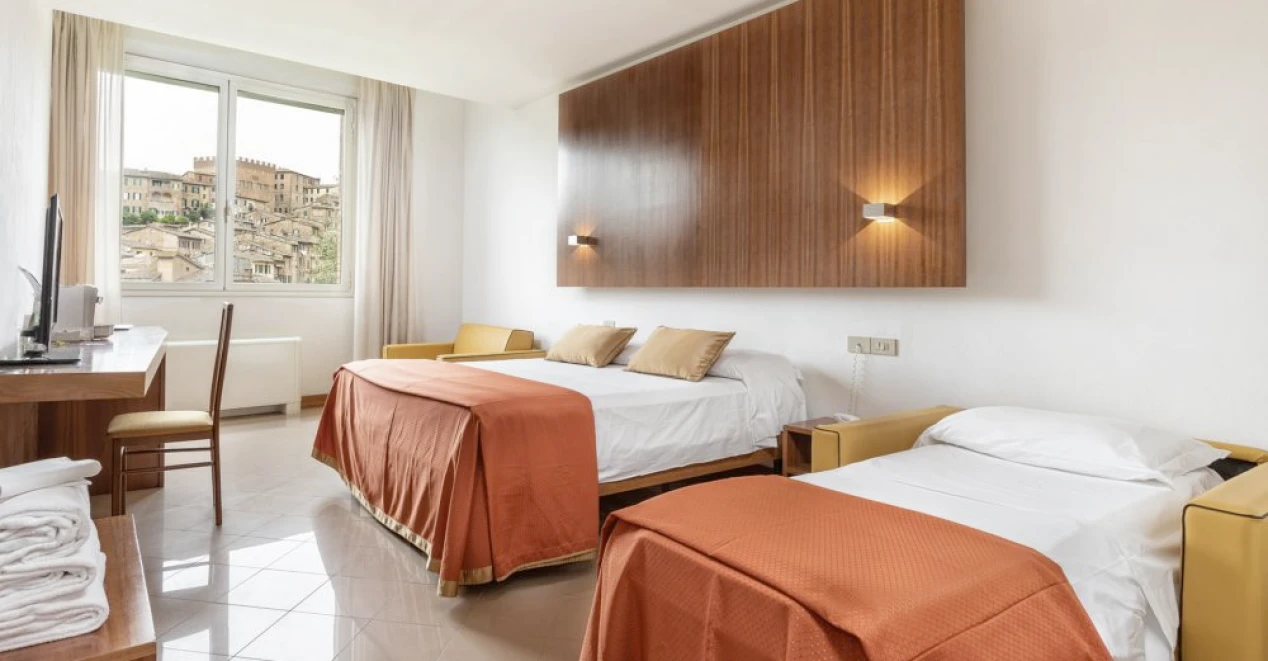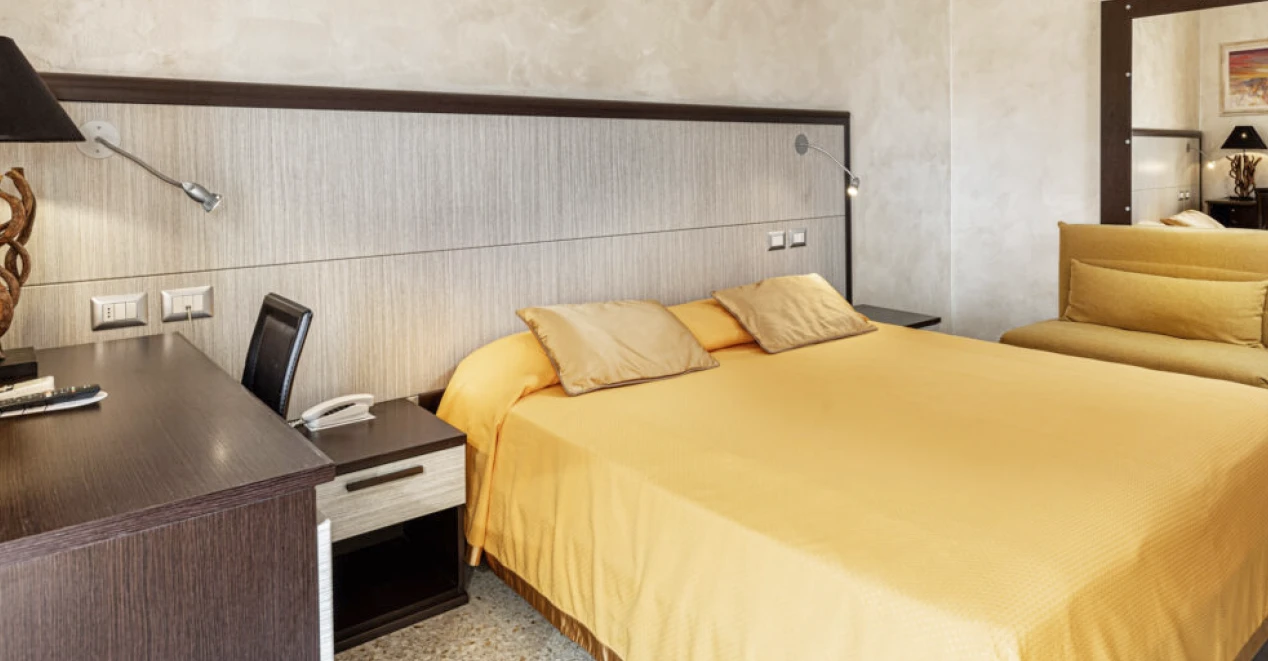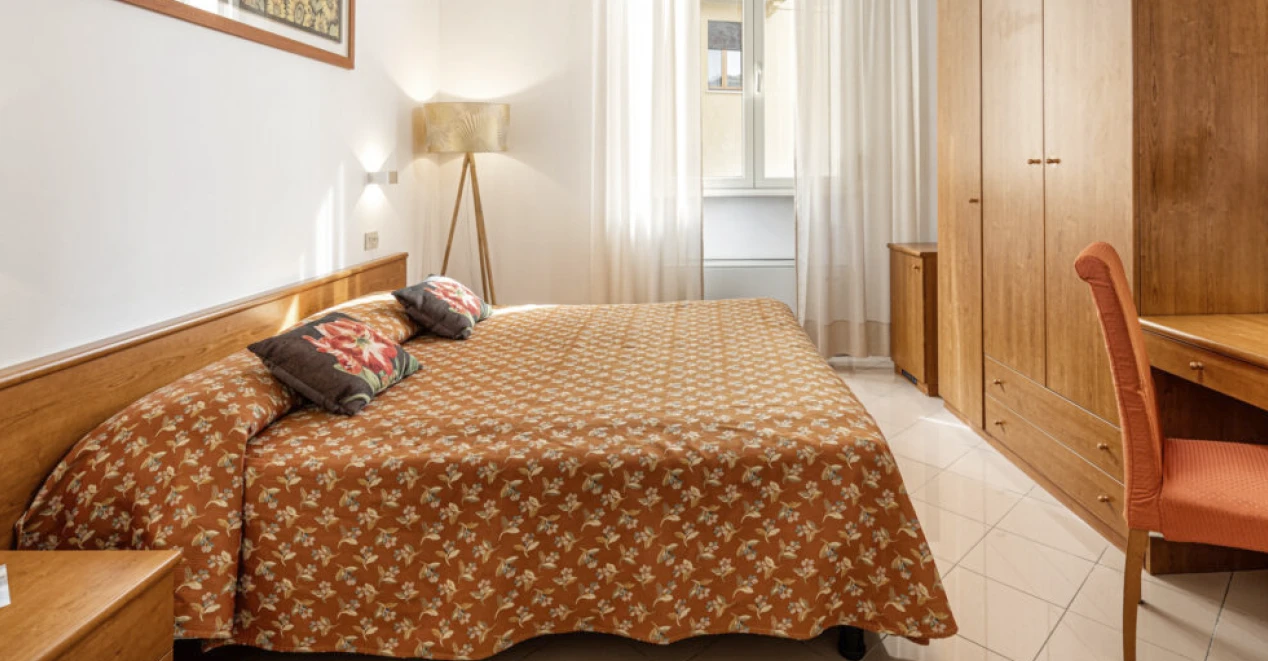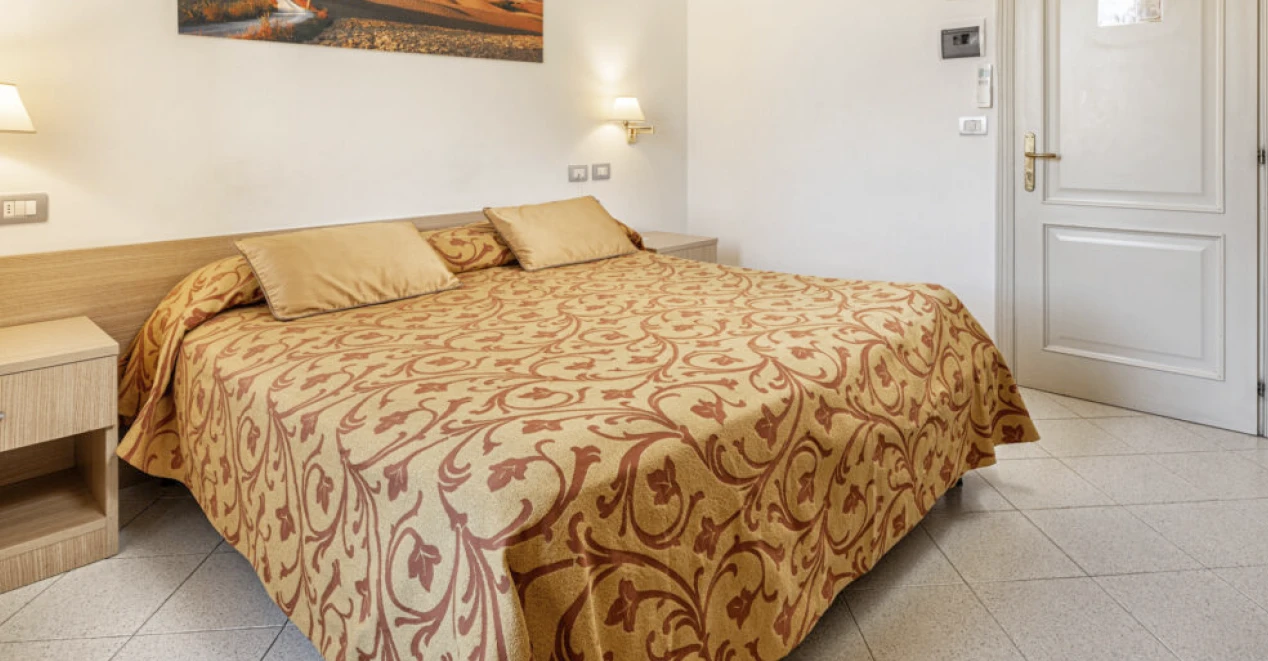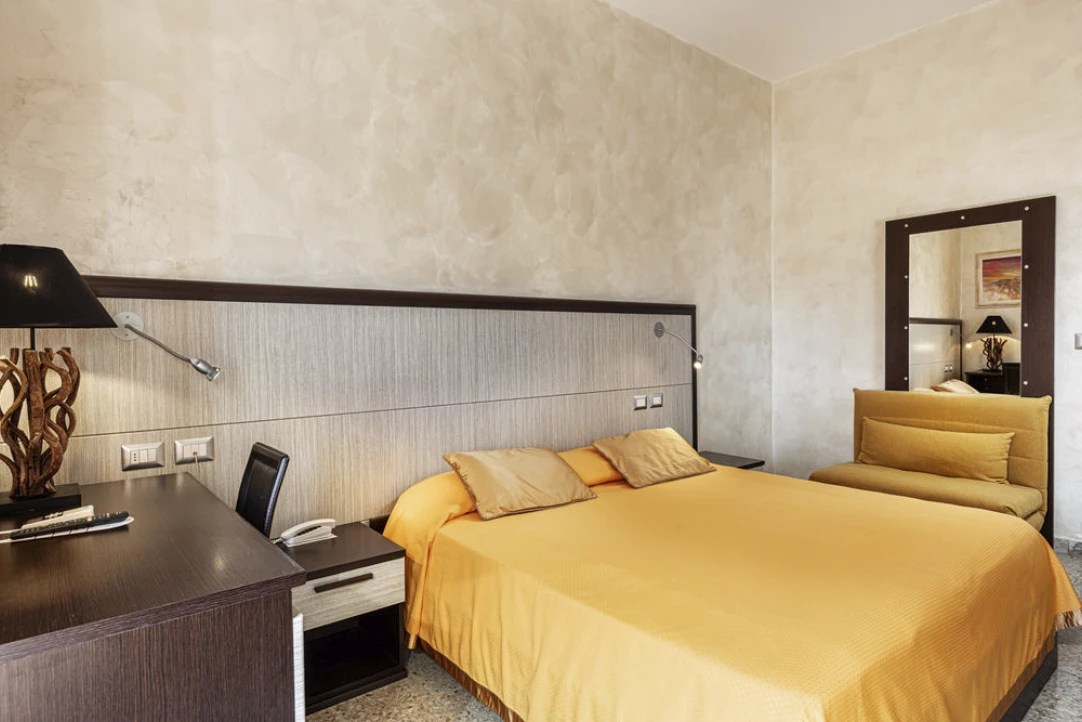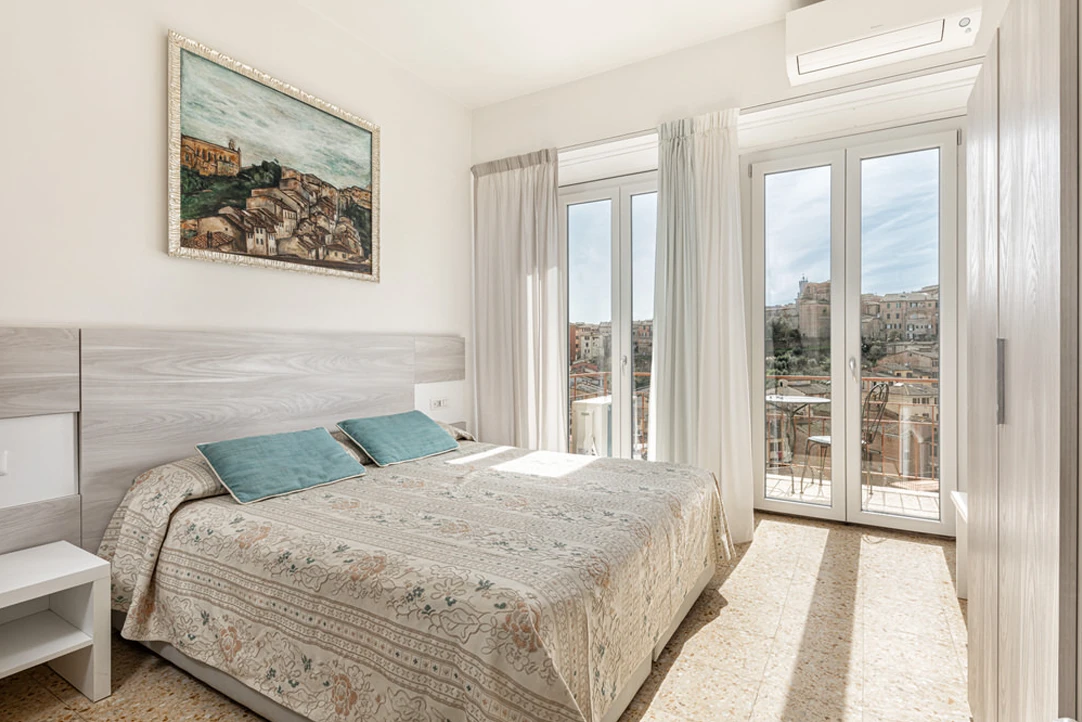

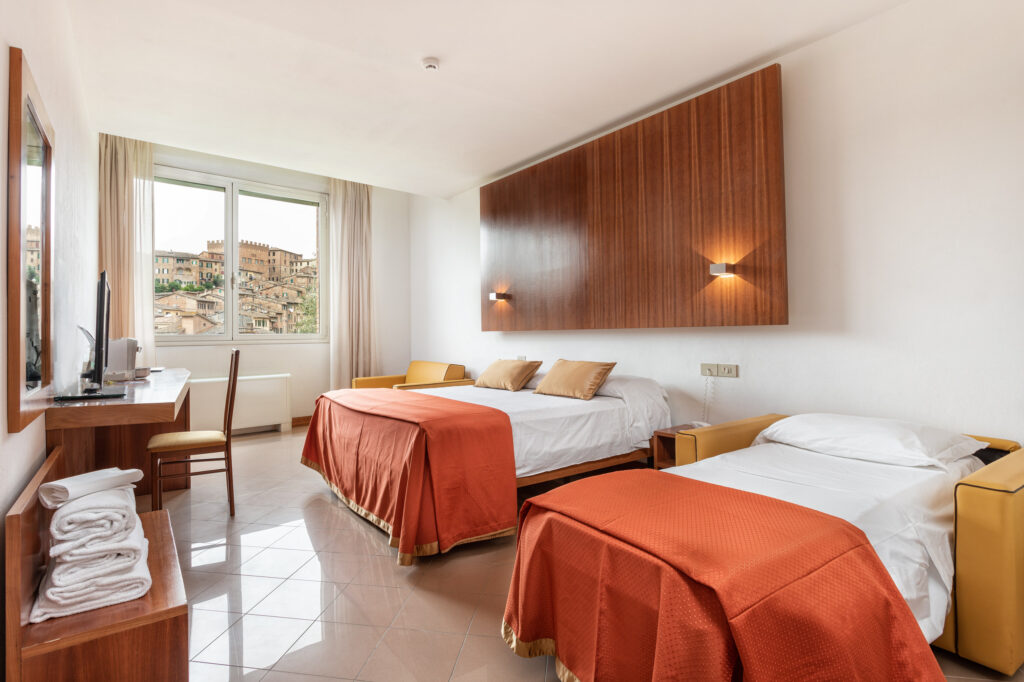
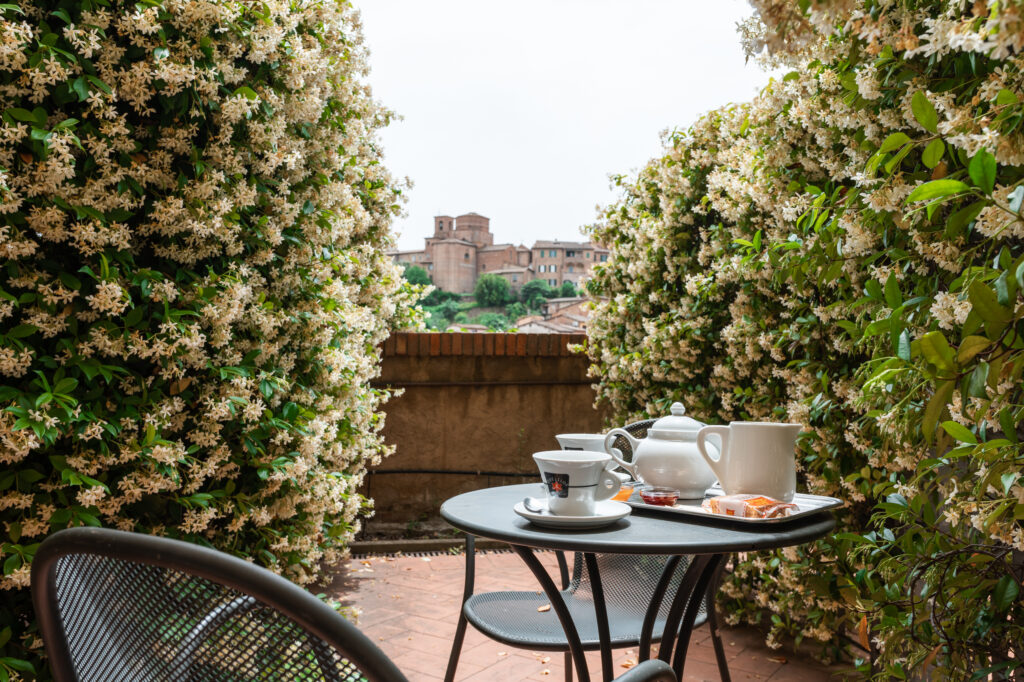
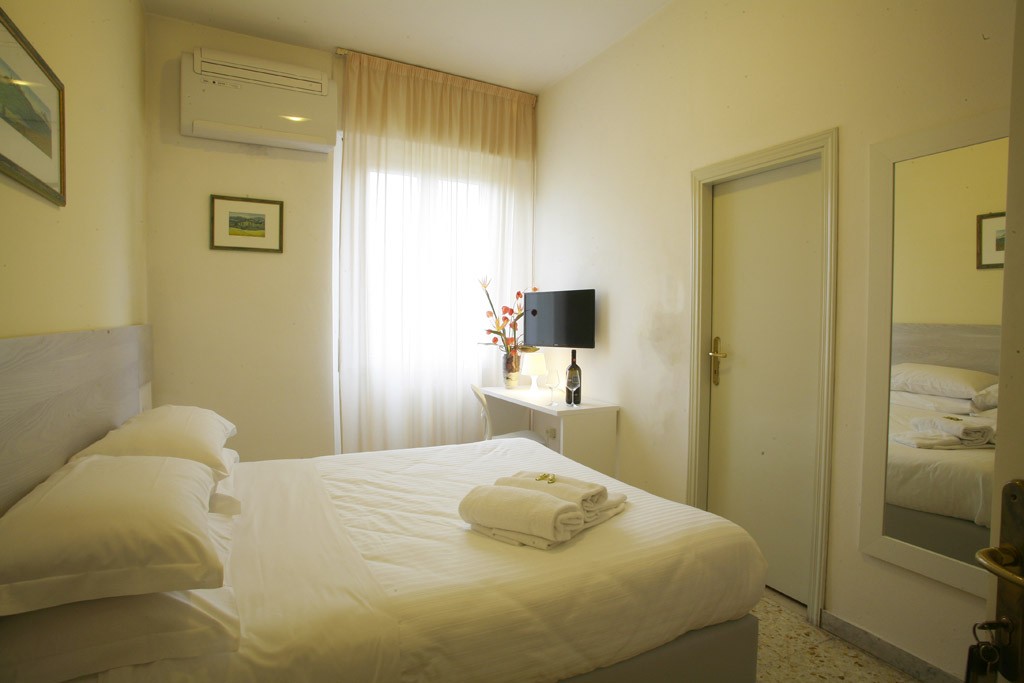
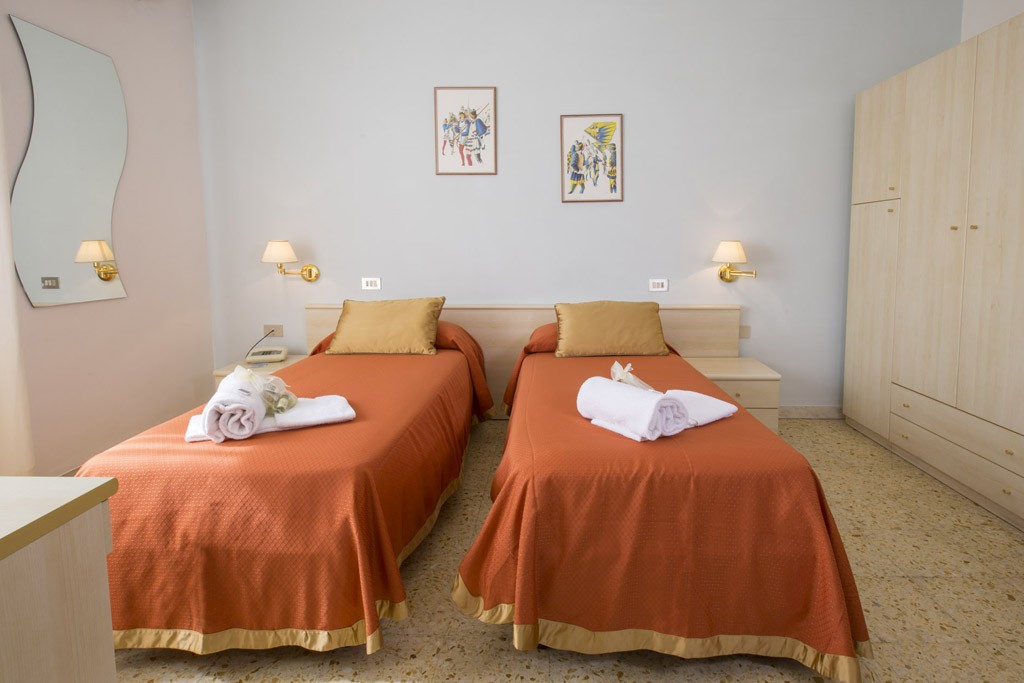
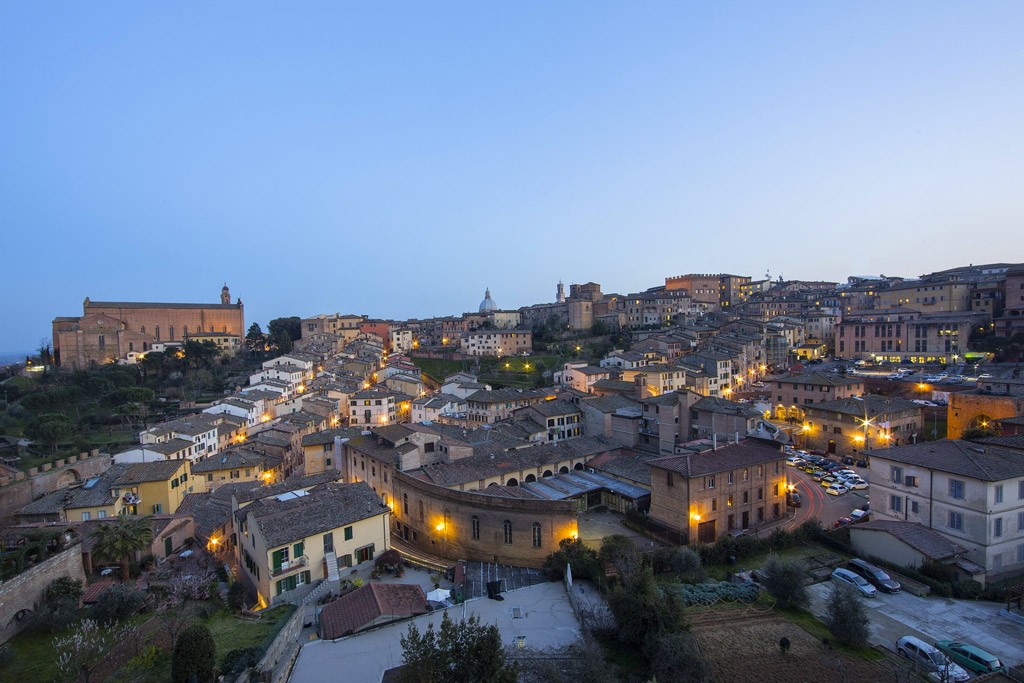
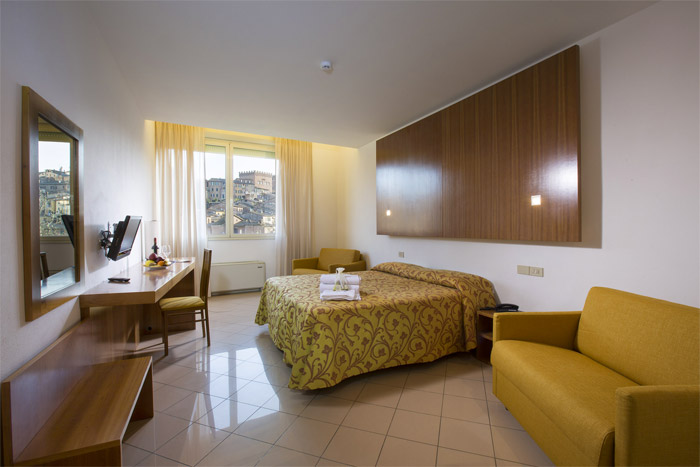
Welcome to Siena! 😊 Get ready to explore this magnificent medieval city and its surroundings on a 5-day journey designed for everyone: families, couples, solo adventurers, students and professionals looking for a break. Your home base will be Hotel Minerva in Siena, a comfortable 3-star hotel located in the historic centre, just a ten-minute walk from Piazza del Campo and 600 metres from the train station. This means that setting off each morning for your explorations will be easy: you’re already in the heart of Siena, with the added advantage of a private garage at the hotel (so if you arrive by car, you can leave it safely in the garage) and the train station nearby for day trips. So let’s prepare for five unforgettable days, at a human pace (Siena is easy to explore on foot!), with delicious Tuscan food and breathtaking views. Ready? Let’s go! 🚶♀️🗺️
Day 1: Siena’s historic centre on foot – Piazza del Campo, Duomo, Torre del Mangia…
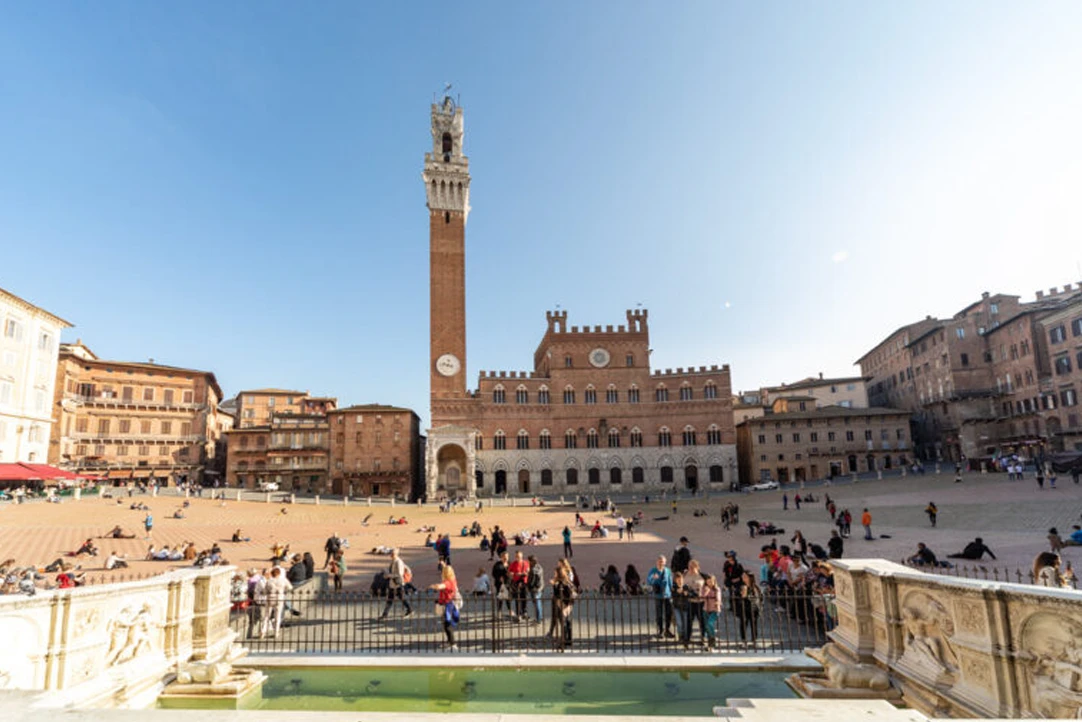
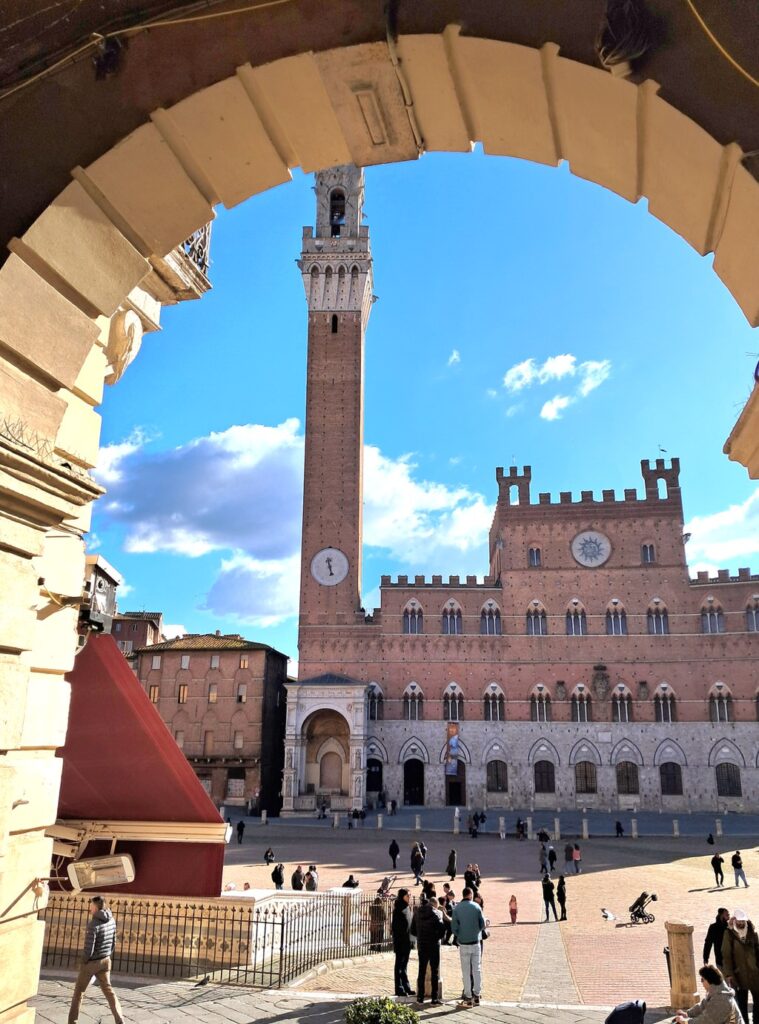
The magnificent Piazza del Campo in Siena, with the Torre del Mangia and the Palazzo Pubblico, is the heart of the medieval city.
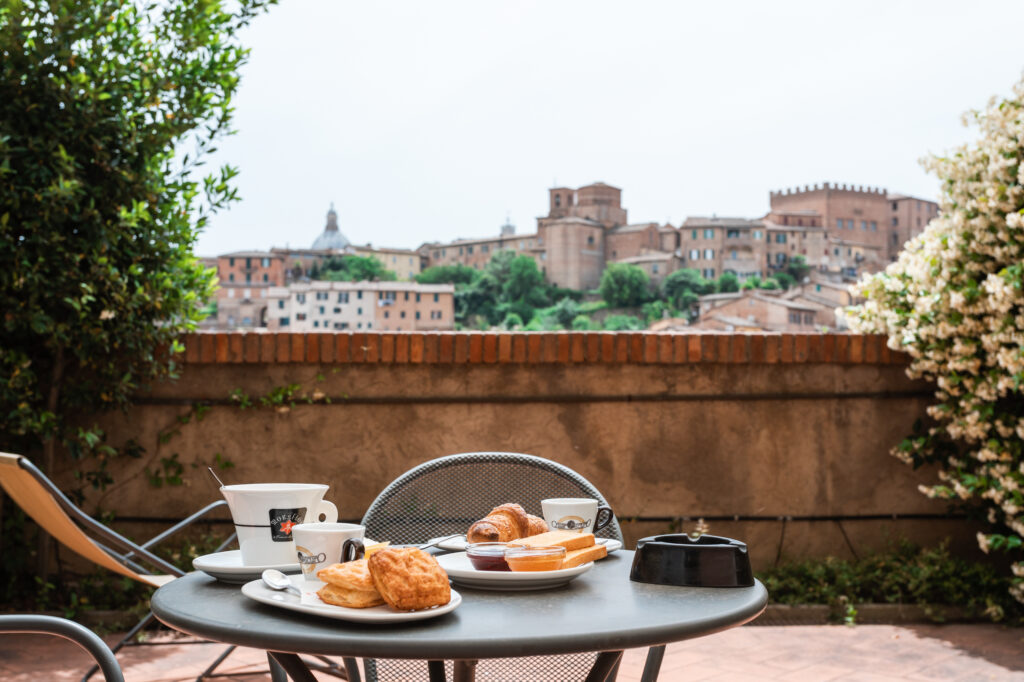
Morning (9:00 – 13:00): After a hearty breakfast at Hotel Minerva (you’ll need energy for Siena’s hills!), leave at 9:00 and walk to Piazza del Campo, the beating heart of Siena. In about 10-15 minutes through medieval streets you’ll reach the shell-shaped piazza, famous for the Palio. Take time to admire the Palazzo Pubblico (the Gothic town hall) and the Fonte Gaia, a 19th-century copy of Jacopo della Quercia’s fountain. At 10:00 we recommend climbing the Torre del Mangia, the 87-metre medieval tower that overlooks the square. The climb is strenuous (around 400 narrow steps!), but in 30 minutes you’ll be at the top enjoying a breathtaking view over all of Siena. Ticket Tower: approx €10 per person (not bookable in advance) – note that access is in time slots every 45 minutes and the tower closes at 19:00 in summer (last entry at 18:15). After descending around 11:00, visit the Museo Civico inside the Palazzo Pubblico (about 1 hour): here you can admire Ambrogio Lorenzetti’s famous Good Government frescoes and Simone Martini’s Maestà. Ticket Museo Civico: approx €9 (combined ticket with Tower €15 valid for 2 days). Upon exit, take a break: sit in Piazza del Campo for a coffee or cappuccino in one of the cafés (yes, prices are a bit touristy, but the view is worth it!).
Lunch (13:00): For lunch, you can either stay in the centre or briefly return to the hotel to rest. Around Piazza del Campo there are excellent Tuscan osterias where you can enjoy pici all’aglione, ribollita or a Chianina steak. For example, behind the Palazzo Pubblico you’ll find less crowded trattorias. Alternatively, pick up sandwiches with Tuscan cured meats from a deli and have an informal picnic sitting on the steps of the piazza – a simple and evocative way to experience Siena like the locals!
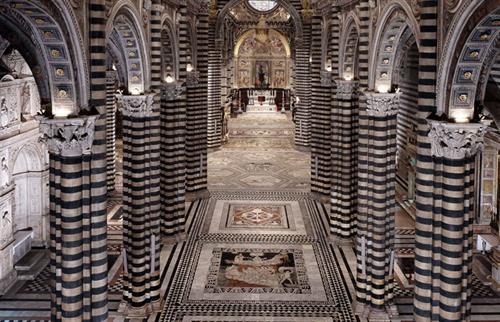
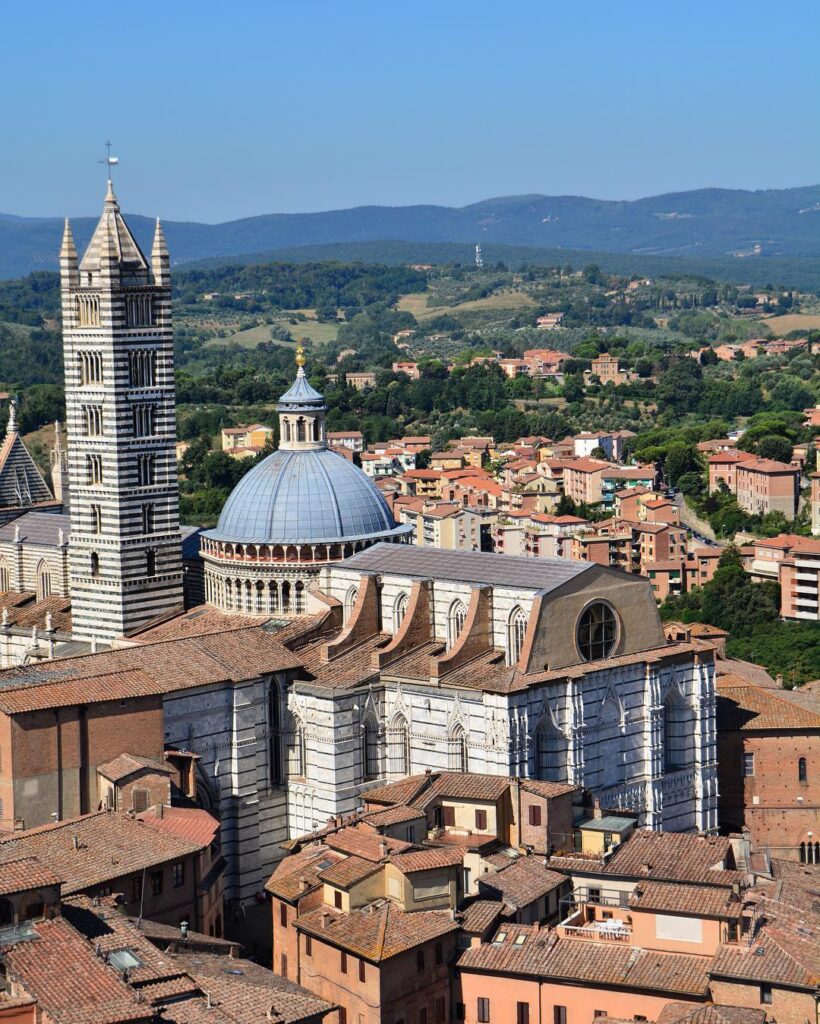
Afternoon (14:30 – 18:30): Dedicate the afternoon to Siena’s religious treasures. At 14:30 head to the nearby Duomo di Siena (Cathedral of Santa Maria Assunta), one of Italy’s Gothic masterpieces. The marble exterior in white and black is spectacular, and the interior will take your breath away: marble inlays on the floor (only uncovered in certain periods of the year), the Piccolomini Library frescoed by Pinturicchio, the ornate dome and sculptures by Michelangelo and Donatello. Allow about 1 hour for the visit. Duomo opening times: usually open 10:00 – 19:00 (Sunday from 13:30) from spring to autumn, but check on-site if there are morning Masses. Tickets Duomo: single entry approx €8-10; alternatively the OPA Si Pass at approx €17-22 includes the Baptistery, Crypt and Museo dell’Opera. Often the pass is worthwhile if you want to see the whole complex. Booking needed? Not mandatory, but in high season it’s advisable to buy tickets online or go early to avoid queues (especially if the floor is uncovered during the summer months, which attracts many visitors). After the Duomo, if you have time and energy, visit across the square the Santa Maria della Scala complex: a former hospital now a museum with underground corridors and beautiful frescoes (like the Pellegrinaio Hall). Duration: ~1 hour to see the main parts. Ticket: €9 full (reduced €8). If you have purchased the 2-day combined ticket (Museo Civico + Duomo/S.M. della Scala), use it here.
Evening (after 18:30): Walk back to the hotel calmly (maybe along Via di Città and Banchi di Sopra, the main shopping streets, to start window-shopping and perhaps buy some ricciarelli – typical Siena biscuits). You can rest at Hotel Minerva before dinner. Dinner (20:00): For the first evening, taste Sienese cuisine in a rustic atmosphere: near the hotel, on Via Camollia (the ancient Via Francigena), you’ll find genuine trattorias frequented by locals. Order pici (thick handmade spaghetti) with wild boar ragù or all’aglione, and a glass of Chianti from the Sienese hills. Or head back towards the centre and enjoy dinner at a restaurant overlooking the illuminated Piazza del Campo (very romantic!). After dinner, a digestive stroll through the quiet historic streets is a must: you’ll see Siena by night with silent medieval palaces and soft lights, a real leap back in time.
Summary table – Day 1 (Siena Historic Centre)
| Attraction/Activity | How to reach from Minerva | Visit duration | Cost (€) | Opening times |
|---|---|---|---|---|
| Piazza del Campo | 1 km (15 min on foot) | 30 min (stroll) | Free (public square) | Always open (pedestrian area) |
| Torre del Mangia | Piazza del Campo | 30 min (climb) | 10 € (flat rate) | Mar–Oct: 10:00-19:00; Nov–Feb: 10:00-16:00 |
| Museo Civico (Palazzo Pubblico) | Piazza del Campo | 1 hour | 9 € (full) Combo: Tower+Museum 15 € | Daily: 10:00-18:00 (last entry 17:15) |
| Duomo di Siena (Cathedral) | 500 m (8 min on foot) | 1 hour | ~8-10 € (single) OPA Pass ~17-22 € | Mar–Oct: ~10:00-19:00; Sun/bank holidays from 13:30 |
| Santa Maria della Scala (Museum) | 50 m (1 min, opposite the Duomo) | 1 hour | 9 € full 8 € reduced | Daily: 10:00-19:00 (last entry 18:15) |
| Dinner in trattoria (e.g. Via Camollia) | 500 m (7 min on foot) | 1-2 hours (as desired) | ~25-30 € per person | Dinner: from 19:00 onwards (booking recommended) |
FAQ – Day 1: Siena’s Historic Centre
- Q: Do I need to book tickets for the Duomo or the Torre del Mangia in advance?
A: For the Torre del Mangia it’s not possible to book in advance (tickets are purchased on-site, entry every 45 minutes). For the Duomo, tickets are normally purchased at the entrance; however, in high season it’s wise to buy online (from the Opera del Duomo’s website) or go early to avoid queues. If you plan to see several parts of the complex, consider the OPA Si Pass cumulative ticket, valid for 3 days, which can also be purchased online. - Q: Are there any restrictions on climbing the Tower?
A: Yes, access to the Torre del Mangia is discouraged for those with heart problems, vertigo or claustrophobia, as the stairs are very narrow and steep. Furthermore, very young children cannot climb (minimum height around 1.10 m; minors must be accompanied). At the entrance you’ll see safety instructions. Only carry essentials (large backpacks aren’t allowed at the top). - Q: Are the museums and the Duomo ever closed?
A: Generally the Duomo, Museo Civico and Santa Maria della Scala are open daily. However, the Duomo is closed to visitors on Sunday mornings (until about 13:30) for services. Some smaller museums in Siena close on Mondays, but the main ones listed above stay open. Still, check for any schedule changes or special closures on-site. - Q: May I take photos inside the Duomo and museums?
A: In the Duomo yes, without flash or tripod. Museums generally allow photos of the works (also without flash, to prevent damage). Certain areas may have photography restrictions marked. Generally, please be respectful during services and in sacred locations. - Q: Where can I park if I drive into Siena?
A: Hotel Minerva has a pay parking garage reserved for guests – a lifesaver, as Siena has ZTL and public car parks often fill up. If you prefer leaving the car outside the centre, there are pay car parks like Parcheggio Santa Caterina or Parcheggio Stadio/Fortezza. From these you can reach Piazza del Campo on foot (10-15 minutes) or by escalators (from Santa Caterina). However, if possible, avoid using the car in the historic centre: Siena is all pedestrian and from Hotel Minerva you can reach everything on foot.
Day 2: Offbeat Siena – Less-known Contrade, botanical garden, hidden museums and relaxation
Morning (9:30 – 12:30): After the immersive experience yesterday, today we explore a quieter and more authentic Siena. At 9:30 leave the hotel and head to the Basilica di San Domenico (10 minutes on foot). This massive brick church houses the relic of the head of Saint Catherine of Siena and is dear to the Sienese. Visit the inside (free entry, about 20 minutes) and from the panoramic terrace beside it enjoy a wonderful view of the Duomo and the city – an excellent photo spot. Then continue into the Fontebranda district, going down the characteristic medieval streets to Fontebranda (a monumental medieval fountain, mentioned by Dante!). Here you’re in the heart of the ancient Contrada dell’Oca, where Saint Catherine was born. If you like, visit the Sanctuary of Saint Catherine, a complex of small oratories and courtyards (free entry) built around the saint’s family home – a suggestive and often silent place, especially in the early morning.
Around 10:45 head up towards Porta Tufi to reach Siena’s Botanical Garden. This hidden garden inside the city walls is a green oasis little known to tourists. Enter via the Accademia dei Fisiocritici (the Natural History Museum, Piazzetta Silvio Gigli 2): you’ll pass between ancient zoology displays – quite a setting! The botanical garden stretches in a little valley below the walls, with shaded paths, greenhouses and over 2,000 plant species. Visit duration: about 1 hour to stroll leisurely. Admire Mediterranean plants, exotic species in the greenhouses and a small medieval fountain hidden among the paths. For children, there are small ponds with turtles and fish. It’s a perfect spot for some nature relaxation after yesterday’s museums. Botanical Garden opening times: open daily, roughly 9:00-18:30 (Saturday till 19:00) in spring/summer. Entry: €5 full, €3 reduced (students €2.50) – free for under 11s, ideal if you have young children with you.
Lunch break (13:00): Exiting the Botanical Garden, you might want something simple. A fun idea (weather permitting) is to have a picnic in the Orto de’ Pecci: a large garden/urban farm right below Piazza del Campo. Reach it in 5 minutes on foot from Porta Tufi via a small path. The Orto de’ Pecci is a park with a lawn, farm animals (geese, donkeys) and even a small restaurant serving home-style cooking. You can rent a deckchair or sit at outdoor tables and eat rustic dishes (pasta with ragù, bruschetta, cold cuts) at low cost. Children can play freely outdoors here while adults relax with an unusual view of the Torre del Mangia. If you prefer an indoor lunch, near Porta Tufi there is also Osteria da Gano, a budget-friendly place loved by university students, offering sandwiches, pasta and salads.
Afternoon (14:30 – 18:00): In the afternoon immerse yourself in the Siena of the Contrade and its quirky museums. Wander without a fixed itinerary through less touristy alleys: for example, walk down Via di Stalloreggi and Via San Pietro, where you’ll see authentic corners and perhaps enter some Contrada Oratory (if open) to understand the local passion for the Palio. In July and August, some Contrada museums open to the public, exhibiting costumes and Palio banners (check if any Contrada offers guided tours).
Next, we recommend visiting the Natural History Museum of the Accademia dei Fisiocritici (yes, you saw the entrance on your way to the Botanical Garden, but it’s worth returning in peace). This old and slightly dusty museum houses curious collections: whale skeletons, taxidermy animals, minerals, fossils and even a room with a crocodile hanging from the ceiling! 😮 Entry is free and it’s a fun place especially if you’re travelling with children or are a science enthusiast. Visit time: about 1 hour to browse the retro displays. Opening times: Monday–Friday mornings, and some afternoons (check because hours vary; generally 9:00-13:00 and 15:00-17:00).
If the natural history museum is closed or if you prefer art, a valid alternative is the Siena National Picture Gallery (on Via San Pietro, not far from the Botanical Garden). This art museum preserves masterpieces of medieval and Renaissance Sienese painting (Simone Martini, Lorenzetti, Sano di Pietro…). Usually very quiet, here you can admire Duccio’s famous Madonna della Misericordia triptych and many golden “Madonna and Child” panels. Duration: 1–1.5 hours. Cost: €8 full (reduced €2 for EU 18-25). Open daily except Tuesday, approximate hours 8:15-19:15.
As the afternoon ends: to finish today’s tour on a high note, head up to the Fortezza Medicea (from the Picture Gallery it’s a 15-minute walk, or from the Natural History Museum 10 minutes uphill). The Fortezza is a bastioned citadel built in the 16th century, free to visit. You can walk along the fortress walls (free entry) and enjoy another marvellous view of Siena at sunset – here you’ll see the Torre del Mangia clearly on one side and the Chianti hills on the other. Inside the fortress there’s also the Enoteca Italiana, where you can stop for some Tuscan wine tasting before dinner (they have a vast selection of wines, including small producers, with the option to sample by the glass).
Dinner (20:00): For day two’s evening you might want something informal. Near the Fortezza, in the Pian dei Mantellini/Via Camollia area, there are craft beer bars and pizzerias frequented by young people and students. For example, Birreria di Siena offers local beers and sandwiches, or Il Pomodorino serves good pizza with a view of San Domenico Basilica. If you prefer a traditional Tuscan dinner, try Osteria La Sosta di Violante on Via di Pantaneto (10 minutes from the hotel): homely atmosphere and excellent Sienese dishes like pici cacio e pepe or bread soup.
Summary table – Day 2 (Offbeat Siena and relaxation)
| Attraction/Activity | Distance from Minerva | Duration | Cost (€) | Opening times |
|---|---|---|---|---|
| Basilica of San Domenico | 800 m (10 min on foot) | 20-30 min | Free | 7:00-18:30 daily |
| Fontebranda & Sanctuary of St. Catherine | 1 km (15 min downhill on foot) | 30-40 min | Free | Always open (Sanctuary 9-13 & 15-19) |
| Siena Botanical Garden | 1.2 km (20 min on foot) | 1 hour | 5 € full;3 € reduced | Mon-Fri 9:00-18:30; Sat 10-19; Sun 10-18:30 |
| Natural History Museum (Fisiocritici) | 1.2 km (same area) | 1 hour | Free | Mon-Fri 9-13; Tue/Thu also 15-17 (varies) |
| National Picture Gallery (optional) | 1 km (15 min on foot) | 1.5 hours | 8 € full;2 € (18-25 years) | Wed-Mon 8:15-19:15; closed Tuesday |
| Fortezza Medicea (walk on walls) | 1.5 km (20 min on foot) | 30 min (free) | Free | Park always accessible (Enoteca 11-20 approx) |
| Casual dinner (e.g. beer/pizza) | 1 km (15 min on foot) | 1-2 hours (as desired) | ~20-25 € per person | Dinner: from 19:00 onwards |
FAQ – Day 2: Siena “off the beaten path”
- Q: Is the Botanical Garden suitable for children? Are there picnic areas inside?
A: Yes, the Botanical Garden is also pleasant for children: they can run along the paths (always accompanied) and explore unusual plants. There is a small area with tables near the entrance where you can have a snack, but it’s not exactly a fully equipped picnic area. Better to use the Orto de’ Pecci nearby for a proper picnic on the lawn: there you’ll find large green spaces and tables, perfect for families. In the Botanical Garden there are no internal bars, so bring your own water and snacks. Tip: be careful on the downhill paths – strollers can be a bit awkward (better to have a carrier/backpack for toddlers). - Q: Are the Contrada museums open to the public?
A: It depends on the period. The 17 Contrada museums usually open by appointment or for special occasions (e.g. in the days preceding the Palio they organise guided tours). However, in the summer some Contrade arrange events open to visitors. You can ask at Siena’s tourist office whether any are available during your stay. Alternatively, there’s the Museum of Rural Life (Contrada Chiocciola) or the Water Museum (near Fonte Gaia) which sometimes offer public openings. In short, check while you’re there. - Q: Is the National Picture Gallery worthwhile if I’m not a huge art lover?
A: The Picture Gallery is recommended for lovers of medieval art, but if that isn’t your primary interest and you’ve already seen many Sienese Madonnas in day one, you may skip it. Alternatively, you might spend that time wandering through the contrade or relaxing. For instance, if the weather’s nice, you could walk up to the Basilica dei Servi (from the Orto de’ Pecci it’s 10 minutes up to a hill opposite the Duomo, with a splendid view). Or simply enjoy a gelato in Piazza del Campo while people-watching. On a trip, some flexibility and down time are important! 😉 - Q: Where can I buy Siena’s typical sweets to take home?
A: Good question to sweeten the day! Siena is famous for ricciarelli (soft almond biscuits) and panforte (a fruit and spice cake enjoyed year-round). You can buy them from historic patisseries in the centre: for example Pasticceria Nannini (via Banchi di Sopra) or Pasticceria Bini (Via di Città) offer artisanal products. Many specialty shops also sell gift boxes of Sienese sweets. A tip: try cavallucci (biscuits with walnuts and anise) and cantucci with Vin Santo, other Tuscan classics easily found.
Day 3: Excursion to medieval villages – Monteriggioni and San Gimignano
The third day is devoted to a day trip from Siena, to discover the fairytale villages of the Tuscan countryside. From your base at Hotel Minerva you can easily set off early in the morning, by car (if you have one) or by public transport.
Without a car: If you don’t have a car, don’t worry. You can reach San Gimignano by bus (line 130) departing from Siena’s bus station (Piazza Gramsci) at around 9:40: there’s a direct bus that takes ~1h10 to get you there. Alternatively, catch the train at 9:18 from Siena station (600 m from the hotel) to Poggibonsi (30 minutes) and then the Poggibonsi–San Gimignano shuttle bus (15 minutes). You’ll arrive in San Gimignano around 11:00.
With a car: If you have a car, you can follow a wonderful route that includes Monteriggioni and San Gimignano on the same day. Leave around 9:00 from the hotel (ask at reception: Hotel Minerva is accessible by car and located just outside the limited traffic zone, so it’s easy to exit the centre heading north). Take the SS674 and SR2 (Cassia) toward Monteriggioni: in about 20 minutes (15 km) you’ll be at the foot of this charming fortified village.
Morning in Monteriggioni (9:30 – 11:00): Park the car in the car park below the walls (Parcheggio Monteriggioni, cost ~€2 per hour) and walk up the short ramp that leads inside the medieval walls of Monteriggioni. You’ll be transported back to the Middle Ages: a perfectly preserved circle of walls with 14 turrets crowns the hill (Dante was so impressed that he mentioned it in the Divine Comedy!). The village is small: a central square with a well and the Church of Santa Maria Assunta, a few alleys with artisan shops, wine bars and specialty shops. Climb the accessible wall walkways for the public: there are two sections of wall to walk along offering splendid views of the surrounding countryside and the towers themselves (entrance to the walkways + “Monteriggioni in Arme” Museum ~5 € combined). The Monteriggioni in Arme Museum is small but fun: it displays reproductions of medieval and Renaissance weapons and armour, and children can try lifting swords and wearing helmets! Dedicate about 20 minutes to it. After exploring the village (an hour is enough), you can stop for a coffee or juice in the little square, enjoying the calm.
Aerial view of Monteriggioni, the fortress village surrounded by 14 towers on the Sienese hills.
11:00 – off to San Gimignano: Get back in the car and continue toward San Gimignano, about 30 km from Monteriggioni (40–45 minutes through the hills via Poggibonsi). You’ll arrive in San Gimignano around 11:45/12:00. Park in one of the lots outside the walls: recommended is Parking P1 Giubileo (south zone, via Baccanella) which is large and good value (€1.50/hour, max ~€6-7 per day). From P1 a free shuttle (on summer weekends) or a 10-minute walk will bring you to Porta San Giovanni, the southern entrance to the village. Alternatively, parking P2 and P3 are closer to the centre but more expensive (up to €3 per hour in the early hours). In high season spaces fill up, so arriving before lunch is smart.
Afternoon in San Gimignano (12:00 – 17:00): As soon as you enter Porta San Giovanni, you’ll be welcomed by the lively atmosphere of San Gimignano, the city of medieval towers (once 72, 13 remain standing). Walk along Via San Giovanni full of shops (this is where you can already browse for souvenirs: hand-painted ceramics, truffle products, San Gimignano saffron, etc.). You’ll arrive at Piazza della Cisterna, the triangular central square with an ancient well at its centre – one of the most photographed corners for its unique backdrop. Stop here for lunch: right on the square you’ll find the famous Gelateria Dondoli, a world champion, where you can taste a spectacular gelato (special flavours like Crema di Santa Fina or saffron and pine nuts!). Maybe pick up a sandwich with finocchiona or porchetta from a butcher shop next door, and finish with Dondoli’s gelato for a quick but unforgettable lunch, perhaps sitting on the well steps in the square. Alternatively, if you prefer a sit-down lunch at a trattoria, try La bruschetteria orcisano or Perucà (somewhat off the beaten tourist track) for Tuscan dishes and local Vernaccia wine.
After lunch, continue your exploration: from Piazza della Cisterna move to nearby Piazza del Duomo, dominated by the Collegiata di Santa Maria Assunta (San Gimignano’s Duomo). Visit the Collegiata: inside you’ll find splendid frescoes covering the walls entirely (scenes from the Old and New Testament by Ghirlandaio and the Sienese school). Visit duration of the Duomo SG: ~30 minutes; Ticket: approx €5 (audio guide included). Afterwards, you can climb Torre Grossa, the only civic tower open to the public among the many private noble towers. Torre Grossa is 54 m tall: in ~15 minutes you’ll climb the steps to the top to admire a breathtaking view of the Tuscan countryside and the towers below – it feels like being in a living medieval skyline! Torre Grossa cost: €9 (cumulative with San Gimignano’s civic museums). If you have time and interest, the combined ticket lets you see the Museo Civico in the Palazzo Comunale (with the famous Sala di Dante and 14th-century frescoes) before climbing the tower, since entrance is through the same palace. Allow around 1 hour for the museum + tower. Alternatively, if museums don’t appeal, stroll to the Rocca di Montestaffoli (5 minutes from the Duomo): it’s a ruined fortress on a hill, now a public park, from which you enjoy another magnificent free view of the towers and the surrounding hills. It’s great for letting children run while adults enjoy the panorama.
By 15:30, perhaps take a snack break: a cappuccino or a glass of Vernaccia di San Gimignano (the local DOCG white wine) in one of the wine bars with terraces – for example, Enoteca DiVinorum has a terrace overlooking the hills. Enjoy the relaxed atmosphere of the village in the afternoon, maybe browsing among art and photo shops (San Gimignano is very photogenic, every corner deserves a shot!).
Return to Siena (17:00 – 18:30): Around 17:00 it’s time to return. If you parked, get back in your car and head to Siena (from San Gimignano to Siena about 50 minutes via Poggibonsi). If you’re by bus, the last useful direct service departs around 17:40 from San Gimignano (check updated times; line 130/A); alternatively bus to Poggibonsi + train to Siena. You’ll arrive in Siena in time for dinner.
Dinner (20:00): After today’s outing, tonight you could dine at the hotel (if Hotel Minerva offers a restaurant service, you could opt for convenience), or try another Sienese place. Since you’ve enjoyed many delicacies today, perhaps a light dinner based on a cheese and salumi platter and a panzanella (traditional bread salad) will suffice. We recommend Enoteca Italiana (inside the Fortezza) if you love wine: you can have an apericena with Chianti or Brunello tastings accompanied by Tuscan nibbles. Alternatively, if you’re still in San Gimignano and want to dine there before heading back, enjoy the evening atmosphere (fewer tourists and soft lights): restaurants like Cum Quibus or Locanda di Sant’Agostino offer excellent Tuscan dinners – but remember you’ll then have to drive back to Siena in the dark, so take care if you’ve tasted too many wines! 😜
Summary table – Day 3 (Monteriggioni & San Gimignano)
| Stop | Distance | Visit duration | Cost (€) | Time info |
|---|---|---|---|---|
| Monteriggioni (village) | 15 km from Siena (20 min by car) | 1 – 1.5 hours | Free entry to the village | Always open (exterior walls) |
| – Walls walkway | – (inside Monteriggioni) | 20 min (two sections) | 5 € combined (walls + museum) | Apr–Sep: 9:30-13:30 / 14:00-19:30; Oct–Mar shorter hours |
| – Monteriggioni in Arme Museum | – (inside Monteriggioni) | 15-20 min | Included in the walls ticket | Apr–Sep: 9:30-13:30 / 14:00-19:30 (same ticket) |
| San Gimignano (town of towers) | 45 km from Monteriggioni (45 min by car) Bus Siena–S.G. ~1h10 | 4-5 hours (afternoon) | N/A – free entry to the village | Historic centre always open Porta S.G. 24/7 |
| – Collegiata (Duomo S.G.) | – (Piazza Duomo S.G.) | 30 min | 5 € (full) | Mon-Sat 10:00-19:30; Sun 12:30-19:00 (summer) |
| – Torre Grossa + Civic Museum | – (Piazza Duomo S.G.) | 1 hour (tower + museum) | 9 € Tower alone; 13 € combined museum+tower | Daily 10:00-19:00 (Apr–Oct) |
| – Rocca Montestaffoli | – (5 min from the Duomo) | 15-20 min (free) | Free | Always accessible (public park) |
| Return bus S.G. – Siena | (50 km, 1h15 via Poggibonsi) | 1h15 (direct) | ~6 € per person (bus) | Last direct bus ~17:40; Train+bus alternative available |
FAQ – Day 3: Monteriggioni/San Gimignano excursion
- Q: Is it better to visit Monteriggioni or San Gimignano if I have little time?
A: If you need to choose, San Gimignano offers more to see (it’s larger, with museums, Duomo, many towers and shops) and is truly unique for its medieval skyline. Monteriggioni is smaller: charming but walkable in under an hour. Ideally, as planned, you can see both with a car in one day, but if you’re without a car and constrained by buses, you should focus on San Gimignano (reachable by public transport) and save Monteriggioni for another time. - Q: How does parking work in San Gimignano?
A: San Gimignano has four main paid car parks just outside the walls (P1, P2, P3, P4). Those closest to the centre (P2 and P3) have higher rates (up to €3/hour for the first hours). The P1 Giubileo is the largest and cheapest (~€1.50/hour, max ~€6-7 per day) and is a 10-minute walk from the centre: it’s our recommendation for savings. All parks are well signposted as you arrive by car; in high season follow the electronic signs indicating available spaces. Note: the parks accept cash, often card, and some Telepass Pay (check the signs). Evening/night parking has a reduced fee (around €5 overnight). If the main lots are full, there are other smaller lots further away with shuttles. - Q: Is it worth taking an organised tour to San Gimignano and surroundings?
A: If you don’t have a car and want convenience, you might consider an organised tour from Siena that includes San Gimignano (sometimes combined with Chianti or Pisa). There are minivan or tourist coach day trips that take you to San Gimignano and perhaps Monteriggioni and a winery, leaving Siena centre in the morning and returning in the evening. The convenience is that you don’t need to worry about bus times or parking, and often you get a guide explaining things. The downside is that times are set and less flexible for free exploration. Assess the cost (around €50-80 per person) and what’s included. If you prefer DIY travel, as explained, the public bus works fine for San Gimignano. - Q: Can we go to thermal baths nearby instead of visiting the villages?
A: Interesting alternative! In the Siena area a nice thermal place is Rapolano Terme (Terme di San Giovanni or Terme Antica Querciolaia), about 30 minutes east of Siena by car. If you like, you could swap out the village trip for a day of relaxation at the baths, especially if the weather is cool or you’re tired of walking. Or incorporate half a day at the baths at another moment: for example, on the evening of day 4 after Val d’Orcia, or in the morning of day 5 if you choose the Chianti option (Rapolano is, however, in the opposite direction). Note that Bagno Vignoni (which you’ll see tomorrow in Val d’Orcia) does have thermal waters but the historic basin isn’t swimmable – whereas at Rapolano you can freely swim in the thermal pools by paying the entry. So yes, doable, but you’d need to reorganise the itinerary a bit. - Q: What can I buy as souvenirs in San Gimignano?
A: In San Gimignano we suggest two products in particular: the purissima saffron of San Gimignano DOP (in filaments, produced in the local countryside, often in elegant jars) and the Vernaccia di San Gimignano DOCG wine (a dry white, excellent as an aperitif or with fish dishes). You’ll also find beautiful Tuscan artistic ceramics (hand-painted plates, decorative tiles) – if you like them, look for artisan workshops off the main streets for better prices. And of course the Tuscan classics: extra virgin olive oil, Cinta Senese cured meats, pecorino cheese (also saffron-infused). Do remember that you’ll need to transport it, so perhaps go for tasting purchases rather than bulky items if you’re flying!
Day 4: Val d’Orcia Tour – Pienza, Bagno Vignoni and Montalcino
The fourth day takes you to discover the picture-postcard landscapes and enchanting villages of the Val d’Orcia, south of Siena (a UNESCO World Heritage Site). Get your camera ready: you’re going to see rolling hills dotted with cypress trees, vineyards, medieval villages and natural hot springs. It’s a packed itinerary, so an early start is needed!
Departure (8:30): From Hotel Minerva, head south to Val d’Orcia. If you don’t have a car, consider renting one for today (the hotel’s garage advantage means you can collect the car the previous day and keep it safe). Another option is a guided tour, but with your own car you’re freer. Take the SS2 Cassia south. The first stop: Montalcino, about 40 km (50 minutes) from Siena. Enjoy the scenic road: you’ll drive through the Crete Senesi and then more vineyard-covered hills as you approach.
Montalcino (9:30 – 11:00): Upon arrival at Montalcino, park outside the walls (there are pay car parks below the fortress, approx €1 per hour). Montalcino is the home of Brunello, so there is wine perfume in the air! 😁 Walk up into the village dominated by the massive 14th-century Fortress. Start with the Fortezza di Montalcino: you can enter the courtyard freely and, if you wish, climb the fortress walls (ticket ~€4) for a beautiful view over the hills of Brunello vineyards. Inside there’s the Enoteca La Fortezza, where even in the morning you can try a glass of Brunello – but perhaps save the wine tasting for later! Stroll through the small centre: the main street leads to the Montalcino Duomo (a sober neoclassical building) and Piazza del Popolo with the Palazzo dei Priori and its narrow tower. Nearby there’s a famous bakery, Panificio Il Giglio, where you can pick up a slice of focaccia or grape schiacciata (in season) to tide you over. Before leaving, a must for wine lovers: choose a winery or wine shop where you can buy a bottle of Brunello di Montalcino DOCG to take home. For example, the Enoteca di Piazza has a vast selection, or you can stop at Biondi Santi or Fattoria dei Barbi on the road out (they also have Brunello museums). Consider your time accordingly.
After 11:00 get back on the road towards Bagno Vignoni (around 30 km from Montalcino via San Quirico d’Orcia). Along the way you’ll pass iconic landscapes: you’ll see the hill with the Chapel of Vitaleta in the distance among cypress trees, and the famous cypress avenue of San Quirico – if you want to take a photo, there’s a pullout along the SP146. You’ll also pass by the San Quirico cypress cluster, a circular group of cypresses in the middle of fields, another popular photo spot.
Bagno Vignoni (11:45 – 13:00): On arrival at Bagno Vignoni, park at the village entrance (free parking along the road). Bagno Vignoni will surprise you because the main square is a steaming thermal pool! In the village centre there is the 16th-century thermal basin surrounded by a loggia and a few houses. Hot water flows from beneath the ground. You cannot bathe in this historic basin (please, no diving! It’s forbidden for preservation reasons), but it’s a sight to see and photograph, especially on cool days when steam creates a magical atmosphere. Take a stroll beneath the Loggia di Santa Caterina and read the plaque celebrating the water nymphs. Visit the little church of San Giovanni Battista next to the basin. Then follow the signs to the Parco dei Mulini: a path descends a few minutes beyond the square and takes you to see ancient waterways and the remains of medieval mills carved in the rock, powered by the thermal water. Here you’ll also find the so-called “Pozze di acqua termale” – natural little pools where the hot water flows and you can dip your feet. If you’d like, immerse your feet for a free warm foot soak! (Bring a towel in your backpack). The pools aren’t big, but small basins where people sit to relax their legs – a rustic and pleasant experience.
Lunch (13:00): Bagno Vignoni has several excellent restaurants, ideal for lunch. In front of the thermal basin are Il Loggiato and La Terrazza (with views of the steaming water) serving Tuscan dishes – there’s nothing more evocative than eating overlooking the “water square”. Alternatively, for a quick lunch, there’s Bistrot L’Officina making gourmet sandwiches and salads, or you can buy bread and pecorino from Pienza in a shop and have a little picnic near the Parco dei Mulini. Don’t forget to try something with truffle if you like it: we’re near San Giovanni d’Asso, a truffle region, and many menus feature pici with truffle.
Afternoon (14:00 – 18:30): After lunch, get back in the car and in 15 minutes you’ll be in Pienza (about 15 km from Bagno Vignoni via SP146). Pienza greets you with a stunning panorama from the road: it sits on a hill dominating the Val d’Orcia. Park just outside the historic centre (there are several pay car parks, e.g. along the walls on Via della Circonvallazione). Enter Pienza’s main street (Corso Rossellino). Pienza is known as the “ideal city” of the Renaissance, wanted by Pope Pius II who was born here. In a few steps you’ll reach Piazza Pio II, harmonious and scenic, with the Pienza Duomo (a bright Renaissance façade) and Palazzo Piccolomini on one side. Visit the Duomo: the interior is bright and houses altarpieces by the Sienese school. But the real gem is behind the Duomo: head to the Belvedere/terrace behind the apse, from which you enjoy an unrestricted view of the Val d’Orcia – hills, fields and the silhouette of Mount Amiata in the distance. This is one of the most beautiful viewpoints of the trip, especially in the late afternoon with golden light. Take photos and soak up the Tuscan countryside air.
Wander around Pienza: follow the narrow lanes with romantic names like Via dell’Amore and Via del Bacio, picturesque alleys often decorated with flower pots, perfect for couple photos 😍. Enter a cheese shop: Pienza is famous for pecorino di Pienza, a sheep’s milk cheese often aged in barrels or caves, acquiring unique flavours. Sample some slices of pecorino offered by the shopkeepers (there are varieties with peppercorns, walnut leaves, spicy…). A great place is Marusco e Maria on Corso Rossellino, where you can also buy small wheels to take home (pecorino vacuum-packed travels well).
If you have time for a museum, Pienza’s Palazzo Piccolomini is worth a visit (the Renaissance summer residence of Pius II): you can tour in half an hour, including furnished rooms and above all the hanging garden with loggia overlooking the valley – a small Renaissance palace. Cost: ~€7. Alternatively, you could go into Palazzo Borgia (the Diocesan Museum) if you’re interested in local sacred art.
Around 17:00, leave Pienza to head back to Siena (about 1 hour, 50 km). If you still have energy and want one last highlight, make a short 10-minute detour along the road to see the Chapel of the Madonna di Vitaleta: it’s a tiny chapel standing alone in a cypress field, one of the most photographed subjects of the Val d’Orcia. It’s accessed from San Quirico d’Orcia on a 1 km white road, then 10 minutes on foot. Otherwise, you can conclude by returning directly to Siena along the Cassia.
Evening (after 19:00): Back in Siena and relax at the hotel after this whirlwind of beauty! For dinner, you can choose to stay in the hotel if you’re tired, or treat yourself to a special dinner for your last evening in Siena: perhaps a high-level place like Osteria Le Logge or Ristorante Mugolone to savour refined Tuscan dishes and toast your holiday with a glass of the Brunello di Montalcino you bought. Alternatively, still, a rustic dinner in an agriturismo: if you have the car and aren’t too tired of driving, you could dine in an agriturismo just outside town (there are some around Santa Regina, 15 minutes from Siena) to enjoy one last evening among the hills. Whatever you choose, you deserve a hearty “well done!” for having seen so much! 🎉
Summary table – Day 4 (Val d’Orcia)
| Place/Attraction | Distance | Visit duration | Cost (€) | Opening times |
|---|---|---|---|---|
| Montalcino (village) | 40 km from Siena (50 min by car) | ~1.5 hours (walk) | Free entry to village | Centre always open |
| – Montalcino Fortress | (at entrance of village) | 30 min | 4 € to access walls | Daily 10:00-19:00 approx (weather permitting) |
| – Brunello tasting | (Fortress Enoteca or wineries) | 15-30 min | 5-10 € per glass (varies) | Enoteca continuous hours 10-19 |
| Bagno Vignoni (thermal village) | 30 km from Montalcino (35 min by car) | 1 hour | Free entry | Village always accessible |
| – Piazza thermal basin | (centre of village) | 10 min (photos) | – (no bathing allowed) | Always visible (outside) |
| – Parco dei Mulini | 5 min on foot from centre | 20 min (walk) | Free | Always open (free pools always accessible) |
| Pienza (town) | 15 km from B. Vignoni (15-20 min by car) | ~2 hours (walk) | Free entry to historic centre | Centre always open |
| – Duomo di Pienza | (Piazza Pio II) | 15 min | Donation | 10:00-18:00 approx |
| – Palazzo Piccolomini | (Piazza Pio II) | 30 min (guided tour) | 7 € full,5 € reduced | Tue-Sun 10:00-18:00 (Nov-Feb closed Mon) |
| – Belvedere/Panorama | (behind the Duomo) | 10 min (photo) | Free | Always accessible |
| Vitaleta Chapel (optional) | 10 km from Pienza (10 min by car + 10 min walk) | 20 min (photo) | Free (outside) | Always accessible (dirt road) |
| Return to Siena | 50 km from Pienza (1h by car) | – | – | – |
FAQ – Day 4: Val d’Orcia Tour
- Q: Can we bathe for free at Bagno Vignoni?
A: Yes and no. 😄 You cannot bathe in the large basin in the centre of Bagno Vignoni (it’s a historical monument, and the water is also very hot ~50°C). However, following the path toward the Parco dei Mulini, you’ll find little natural pools where the thermal water collects and you can bathe. Don’t expect a spa: they are rustic basins carved into the travertine; the water reaches a warm temperature (not boiling) and you can sit and relax your feet and calves. You should bring anti-slip shoes or sandals for walking on the limestone deposit, which can be slippery. There are no changing rooms or public showers, so plan accordingly. If you want a proper thermal bath, go to the paid spas nearby: Hotel Posta Marcucci or Adler Spa have thermal pools (day ticket ~€25-30), or as mentioned Rapolano Terme on the way back. - Q: How do we get around Val d’Orcia without a car?
A: Unfortunately moving around Val d’Orcia by public transport is difficult if you want to visit multiple places in one day. There are buses from Siena to Montalcino (line 0P1, around 1h20) and separately to Pienza/San Quirico (line 112, ~1h40), but schedules are infrequent and it’s especially hard to connect Pienza–Montalcino–Bagno Vignoni directly. Without a car, the best solution is to join a organised tour from Siena that covers the Val d’Orcia (many tours include Montalcino, Pienza and Montepulciano in a day with wine tastings). Alternatively, you could rent a car for a day (also directly from Siena; the hotel can help contact a rental company). Another idea for the more athletic: explore by e-bike! There are rental services in Pienza or San Quirico to cycle between villages, perhaps splitting the visit over two days. But to follow our programme in one day, a private car is practically essential. - Q: Where can we refuel or buy snacks in Val d’Orcia?
A: Practical question! Start out with a full tank from Siena. In Val d’Orcia petrol stations are not everywhere: you’ll find them in Montalcino (one at the village entrance), in San Quirico d’Orcia, and in Pienza. The roads are scenic but isolated; better not risk running out of fuel. For snacks: in Montalcino there are grocery shops and bakeries, in Pienza many food shops (cheese, cured meats) – you can easily buy water, snacks and what you need. Bagno Vignoni has cafés and grocery shops but being a tourist spot prices are a little higher. Always carry water in the car; the Val d’Orcia sun can be strong in summer and some areas (e.g. Vitaleta) have no shade. - Q: What’s a good place for Brunello tasting nearby, perhaps also Vino Nobile di Montepulciano?
A: For Brunello you’re spoilt for choice in Montalcino: the Enoteca inside the Fortress is very atmospheric and offers tastings from various wineries. Outside the centre, we suggest the historic Fattoria dei Barbi, which has a free Brunello museum and guided tasting tours by reservation. If you want to add Montepulciano (famous for Vino Nobile), note that it’s a bit out of the way for today’s itinerary (20 km beyond Pienza). If you love Tuscan red wines, you could skip Bagno Vignoni and include Montepulciano: visit a monumental cellar in the centre (e.g. Cantina del Redi) and sample Vino Nobile. Or save Montepulciano for a future trip 😉. Either way, if you’re the driver, limit tastings or swap turns with a designated driver. - Q: Is Val d’Orcia safe to drive? Are the roads tricky?
A: The main roads (SR2 Cassia, SP146) are well maintained and paved, with gentle curves through the hills – no particular difficulty, just drive carefully since they are narrow and undulating. The white roads (unpaved) toward Vitaleta or other agriturismi should be taken slowly but are passable even by normal cars; just watch for potholes. In summer watch out for cyclists and tractors that you might encounter behind a curve! At night the roads are dark (very few street lights outside built-up areas), so if you come back late slow down and watch for wildlife (deer, porcupines) that sometimes cross the road. Overall, driving in Val d’Orcia is a pleasure for the eyes; just use common sense.
Day 5: Among vineyards and castles – Chianti itinerary or medieval Radicofani
The final day offers two options, depending on your interests: A) explore the hills of the Chianti Classico, land of fine wines and enchanting villages north of Siena; B) head south-east to Radicofani, the last bastion of the Val d’Orcia, famous for its impressive fortress and legends of gentleman bandits. Both choices will leave wonderful memories, so weigh up what attracts you most (and also how tired you are so far 😅). In any case, depart from Hotel Minerva with your car. (If you don’t have a car, we recommend the Chianti option by bus, as Radicofani is almost unreachable by public transport).
Option 5A: Chianti Classico Tour (Castellina – Radda – winery tasting)
Morning (9:30 – 13:00): Leave Siena at 9:30 taking the SR222, the famous Chiantigiana, towards Castellina in Chianti. The road winds through hills of vineyards and woods – drive leisurely and enjoy the landscape. In about 30 minutes (20 km) you’ll reach Castellina. Park at the village entrance (free or disc parking available). Castellina in Chianti is a charming village with Etruscan origins, today a lively wine centre. Stroll along the main street to the medieval Rocca: you can climb its tower for a lovely view over the rooftops and vineyards. Then walk the evocative Via delle Volte covered walkway, a passage under the houses with panoramic openings, full of artisan shops and wine bars. Visit the small San Salvatore church and, if you’re interested in Etruscans, the Chianti Archaeological Museum inside the Rocca (artifacts found in the area). Time in Castellina: about 1 hour to see the centre. Before moving on, treat yourself to a taste of focaccia with olive oil at the bakery or a coffee with a view of the hills.
Next stop: Radda in Chianti, only 15 km from Castellina (20 minutes by car along a scenic road among vineyards). You’ll arrive around 11:30. Radda is the historical capital of Chianti, a village surrounded by walls with picturesque alleys. Park outside the gate and enter the compact centre: you’ll find the Palazzo del Podestà (on the main square) with the coats of arms of the old families, and a little further the Propositura di San Niccolò (a Gothic church). Radda is perfect for buying wine: here the Casa del Chianti Classico is located (in the former Santa Maria al Prato convent) where you can visit an exhibition about Chianti wine and taste it. You can make a short visit (30 minutes) and perhaps taste a glass of Chianti Classico DOCG. Tasting price: around €10 for three guided samples. If you prefer something more rustic, many wine shops offer paid tastings – or enter the Palazzo Leopoldo Wine Shop for advice.
Lunch (13:00): For lunch in the Chianti region, the best is an agriturismo or panoramic trattoria. Near Radda (5-10 minutes by car) there are several: for example Osteria Le Panzanelle (in Lucarelli, on the way to Greve) famous for pici with duck ragù, or Casa Porciatti right in Radda, which functions as a butcher/wine shop with tables for platters and hot dishes. Whatever you choose, accompany your meal with a glass of Chianti Classico Riserva – and toast to your holiday! 🍷
The gentle hills of Chianti Classico near Radda: rows of vineyards, stone farmhouses and cypress trees outline a postcard landscape.
Afternoon (14:30 – 18:00): After lunch, head leisurely to Gaiole in Chianti (another historic village 20 minutes from Radda). Along the way, you can make a detour to the Castello di Brolio, one of the most famous castles in Chianti, owned by the Ricasoli family for centuries. The castle is surrounded by vineyards and woods; you can visit the gardens of Castello di Brolio (ticket ~€6) and possibly taste Barone Ricasoli wines in their wine bar. The gardens offer beautiful views (on clear days you can even see Siena in the distance). If you’d rather not detour, continue towards Gaiole and maybe stop at Vertine, a tiny fortified hamlet above Gaiole, very picturesque (free entry, 10 minutes to see it, basically a handful of beautifully preserved medieval houses).
Arriving in Gaiole in Chianti around 16:00, you’ll see that it’s less of a historic village, more a collection of houses along the road, known because from here roads lead to many castles and parish churches (it’s the starting point of the L’Eroica cycle event). If you’re into vintage cycling, there might be some shops dedicated. Nearby, you can visit the Abbey of Badia a Coltibuono (10 minutes from Gaiole): an ancient abbey turned winery, with beautiful gardens and a mystical feel. Alternatively, just outside Gaiole is the Castello di Meleto 5 minutes from the centre: you can park and wander its courtyard (free entry) and perhaps join a guided tour with tasting if you arrive at the right time (they usually run one in the afternoon, about 1 hour, cost ~€20 including Chianti samples).
Around 17:30 start returning towards Siena (Gaiole is about 30 km from Siena, 45 minutes by car). On the way back, if you have spare time and inclination, you could stop in Castelnuovo Berardenga (the last village of Sienese Chianti) for a coffee in the square or simply continue to the city.
Evening (20:00): Final evening in Siena! A great idea to wrap up the trip might be a dinner in a wine bar in the centre with a tasting menu: for example Enoteca I Terzi or Taverna di San Giuseppe (the latter has an Etruscan cellar you can visit!). Savour your last moments under the brick vaults, enjoying perhaps pici all’aglione and a dessert such as panpepato. Finally, take a digestive stroll in Piazza del Campo at night to say goodbye to Siena illuminated one last time. 💖
Option 5B: Excursion to Radicofani – the castle on the horizon
Morning (9:00 – 11:00): Depart at 9:00 by car from Minerva towards Radicofani, the southernmost town of the Siena province. It’s a drive of about 70 km (1h15) along the Cassia, passing again through the Val d’Orcia. Enjoy the ride because you’ll see different landscapes, increasingly rugged as you approach Mount Amiata. Radicofani appears from afar with its unmistakable tower on the basalt hill. Upon arrival, park in town and start your visit: Radicofani is small but pretty, with dark lava stone houses and two interesting churches (San Pietro and Sant’Agata) housing Robbia terracottas. The real attraction, however, is the Radicofani Fortress dominating above. From the village you can climb on foot (15-20 minutes of steep ascent) or by car almost to the entrance of the fortress park. Fortress entrance: about €5 per person. The fortress, recently restored, lets you climb the main tower (Torre di Guido) from which the view is 360°: on clear days you can see the Val d’Orcia, Lake Bolsena, Mount Amiata and even faraway Siena. It’s truly impressive! You can explore the walkways and various posts, imagining the adventures of Ghino di Tacco, the famous gentleman thief who made Radicofani his base in the Middle Ages (an Italian “Robin Hood” mentioned by Dante and Boccaccio). Inside you’ll find panels telling the fortress’ history. Allow about 1 hour for the visit and photos. Opening hours: in summer the fortress is open daily ~10:00-19:00 (in winter only weekends). Have a coffee at the little bar inside the Rocca if it’s open, just for the thrill of drinking “at the castle”.
Lunch (12:30): Back in town, have lunch at the Osteria La Pace, Radicofani’s historic eatery known for home-style Tuscan cooking (homemade pici, wild boar, local pecorino). Or, if you want something quick, there’s a bakery/grocery where you can pick up a filled focaccia. After lunch, before leaving, stop by the Ghino di Tacco monument at the town viewpoint, and enjoy one last panoramic look: from Radicofani the view of the clay hills (known as “calanchi”) is unique.
Afternoon (14:00 – 17:30): On the return journey to Siena, you can add some extra stops: for example descend to the valley and visit the Romanesque Abbey of San Salvatore in Abbadia San Salvatore (on Mount Amiata) or stop in San Quirico d’Orcia if you didn’t see it the previous day (a beautiful village with the Horti Leonini, free Italian-style gardens). Another gem: travelling along the Cassia you’ll find signs for the free thermal springs of Bagni San Filippo (near Radicofani): a short walk in the woods takes you to the spectacular limestone formation called the “White Whale”, with waterfalls of white thermal water and natural pools where you can bathe for free. If you’re interested, pack a swimsuit and towel in your car and take this regenerating detour (it takes about 1.5 hours including visit and bathing). Otherwise, continue directly to Siena.
Evening: Return to Siena around dinner time. Free evening: you can decide to revisit your favourite spots in town for a final goodbye (perhaps one last gelato from Kopakabana on via dei Rossi, or a drink in Piazza del Campo to imprint the atmosphere firmly in memory). Toast the end of these five intense and splendid days!
FAQ – Day 5: Chianti or Radicofani
- Q: Chianti or Radicofani: which is more recommended?
A: It depends on your preferences! Chianti: ideal if you love wine, rolling landscapes with orderly vineyards and want a relaxed food and wine experience. It offers small villages, castles and many tasty stops. Radicofani: recommended if you’re fascinated by historic spots off the beaten track, fortresses and “frontier” panoramas. It’s further and more isolated, but has a very authentic and rugged charm. In summer the Chianti offers shade from vineyards and cool villages to stroll in; Radicofani, being higher, is breezy but with fewer refreshment stops. Ultimately, if after yesterday’s Val d’Orcia you want to change direction go north to Chianti; if the Val d’Orcia enchanted you and you want to see another spectacular corner of it, Radicofani is for you. - Q: Can we do both in one day?
A: Honestly no, that would be too many kilometres and too many places. Better to enjoy one of the two options leisurely. If you really wanted a “taste” of both Chianti and a peek at Radicofani, you’d almost need a rally – not recommended. Save one for a future trip; it’ll give you an excuse to return to Tuscany! 😉 - Q: In Chianti, is booking necessary for winery tastings?
A: For guided visits in famous wineries (e.g. Castello di Brolio, Fonterutoli, Antinori at Badia a Passignano) yes, it’s advisable to book in advance as they have set times and limited spots. If you simply want to drop into a wine bar for a glass, no booking is needed: you’ll find wine bars open in Castellina, Radda, Gaiole freely. Some smaller farms in Chianti welcome visitors spontaneously for tastings, but it’s always good manners to call ahead if possible. Given that your trip is flexible, you can decide on the spot: if you pass a farm that inspires you, drop in and ask if they do tastings. Tuscans are hospitable and will rarely say no; they’ll likely seat you in their cellar with genuine hospitality. 😃 - Q: What else is special in Radicofani beyond the fortress?
A: Radicofani is tiny, and the Fortress is undoubtedly the star. However it has some churches with interesting artworks: in San Pietro church there are beautiful glazed terracottas by the Della Robbia school. Plus Radicofani was an important Via Francigena stop: pilgrims rested here travelling towards Rome. So you’ll find references to the Francigena (hostels, plaques, a stretch of Roman road outside the town). And then there’s the legend of Ghino di Tacco, the gentleman bandit: his story fascinates many (he robbed the rich to give to the poor, and even cured an abbott’s stomach ailment with San Filippo’s thermal waters and honey, earning papal forgiveness). Radicofani is steeped in history and legend. Finally, a special aspect: being isolated and high up, at night it’s a fantastic place to see the stars because there’s very little light pollution. If you happen to be there after sunset, the spectacle of the starry sky over the fortress is unforgettable. - Q: Are there typical souvenirs to buy in Chianti or Radicofani?
A: In Chianti it’s mainly about wine: you can buy bottles of Chianti Classico (perhaps with the black rooster symbol of the consortium) directly from producers or wine shops. The extra virgin olive oil of Chianti is also excellent and sold in tins or nice bottles. Other souvenirs could be artisan products: in Castellina a leather craftsman, in Radda painted ceramics, in Greve (if you go) cured meats and the typical harvest knife (a special folding knife). In Radicofani, being small, you’ll find perhaps some local honey (Amiata hills rich in flora), pecorino cheese produced in surrounding pastures and some gadget with the “Ghino di Tacco” theme sold at the bar or pro loco. Also here, wines: the area produces Rosso Orcia DOC, less known than Brunello but interesting – small local wineries might sell it. Basically, everywhere in Tuscany there’s something tasty to take home!
Practical tips for different types of travellers
Now that we’ve outlined the entire itinerary, here are personalised tips to help you tailor the trip to your needs, depending on how you’re travelling:
For families with children
- Rhythms and breaks: With kids in tow, keep the pace flexible. The itinerary is packed, but don’t be afraid to skip something if the little ones are tired or want to play. For example, after a museum make a gelato stop or go to a park (Orto de’ Pecci in Siena is perfect for letting them run). Use afternoons for naptime (even in the car during transfers).
- Child-friendly spots: Siena has the Lizza Park with slides and a small playground, great for a runaround. In villages like San Gimignano and Pienza, many squares are pedestrian areas where kids can walk safely next to you. Bagno Vignoni will fascinate kids for the idea of a “pool in the middle of the village”! Bring a swimsuit and towel: perhaps at Bagni San Filippo (day 5 option B) or at Bagno Vignoni’s ponds they can enjoy natural warm water (always with care).
- Meals: Many restaurants in Tuscany cater to children, but note the hours: lunch in Italy goes from 12:30 to 14:00 and dinner from 19:00 to 21:30. Outside these times you might find kitchens closed, so plan snacks. Always carry emergency snacks (crackers, fruit) and water, especially on car transfers. In trattorias, if kids are fussy, order simple dishes: pasta with tomato sauce, cutlets and chips (they’re on every menu). And remember: Tuscan gelato is a life saver for tantrums 😉.
- Stroller vs carrier: Siena centre has many inclines, stairs and cobblestones: a lightweight stroller is fine, but in some areas (Tower del Mangia, Botanical Garden downhill, fortresses) it’ll be inconvenient. Better to also have a carrier/backpack for little ones, so you’re more agile.
- Involvement: Make the visit a game! Tell legends (the ghost of Palazzo Pubblico? Stories of the Palio and the animals of the Contrade: the Dragon, the Giraffe – children love these stories). In San Gimignano let them count the towers they see, in Monteriggioni imagine being knights on those walls. This way they’ll be more engaged and less bored.
- Safety: Tuscan towns are safe, but in crowded places keep children close (Piazza del Campo during peak tourist hours, San Gimignano in August). Be careful on the towers: access is prohibited to very small kids, and always keep them close at the top; there are barriers, but better not let them run.
- Pharmacies and emergencies: Carry a small kit (plasters, children’s fever reducer, mosquito repellent in summer). You’ll find pharmacies in Siena and main centres (e.g. San Gimignano, Pienza). Italy’s emergency number is 112 (also 118 for ambulance, 113 police, 115 fire brigade). Hopefully you won’t need it!
For couples
- Romance: Siena and its surroundings offer dreamlike views. Make the most of it! Climb the Facciatone of the Duomo (if you get the Opa Si Pass you’ll have access to the Duomo’s panoramic terrace, perfect for romantic photos). Enjoy sunsets: in Siena from the Campanile of Basilica dei Servi the sunset view is splendid; in Val d’Orcia the golden light will give you magical moments (e.g. at Pienza’s Belvedere or among the cypresses).
- Candlelight dinners: Book at least one special dinner. We recommend La Taverna di San Giuseppe in Siena: intimate atmosphere in a stone grotto, excellent wine (they have a cellar from 1100!). Or a dinner in an agriturismo in Chianti, perhaps outdoors under the stars with the silence of the hills around – super romantic. Bagno Vignoni by night, with the thermal basin lit up, is another unique scenario: sipping a local wine sitting by the water’s edge (glass from the nearby bar) will be a great memory.
- Couple’s wellness: Consider a relaxing spa moment: in Rapolano Terme some establishments offer couple packages (massages and thermal baths). Or the free baths (Bagni San Filippo) where you can apply natural mud to each other – an adventurous experience to share!
- Photos together: Take advantage of picturesque locations to snap couple photos: under the arch of Via di Pantaneto with the view of Torre del Mangia, hugging in front of Vitaleta’s panorama, or kissing in Via dell’Amore in Pienza (there’s even the street sign!). Bring a small tripod or ask passers-by (other tourists in a romantic mood will often help).
- Surprises: If you’re celebrating something (anniversary, honeymoon), let the hotel know – they often arrange a small surprise (e.g. complimentary prosecco). And consider buying a special keepsake: a vintage wine from your wedding year, a local handicraft (like a ceramic plate with a dedication). Chianti or Montalcino offer many gift ideas.
- Slow moments: Don’t rush too much. Also enjoy the Italian “dolce far niente”: sit at a café table in Piazza del Campo watching people, hand in hand with no hurry. These moments are as valuable as a thousand museums. A night walk when the streets are empty, or waking up early and strolling at dawn in the centre (Siena’s summer dawn is cool and almost deserted, very suggestive) can be unforgettable for a couple.
For solo travellers
- Socialising: Travelling alone in Siena is safe and pleasant. If you want to meet people, join guided tours (there are many walking tours in the city – you might find yourself chatting to other visitors). In the evening, try an international pub like the Fish Pub or the Libreria Piccolomini Pub where Erasmus students and foreigners often gather, creating a convivial atmosphere. Also, hostels and food tours (like group tastings in Chianti) are great ways to meet other travellers.
- Security: Siena is calm even late at night. Normal precautions: keep an eye on your valuables in crowded areas (pickpocketing is rare but it’s better to be careful), avoid unlit parks on your own after dark. Generally you’ll be able to wander worry-free, even at night in the historic centre, which is frequented by students and locals until late.
- Eating alone: In Italy eating alone is perfectly fine, don’t feel uneasy. A tip: sit outside, enjoying the view and people-watching – it’ll feel more natural. Or choose places with a counter or shared tables (in some osterias they exist). You can also opt for a buffet aperitivo: take a good glass and various snacks; you’ll eat well and maybe chat with the bartender or neighbours.
- Accommodation and logistics: Hotel Minerva is a good base even for solo travellers: close to the station and centre, so you can move around easily. If you sometimes prefer to dine in the hotel, take advantage of the service (so you don’t have to go out if you’re tired in the evening).
- Pictures of yourself: Bring a selfie stick or ask passers-by to take photos of you with the monuments (tourists are usually happy to swap, take one for them and they’ll offer to do yours). Siena also has panorama spots with smartphone supports (e.g. sometimes on the Duomo terrace they put stands): use them for some spectacular self-portraits.
- Unique experiences: Alone you can fully enjoy certain details: perhaps spend more time in the picture gallery if you love art without boring anyone, or go hiking on a section of the Via Francigena near Siena (e.g. from San Quirico to Bagno Vignoni) if you love trekking – things that would be harder to improvise in a group. This itinerary is flexible, feel free to personalise it based on your interests, taking advantage of the freedom of a solo traveller.
- Budget: Travelling alone, watch your budget: eating at restaurants every meal can add up. Alternate sit-down lunches with street-food snacks (many delis sell porchetta, pizza slices, etc.). The good thing about Siena is you can eat excellent food without spending too much. For example, a panino with finocchiona and pecorino bought from a delicatessen and eaten on a panoramic bench can be as satisfying as a restaurant lunch.
For students (or young backpackers)
- Budget tips: Follow the itinerary but in low-cost mode: Siena has drinking fountains (fill your bottle at the fountain behind the Palazzo Comunale in Piazza del Campo, for example). Eat where students go: at lunch there are university canteens open to non-students with complete meals at bargain prices (e.g. Bandini canteen near Piazza Gramsci). Or choose substantial aperitifs: for 8-10 € in some bars you’ll get a drink and buffet food (in Siena apericena isn’t as widespread as in Milan, but some places on via Pantaneto offer plentiful snacks with your drink).
- Cheap transport: Move around with local buses if you don’t want to walk too much: Siena has urban lines (a ticket costs around €1.50). For example, from Minerva if you don’t feel like walking up to the centre you can take a minibus from the station to Piazza del Sale. For the surroundings, use public transport as much as possible: as mentioned, buses to San Gimignano, regional train to Poggibonsi and Montepulciano, etc. Of course, some remote places require an organised tour, but you might even consider hiring bikes (E-bikes) to tour Chianti – some backpackers do!
- Alternative accommodation: Although you’re already staying at Hotel Minerva, note that Siena also has hostels and budget guesthouses – good to know for friends who join or future visits.
- Nightlife: Siena’s nightlife scene (as a university city) offers pubs, little bars on Pantaneto and sometimes student parties. Ask the hotel staff if they know of parties during your stay. In summer, they often organise open-air cinema or small concerts in the Fortezza – free or cheap. Keep an eye on social media or posters in town.
- Student discounts: Always carry your university ID or ISIC card: state museums such as the Picture Gallery offer a reduced ticket €2 for EU under 25; the Botanical Garden had a student discount (€2.50). Don’t be shy to ask “Is there a student reduction?”. In many cases you’ll save a few euros, always handy.
- Special experiences: As a student you might appreciate low-cost cultural experiences: for example, watching a Contrada trial if you’re around before the Palio (the trials are free to watch in the piazza, whereas the Palio itself is almost inaccessible). Or visit the University of Siena itself, one of the oldest: the Rectorate (Banchi di Sotto) has notable medieval courtyards; or the Biblioteca degli Intronati, if you’re a bookworm, is in a historic building. In short, immerse yourself in the local daily life in addition to tourist attractions.
For professionals (business/bleisure travellers)
- Optimising time: If you’re on a business trip or have calls to attend, take advantage of the hotel’s strategic location: early morning you could take a short stroll (e.g. breakfast, seeing Siena wake up) and return for any videoconferences. Hotel Minerva offers free Wi-Fi and meeting space, so you can set up a temporary “office”.
- Bleisure (business + leisure): Plan your free moments to see what interests you most. For instance, if you work until 15:00, you can then fit in the must-sees (Duomo, Piazza del Campo) within shorter hours. Many sites close at 18-19, so consider splitting up the itinerary: some historic centre on the evening of arrival (Piazza del Campo and dinner), and then using weekends or free afternoons for trips.
- Fast transport: If you need to head to Florence or Rome for work, note that trains and Freccialink buses depart from Siena. The station 600 m from the hotel connects to Florence in 1h30. Thus, you might even combine something like Chianti while going towards Florence (e.g. leaving by bus from Siena and getting off at Poggibonsi then continuing). In short, you can merge work travel with leisure spots – a puzzle, but possible.
- Smart meals: Take advantage of lunch breaks to try local cuisine: if you have local colleagues, get them to take you to a trattoria (you’ll impress asking for a “crostino nero and ribollita” 😉). If you work remotely and have tight timings, know that many small restaurants do take-away: for example pici to-go, gourmet paninis, etc., so you can eat in your room while replying to emails if needed. But hopefully you can enjoy dinner calmly!
- Relax: After days of work/study, places like Bagno Vignoni or Rapolano are perfect for switching off: warm thermal water = melting stress. So, professional on the road, treat yourself to those couple of hours soaking: you’ll return recharged for professional activities too.
- Mixing work and holiday: If you stay longer for smart working, alternate a full work day (at the hotel or in a co-working space – there are several in Siena) with a day off for excursions. The main thing is to communicate well and disengage when you’re exploring: no emails at the top of Torre del Mangia! 😉 (Speaking of which, the Torre del Mangia is 87 m high: ideal for literally disconnecting from work and clearing your mind with the view).
We wish you a great trip and lots of fun over these 5 days in and around Siena! 🎉 We hope this informal guide helps you make the most of the city of the Palio and the surrounding Tuscan wonders. Follow the schedule but also allow yourself to be surprised by positive chance: you might stumble upon a Contrada festival, a spectacular sunset or a new friend met along the way. Siena and Tuscany can give you special moments in every season. Enjoy every instant and remember the Sienese saying: “Slow and steady wins the race”… savour each moment without rushing. Happy travels! 🌻🏰🚗